GS 2: GovernanceGS 2: PolityGS 1: Indian SocietyPrelimsGS 2: Indian Constitutional Evolution, Features, Amendments, Basic Structure Doctrine
Article 371 A to J, and what K can do for Ladakh, Pg13
Centre proposes Article 371K for Ladakh, granting special constitutional safeguards and an elected UT-level body with legislative, executive, and financial powers.
Practice MCQs
760 Students attempted
Key Highlights:
- The Centre has proposed inserting a new provision, Article 371K, into the Constitution to provide special constitutional safeguards for Ladakh.
- This proposal follows an "in-principle understanding" between the Ministry of Home Affairs (MHA) and representatives of the Apex Body, Leh (ABL) and Kargil Democratic Alliance (KDA).
- The proposed Article 371K aims to create a directly elected Union Territory-level body for Ladakh with legislative, executive, financial, and planning powers.
- The new body would have legislative powers over subjects like land, culture, language, forests, environment, and natural resources.
- Ladakh's leaders are also seeking control over law and order, and protection for land and customary practices, similar to Article 371A and Article 371G.
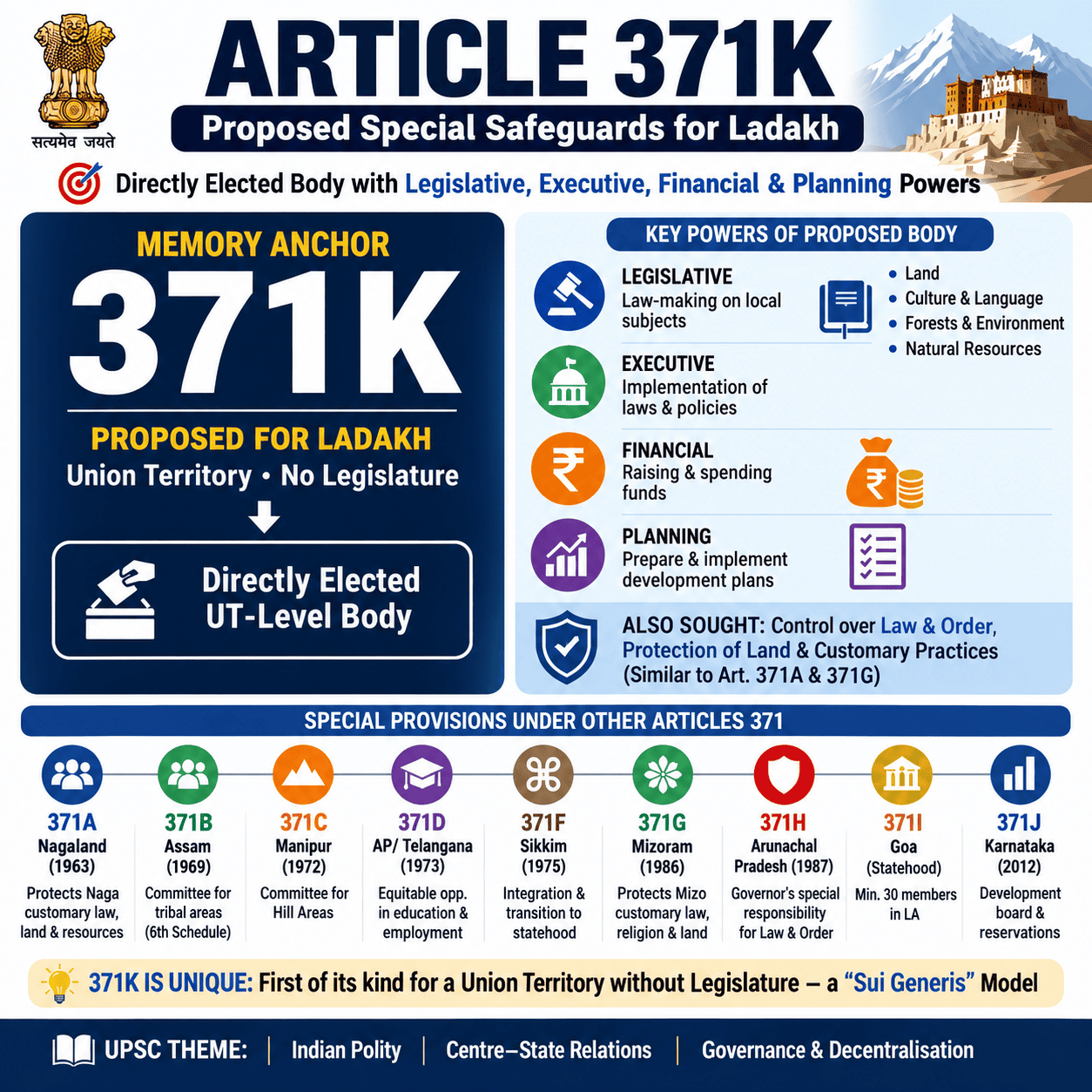
Article 371K.jpg
Detailed Insights:
- The original Article 371, adopted in 1950, was a transitional provision for Central supervision over Part B States (princely states) for 10 years.
- The States Reorganisation Act and the Seventh Constitutional Amendment of 1956 abolished the Part A, B, C classification, and the original Article 371 was replaced.
- The current Article 371 provides special arrangements for Maharashtra and Gujarat, focusing on equitable development of regions like Vidarbha, Marathwada, Saurashtra, and Kutch.
- Article 371A (inserted in 1963) for Nagaland protects Naga religious and social practices, customary law, and ownership of land and resources, based on the 16-Point Agreement of 1960.
- Article 371B (inserted in 1969) for Assam, through the 22nd Constitutional Amendment, allowed the President to create a committee within the Legislative Assembly for tribal areas under the Sixth Schedule.
- Article 371C (inserted in 1972) for Manipur provides for a special committee of the Legislative Assembly for hill areas, with the Governor reporting to the President on their administration.
- Article 371D (inserted in 1973) for Andhra Pradesh (and now Telangana) ensures equitable opportunities in education and public employment, stemming from the Six-Point Formula of 1973.
- Article 371F (inserted in 1975) was crucial for Sikkim's integration into the Indian Union, managing its transition to statehood.
- Article 371G (inserted in 1986) for Mizoram protects Mizo customary law, religious practices, and land ownership, following the Mizo Peace Accord of 1986.
- Article 371H (inserted in 1987) for Arunachal Pradesh gives the Governor special responsibility for law and order.
- Article 371I for Goa (inserted when it became a state) simply mandates a minimum of 30 members in its Legislative Assembly.
- Article 371J (inserted in 2012) for the Kalyana Karnataka region (formerly Hyderabad-Karnataka) addresses regional backwardness through a development board and reservations in employment and education.
- The proposed Article 371K for Ladakh would be unique as it applies to a Union Territory without a legislature, aiming for a "sui generis" (unique) model of governance.
- Ladakh's leaders are seeking a stronger democratic governing institution than existing models, with significant control over local affairs.
Key Concepts Involved:
- Article 371: A part of the Indian Constitution providing special provisions for certain states to address their unique historical, social, and economic needs.
- Union Territory (UT): An administrative division in India directly governed by the Central Government, some of which have their own legislatures.
- Legislative Assembly: A deliberative body of elected representatives in states and some Union Territories, responsible for making laws.
- Sixth Schedule: A constitutional provision under Article 244 that allows for the formation of autonomous administrative divisions (Autonomous District Councils) in certain tribal areas of Assam, Meghalaya, Tripura, and Mizoram.

SuperKalam is your personal mentor for UPSC preparation, guiding you at every step of the exam journey.
Download the App


STUDY RESOURCES
CONTACT US
ⓒ Snapstack Technologies Private Limited