GS 2: GovernanceGS 2: PolityGS 2: Social JusticePrelimsGS 2: Constitutional Bodies
SIR's Exclusion of Citizens Is Made Possible by Complicity of Institutions, Pg11
Supreme Court's SIR ruling enables ECI to exclude citizens from electoral rolls, potentially harming vulnerable groups and democratic representation.
Practice MCQs
753 Students attempted
Key Highlights:
- The ongoing Special Intensive Revision (SIR) of electoral rolls is leading to the exclusion of citizens across various states.
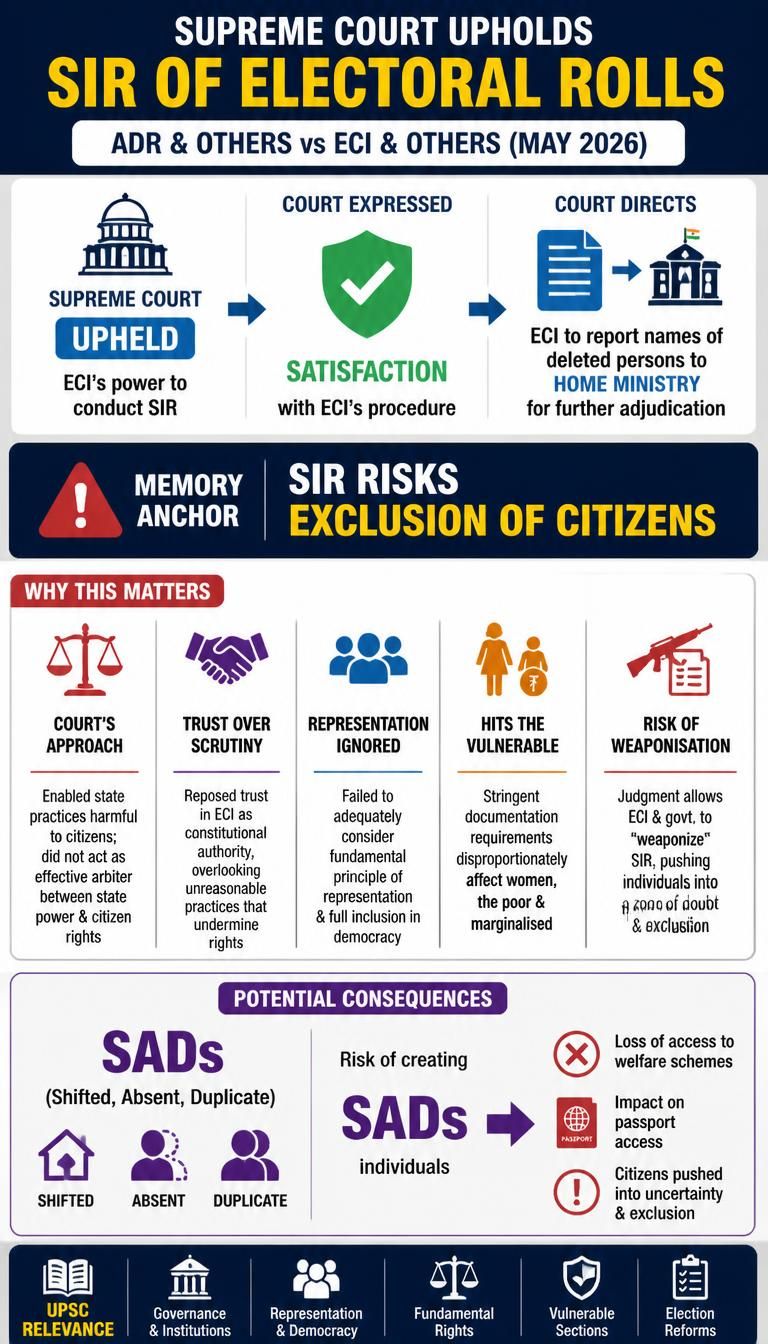
- The Supreme Court, in its May 2026 ruling in ADR & Others vs ECI & Others, upheld the Election Commission of India's (ECI) power to conduct the SIR.
- The ruling expressed satisfaction with the ECI's procedure, placing significant trust in the poll body.
- The judgment directs the ECI to report the names of deleted persons to the Home Ministry for further adjudication.
SIR.jpg
Detailed Insights:
- The Supreme Court's decision is viewed as enabling state practices that may harm citizens by not acting as an effective arbiter between state power and citizen rights.
- The Court chose to repose trust in the ECI as a constitutional authority, overlooking the possibility of unreasonable practices undermining citizens' rights.
- The ruling failed to adequately consider the fundamental principle of representation and the importance of full inclusion in a democratic system.
- The SIR risks disproportionately affecting vulnerable sections like women, the poor, and the marginalized due to stringent documentation requirements.
- The judgment potentially allows the ECI and the government to "weaponize" the SIR exercise, pushing individuals into a zone of doubt and harassment.
- The process could create "SADs" (Shifted, Absent, Duplicate) individuals, impacting their access to welfare schemes and passports.
Key Concepts Involved:
- Special Intensive Revision (SIR): A process undertaken by the Election Commission of India to update and purify electoral rolls by identifying and removing ineligible voters.
- Electoral Rolls: Official lists of eligible voters for elections, maintained and periodically revised by the Election Commission of India.
- Representation: The democratic principle ensuring that citizens' voices and interests are reflected in governance through their elected representatives.
- Judicial Vigilance: The judiciary's active role in scrutinizing state actions and policies to protect citizens' fundamental rights and uphold constitutional principles.

SuperKalam is your personal mentor for UPSC preparation, guiding you at every step of the exam journey.
Download the App


STUDY RESOURCES
CONTACT US
ⓒ Snapstack Technologies Private Limited