GS 3: Science & TechnologyGS 2: Social JusticeGS 3: Internal SecurityGS 2: International RelationsPrelims
UN: International criminal groups using technology to expand in and beyond Asia, Pg2
UN report exposes Southeast Asia's criminal networks using AI, deepfakes for global scams, human trafficking, causing $114 billion losses by 2025.
Practice MCQs
746 Students attempted
Key Highlights:
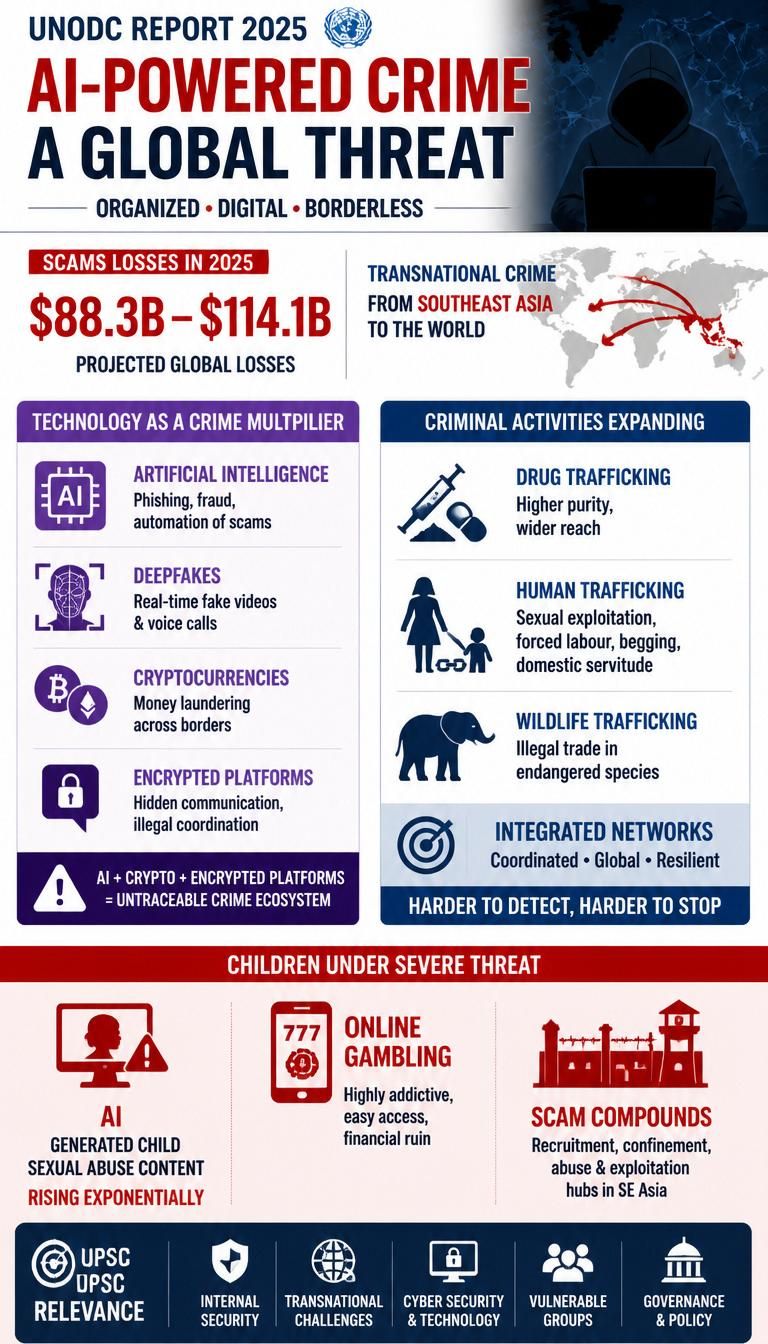
- A recent report by the United Nations Office on Drugs and Crime (UNODC) reveals that international criminal groups are leveraging integrated networks and advanced technology to expand their illicit activities globally.
- Scams alone are projected to cause estimated combined losses of $88.3 billion to $114.1 billion in 2025.
- Transnational crime, previously concentrated in Southeast Asia, is now expanding to other regions, with global groups engaging in drug, human, and wildlife trafficking in Asia.
- Criminals are exploiting technologies like Artificial Intelligence (AI), deepfakes, cryptocurrencies, and encrypted platforms for money laundering, sexual extortion, and various forms of exploitation.
- The report highlights a significant threat to children from AI-generated child sexual abuse content and online gambling, often facilitated by scam compounds in Southeast Asia.
AI Powered Crime.jpg
Detailed Insights:
- The UNODC report, released on Tuesday, details how criminal networks use AI to steal from victims worldwide and to create convincing phishing content and real-time deepfake videos and voice calls.
- East Asian crime syndicates are employing malware, generative AI, and deepfakes for sexual extortion and exploitation, increasing risks of in-person and live-streamed abuse.
- Victims are trafficked not only for the sex industry but also forced into domestic servitude, begging, and labor.
- The report estimates annual sales of illicit drugs in Southeast Asia and nearby countries at up to $109 billion, with soaring seizures of substances like methamphetamines, heroin, and ketamine.
- The Sulu-Celebes maritime "triangle", encompassing parts of Indonesia, Malaysia, and the Philippines, is identified as a crucial corridor for cocaine shipments from Latin America and for smuggling wildlife and small arms.
- Thailand and Vietnam are emerging as sources for cannabis trafficked to Japan and Europe.
- Criminals utilize cross-border financial and technology networks, including cryptocurrencies and satellite communications, to support a "criminal service infrastructure" and operate scam compounds in remote areas.
- In response to law enforcement raids on industrial-sized scam centers in Myanmar, Laos, and Cambodia, criminal operations are shifting to other global regions or adopting smaller-scale models.
- The UNODC advocates for a coordinated, cross-border strategy integrating enforcement across data, communications, financial systems, and online services to counter this evolving criminal ecosystem.
Scientific/Technical Concepts Involved:
- Artificial Intelligence (AI): The ability of machines to perform tasks typically requiring human intelligence, such as learning, reasoning, and problem-solving.
- Generative AI: A type of AI that creates new, original content like text, images, and code by learning patterns from large datasets.
- Deepfakes: Synthetic media (videos, images, or audio) created using powerful AI tools to manipulate or generate content, often to deceive.
- Cryptocurrency: A digital or virtual currency secured by cryptography, operating on decentralized blockchain technology without a central authority.

SuperKalam is your personal mentor for UPSC preparation, guiding you at every step of the exam journey.
Download the App


STUDY RESOURCES
CONTACT US
ⓒ Snapstack Technologies Private Limited