GS 2: GovernanceGS 1: Indian GeographyGS 2: PolityGS 3: Environment & EcologyPrelims
Provide feedback on Aravallis: SC panel opens 21-day window for inputs, Pg4
Supreme Court panel opens 21-day window for public input on Aravalli Hills' controversial 100-meter protection definition, aiming to resolve ecological ambiguities.
Practice MCQs
746 Students attempted
Key Highlights:
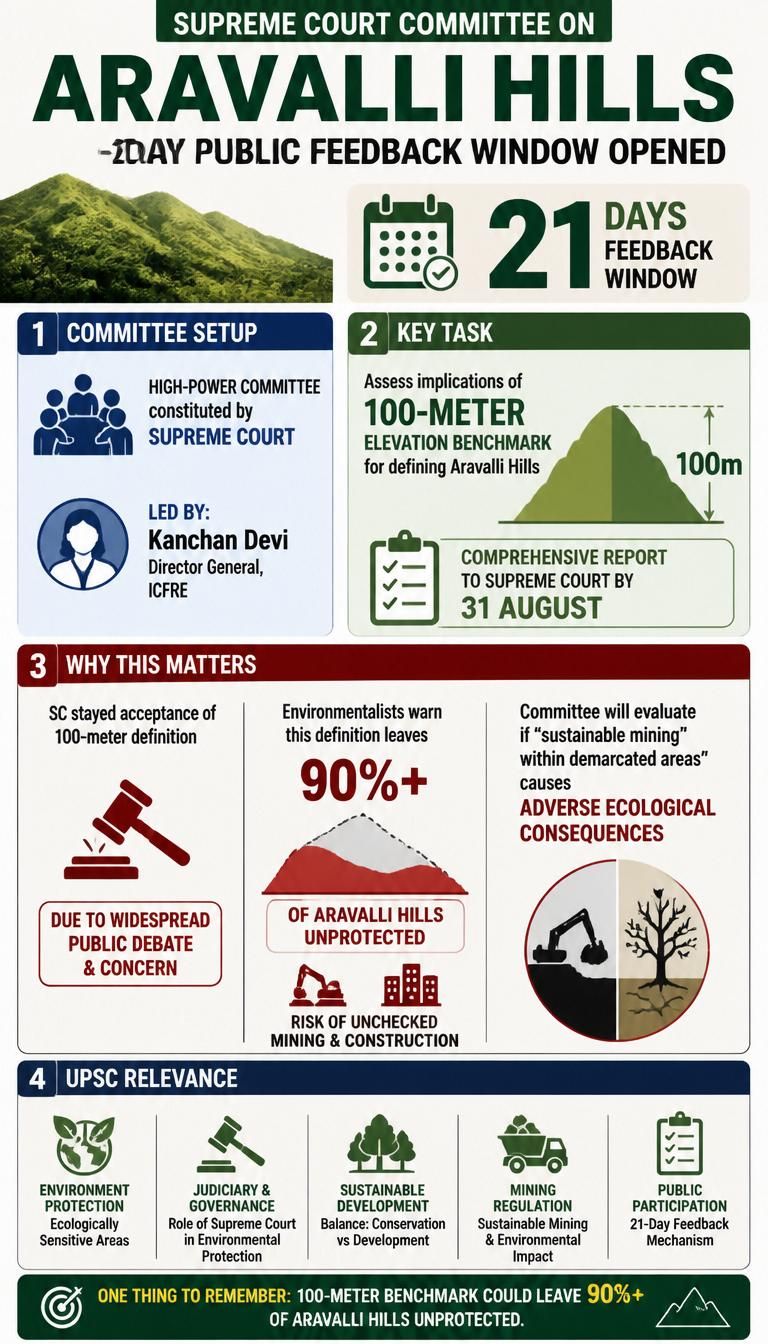
- A high-powered committee constituted by the Supreme Court has opened a 21-day window for feedback on issues concerning the Aravalli Hills.
- The panel, led by Kanchan Devi, Director General of the Indian Council of Forestry Research and Education (ICFRE), aims to resolve ambiguities in an October 2025 report by an Environment Secretary-led panel.
- The committee is tasked with assessing the implications of a proposed 100-meter elevation benchmark for defining the Aravallis.
- Its comprehensive report is scheduled to be submitted to the Supreme Court by August 31.
Aravalli.jpg
Detailed Insights:
- The Supreme Court had previously stayed its own order accepting the 100-meter elevation definition due to widespread public debate and concern.
- Environmentalists feared that this definition would leave over 90% of the Aravalli Hills unprotected from unchecked mining and construction.
- The committee will analyze whether "sustainable mining" within the newly demarcated areas would lead to adverse ecological consequences.
- Stakeholders invited for inputs include environmentalists, mining leaseholders, project proponents, villagers, farmers, and local communities.
- The Aravalli Hills are crucial for regional biodiversity and support the livelihoods of many local communities.
Key Concepts Involved:
- Aravalli Hills: An ancient mountain range in Western India, spanning several states, vital for ecology, water recharge, and biodiversity.
- Sustainable Mining: Mining practices that minimize environmental impact, ensure long-term resource availability, and maintain ecological balance.
- Indian Council of Forestry Research and Education (ICFRE): An autonomous organization under the Ministry of Environment, Forest and Climate Change, conducting forestry research and education.

SuperKalam is your personal mentor for UPSC preparation, guiding you at every step of the exam journey.
Download the App


STUDY RESOURCES
CONTACT US
ⓒ Snapstack Technologies Private Limited