GS 2: GovernanceGS 3: EconomyPrelimsGS 3: Farm Subsidies and Minimum Support PricesGS 3: Government Budgeting
Fertiliser subsidy spent by Centre in FY 2026-27 till July 13, Pg10
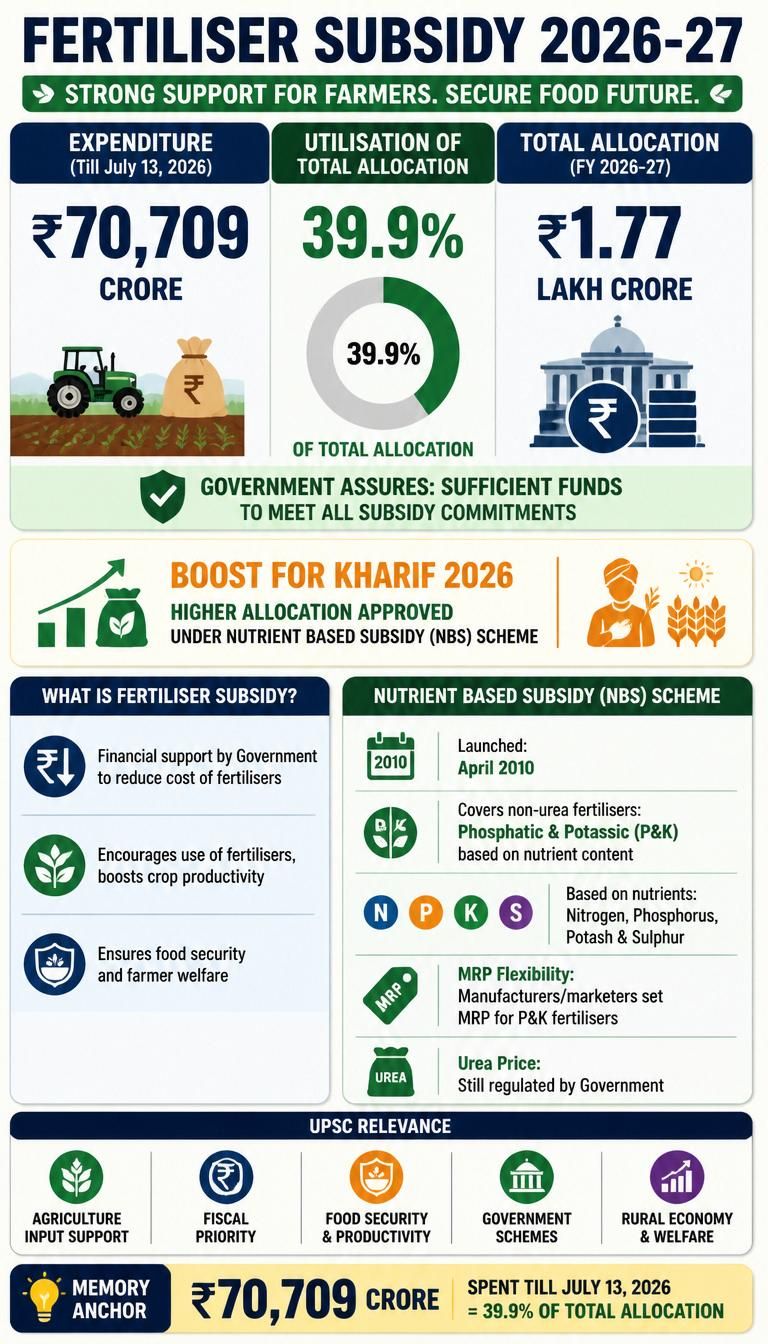
Centre spends ₹70,709 crore on fertiliser subsidy by July 13, 2026, 39.9% of total, assuring sufficient funds and higher NBS.
Practice MCQs
746 Students attempted
Key Highlights:
- The Centre spent ₹70,709 crore on fertiliser subsidies in Fiscal Year 2026-27 until July 13.
- This expenditure represents 39.9% of the total allocation of ₹1.77 lakh crore for the year.
- The government has assured the availability of sufficient funds to meet subsidy commitments.
- A higher allocation has been approved under the Nutrient Based Subsidy (NBS) scheme for the Kharif 2026 season.
Fertiliser Subsidy.jpg
Detailed Insights:
- Fertiliser subsidy is a critical financial incentive provided by the government to farmers to lower the cost of fertilizers, thereby promoting agricultural productivity and ensuring food security.
- The Nutrient Based Subsidy (NBS) scheme, launched in April 2010, provides fixed subsidies on non-urea fertilizers, specifically Phosphatic and Potassic (P&K) fertilizers, based on their nutrient content (Nitrogen, Phosphorus, Potash, and Sulphur).
- Under the NBS scheme, manufacturers and marketers have the flexibility to set the Maximum Retail Price (MRP) for P&K fertilizers, unlike urea whose price remains regulated.
- The Kharif season in India typically spans from June to October, coinciding with the southwest monsoon, and is crucial for the cultivation of major crops like rice, maize, and cotton.
- The Department of Fertilizers, operating under the Ministry of Chemicals and Fertilizers, is tasked with ensuring the adequate and timely availability of fertilizers at affordable prices across the country.
- The government's continued commitment to fertilizer subsidies aims to reduce input costs for farmers, stabilize their income, and foster overall agricultural growth.
- Despite its benefits, the fertiliser subsidy regime faces challenges such as a significant fiscal burden, potential environmental degradation due to imbalanced use, and price distortions, particularly concerning urea.
Key Concepts Involved:
- Fertiliser Subsidy: Financial support provided by the government to reduce the market price of fertilizers for farmers.
- Nutrient Based Subsidy (NBS) Scheme: A policy introduced in 2010 that links subsidies for non-urea fertilizers to their nutrient content (N, P, K, S) rather than the product itself.
- Kharif Season: The monsoon cropping season in India, generally from June to October, dependent on the southwest monsoon for cultivation.
- Fiscal Year (FY): The 12-month accounting period in India, running from April 1st to March 31st of the following year, used for budgeting and financial reporting.

SuperKalam is your personal mentor for UPSC preparation, guiding you at every step of the exam journey.
Download the App


STUDY RESOURCES
CONTACT US
ⓒ Snapstack Technologies Private Limited