GS 1: World GeographyGS 2: Social JusticeGS 3: EconomyPrelimsGS 2: Important International Institutions, Agencies and Fora
Africa surpasses Asia with highest population facing hunger, says UN, Pg16
Startling UN report reveals Africa now home to most hungry people, surpassing Asia for first time ever.
Practice MCQs
746 Students attempted
Key Highlights:
- Africa has for the first time surpassed Asia in the number of people facing hunger, according to a United Nations report.
- The finding was published in The State of Food Security and Nutrition in the World (SOFI) 2026 report, released on July 21, 2026.
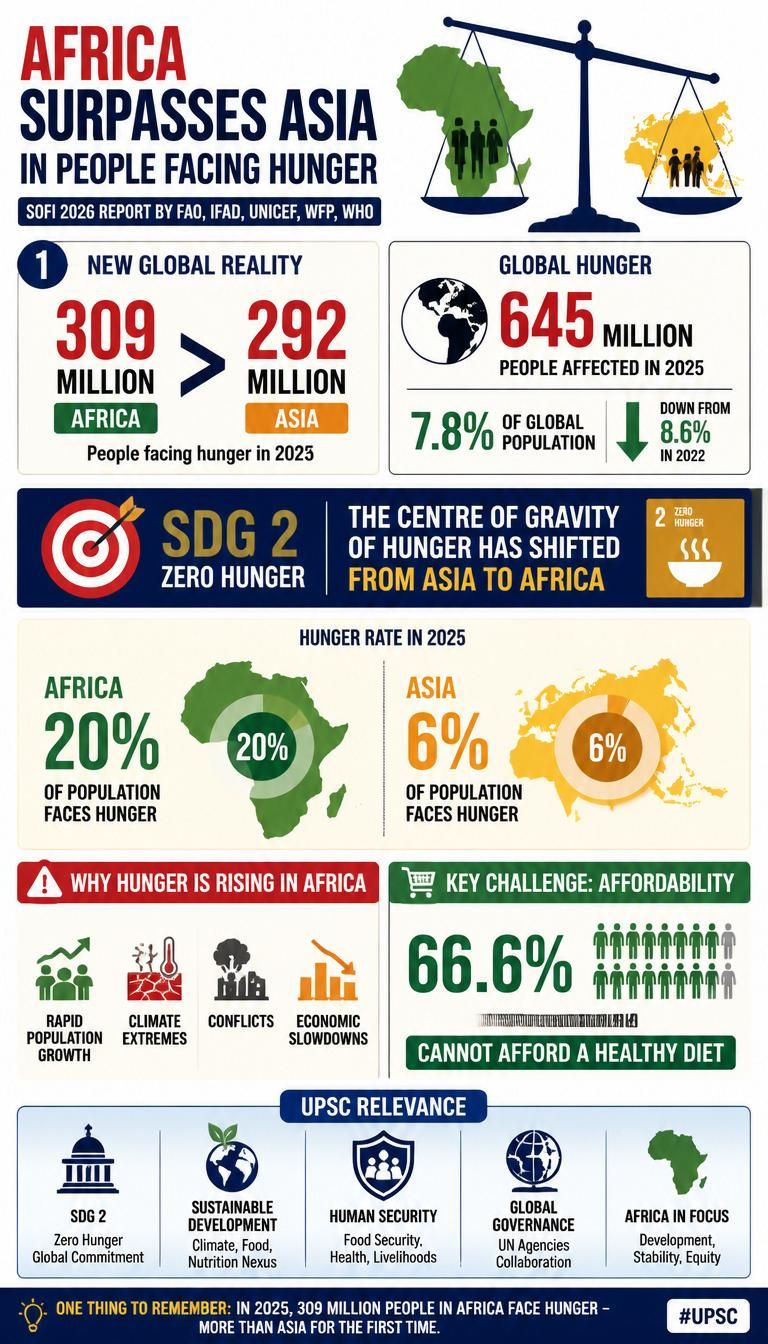
- The report, a joint effort by FAO, IFAD, UNICEF, WFP, and WHO, indicated that 309 million people in Africa faced hunger in 2025.
- In contrast, 292 million people in Asia experienced hunger during the same period.
- Globally, 645 million people, or 7.8% of the population, faced hunger in 2025, a decrease from 8.6% in 2022.
Africa surpasses Asia.jpg
Detailed Insights:
- The shift in the "centre of gravity of hunger" from Asia to Africa highlights uneven global progress towards achieving Sustainable Development Goal 2 (Zero Hunger).
- Approximately 20% of Africa's population faced hunger in 2025, compared to about 6% of Asia's population.
- A significant challenge in Africa is the affordability of healthy diets, with two-thirds (66.6%) of its population unable to afford one.
- Factors contributing to rising hunger in Africa include rapid population growth, climate extremes, conflicts, and economic slowdowns.
- The report suggests that African nations should prioritize developing animal-source food production and supply systems, which are currently expensive in the region.
- Countries like China have made significant strides in controlling hunger, while India is also intensifying its efforts.
Key Concepts Involved:
- Undernourishment: A state of insufficient food intake to meet dietary energy requirements over a prolonged period.
- Food Security: The condition where all people, at all times, have physical, social, and economic access to sufficient, safe, and nutritious food.
- Sustainable Development Goal 2 (SDG 2): A United Nations goal aiming to end hunger, achieve food security and improved nutrition, and promote sustainable agriculture by 2030.
Previous14/14

SuperKalam is your personal mentor for UPSC preparation, guiding you at every step of the exam journey.
Download the App


STUDY RESOURCES
CONTACT US
ⓒ Snapstack Technologies Private Limited