GS 2: GovernanceGS 2: PolityGS 3: Science & TechnologyPrelimsGS 2: E Governance
A checklist for a new-age courtroom, Pg13
Expert warns Supreme Court's draft AI regulations for judiciary lack robust institutional framework and clear approval standards, risking inconsistent justice delivery.
Practice MCQs
746 Students attempted
Key Highlights:
- The Supreme Court of India has published draft regulations for the use of Artificial Intelligence (AI) in courts, inviting public comments.
- These regulations aim to govern AI adoption across the judiciary, establish oversight institutions, and define approval processes for AI systems.
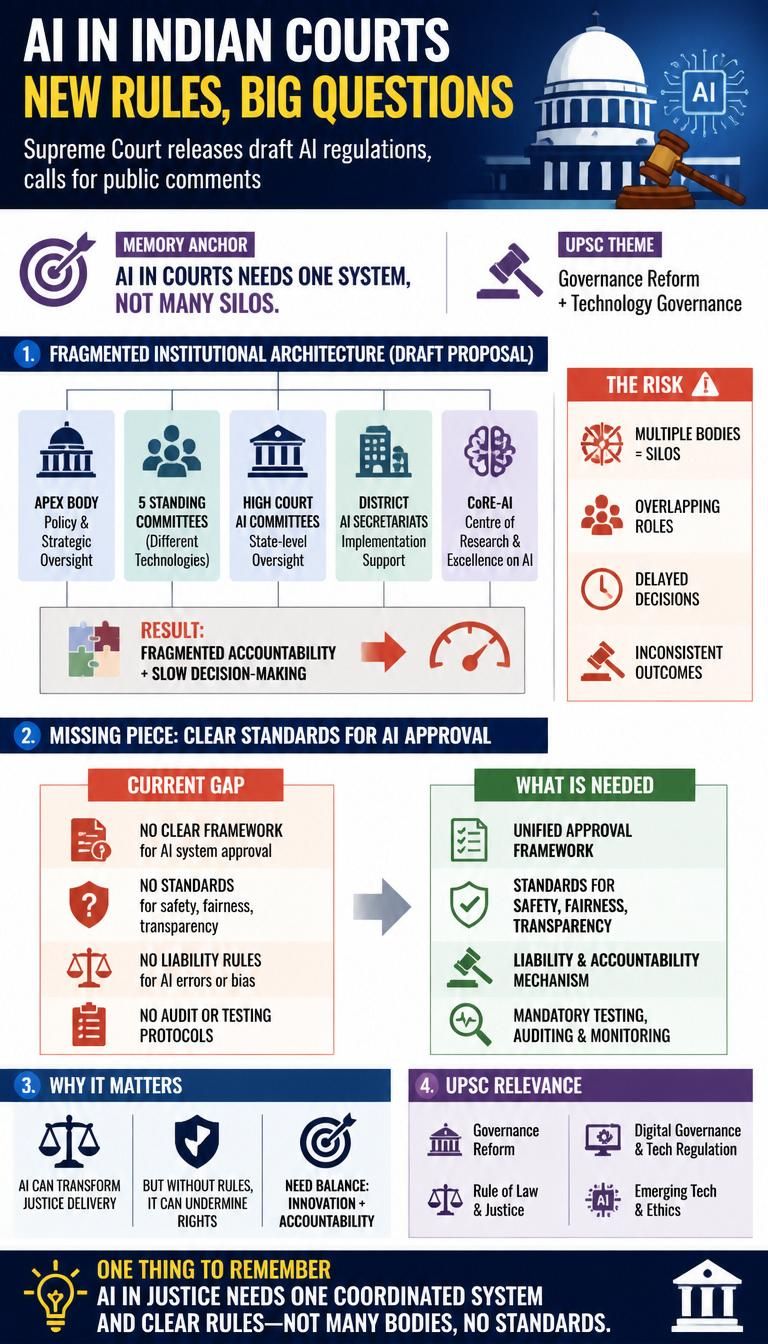
- The article highlights two primary concerns: the fragmented institutional architecture for technology governance and the absence of clear standards for AI system approval.
- It suggests that the current approach of creating new bodies for each technology could lead to inefficiencies and inconsistent outcomes.
AI in Indian Courts.jpg
Detailed Insights:
- The draft regulations propose an apex body, five standing committees, High Court AI committees, district AI secretariats, and a Centre of Research and Excellence on AI (CoRE-AI).
- This fragmented institutional structure, with separate committees for different technologies, can lead to fragmented accountability and slow decision-making.
- The article advocates for a permanent institution, similar to the Tamil Nadu Medical Services Corporation (TNMSC) or the Unique Identification Authority of India (UIDAI), to absorb all technology governance functions.
- It draws a parallel with the National Payments Corporation of India (NPCI), which set the standard for Unified Payments Interface (UPI) but allowed the market to build applications.
- A significant gap in the draft regulations is the lack of specific standards for what an AI system must demonstrate to earn approval, such as explainability, acceptable error rates, and training data sources.
- Without defined standards, each of India's 25 High Courts might independently determine AI system acceptability, potentially leading to inconsistent approvals and varied justice delivery.
- The proposed CoRE-AI should function as a neutral body to set these standards, separate from the procurement process, ensuring impartiality and consistency.
Key Concepts Involved:
- Artificial Intelligence (AI): The simulation of human intelligence processes by machines, especially computer systems.
- Unified Payments Interface (UPI): An instant real-time payment system developed by NPCI facilitating inter-bank transactions.
- e-Committee: A body within the Indian judiciary responsible for overseeing the computerization and digitization of courts.
- Unique Identification Authority of India (UIDAI): A statutory authority established to issue Aadhaar unique identification numbers to Indian residents.

SuperKalam is your personal mentor for UPSC preparation, guiding you at every step of the exam journey.
Download the App


STUDY RESOURCES
CONTACT US
ⓒ Snapstack Technologies Private Limited