GS 3: Science & TechnologyGS 3: Environment & EcologyPrelimsGS 3: Conservation, Pollution and DegradationGS 1: Changes in Critical Geographical Features, Water Bodies, Ice Caps, Flora and Fauna
Scientists unearth new instance of ‘contagious cancer’ in animals, Pg II
Researchers discover fourth instance of contagious cancer in brown bullhead catfish, offering insights into disease transmission and immune evasion.
Practice MCQs
760 Students attempted
Key Highlights:
- Scientists have identified a fourth instance of naturally occurring contagious cancer in animals, specifically melanoma in brown bullhead catfish.
- The discovery was made by researchers from the University of Vermont, studying catfish in Lake Memphremagog, straddling the U.S.-Canada border.
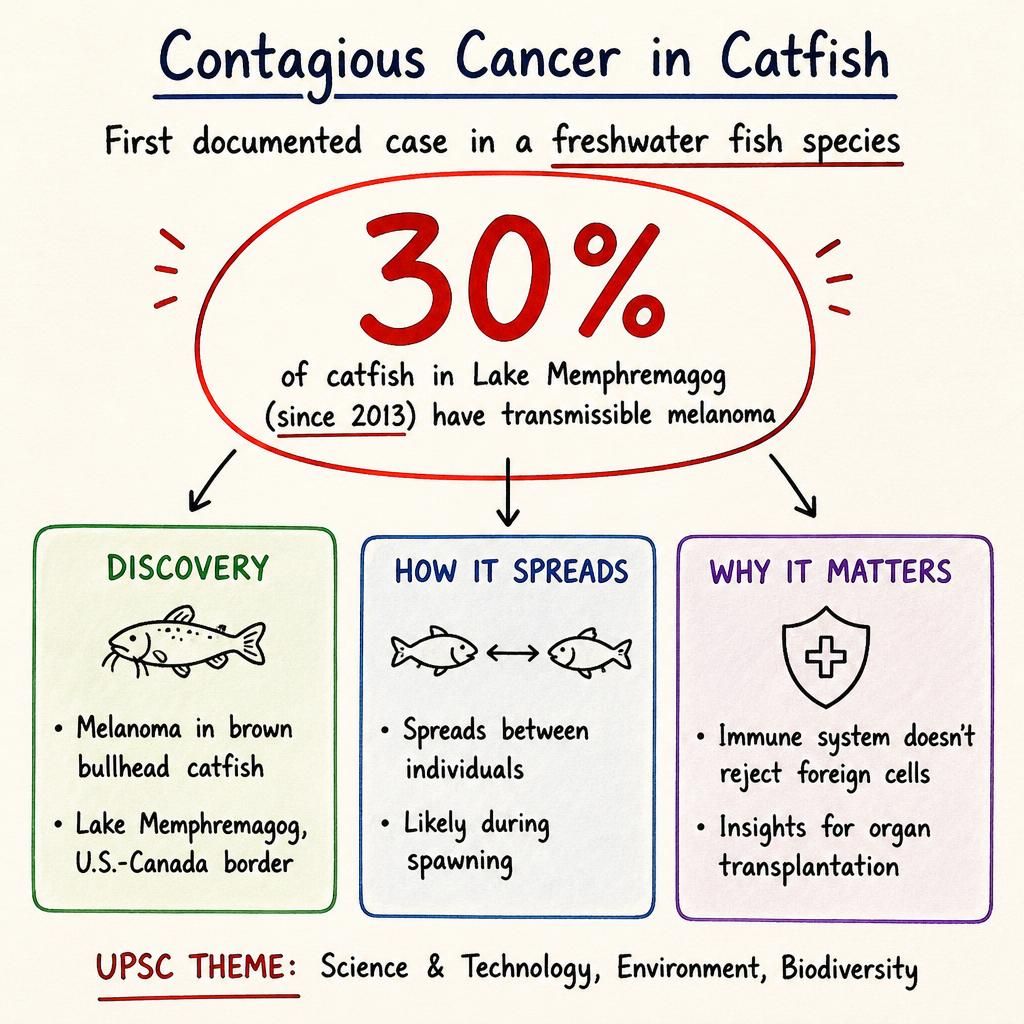
- Approximately 30% of catfish collected from the lake since 2013 were found to be afflicted with this transmissible cancer.
- Genetic analysis of the cancer cells revealed they originated from a distantly related fish and have been spreading between individuals, behaving like a parasite.
- This is the first documented case of transmissible cancer in a freshwater fish species.
Cancer Studies.jpg
Detailed Insights:
- Cancers typically arise from an individual's own cells and are not contagious, unlike infectious diseases.
- The melanoma in catfish is an aggressive cancer originating from melanocytes, skin cells responsible for pigment.
- Researchers initially suspected a virus or environmental contaminant due to the high prevalence of black lesions on the fish.
- Whole-genome sequencing showed that the tumor cells in different fish were genetically identical to each other but distinct from the host fish's normal cells.
- The cancer cells' mitochondrial DNA showed significantly more changes than normal cells, indicating an external origin.
- Reproduction, particularly during spawning when fish interact closely, is a likely mechanism for the cancer's transmission.
- This finding offers insights into how a host's immune system might not reject foreign cells, potentially aiding research into organ transplantation.
- Previous instances of transmissible cancers include Canine Transmissible Venereal Tumour (CTVT) in dogs, Devil Facial Tumour Disease (DFTD) in Tasmanian devils, and Bivalve Transmissible Neoplasia (BTN) in molluscs.
- DFTD has severely impacted Tasmanian devil populations, causing significant declines.
- BTN can spread through seawater and has even been observed to jump between different mollusc species.
Scientific/Technical Concepts Involved:
- Melanoma: A type of cancer that originates in melanocytes, the cells that produce melanin, which gives skin its color.
- Mitochondrial DNA (mtDNA): Genetic material found in mitochondria, distinct from nuclear DNA, used to trace maternal lineage and cellular origin.
- Whole-genome sequencing: A laboratory process that determines the complete DNA sequence of an organism's genome at a single time.
- Transmissible cancer: A rare type of cancer where living cancer cells themselves spread between individuals, acting like an infectious agent.

SuperKalam is your personal mentor for UPSC preparation, guiding you at every step of the exam journey.
Download the App


STUDY RESOURCES
CONTACT US
ⓒ Snapstack Technologies Private Limited