GS 3: Science & TechnologyGS 3: Environment & EcologyPrelimsGS 3: Disaster and Disaster ManagementGS 3: Conservation, Pollution and Degradation
Heat Storms: Giant Heat Waves, Pg II
Scientists introduce 'heat storm' concept for massive, cascading heat waves, with 'Vera' lasting 367 days across 85% of the globe.
Practice MCQs
760 Students attempted
Key Highlights:
- Climate researchers have introduced the concept of "heat storms" to describe massive, prolonged heat events that blanket vast areas.
- These "heat storms" are distinguished from traditional heat waves by their extensive scale and significantly longer duration.
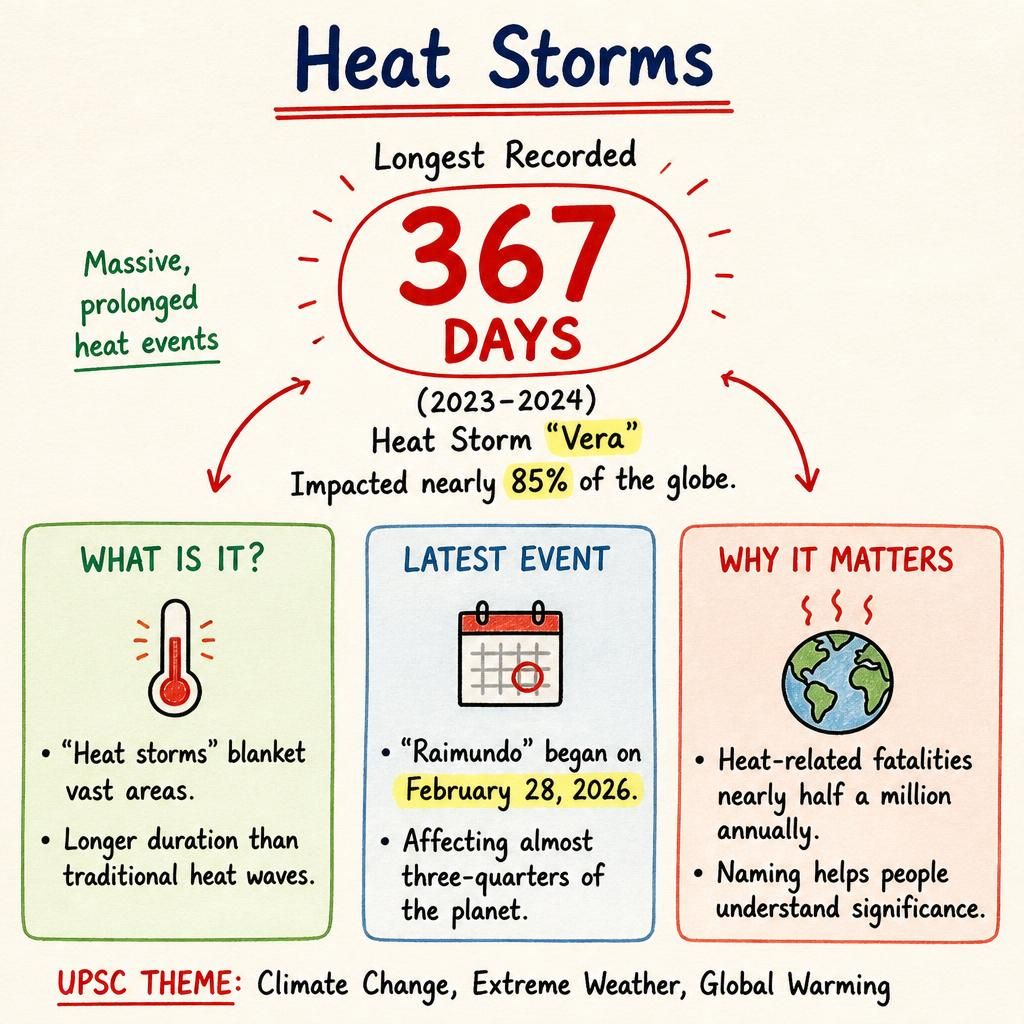
- The largest recorded "heat storm," named Vera, lasted 367 days from 2023-2024 and impacted nearly 85% of the globe.
- Currently, the world is experiencing a "heat storm" named Raimundo, which began on February 28, 2026, affecting almost three-quarters of the planet.
Heat Storm.jpg
Detailed Insights:
- The concept of "heat storm" was developed through a consultation with climate researchers and an analysis of global temperature data since 1960.
- The duration of these extreme heat events has increased substantially, from about two months in the 1960s to nine months in the early 2000s.
- A "heat cascade" describes instances where multiple "heat storms" occur either consecutively or simultaneously, amplifying their overall impact.
- Anthony Leiserowitz, director of the Yale Program on Climate Change Communication, emphasizes that naming such events helps people understand their significance.
- Heat-related fatalities are estimated to be nearly half a million annually, highlighting the severe human cost of these phenomena.
- The new terminology aims to better connect the scientific understanding of global warming, particularly the 2 degree Celsius target, with public perception.
Key Concepts Involved:
- Heat Storm: A proposed new term for massive, prolonged, and widespread heat events that are larger and longer than traditional heat waves.
- Heat Cascade: A phenomenon characterized by multiple "heat storms" occurring either sequentially or concurrently, intensifying their effects.
- Pre-industrial levels: A historical baseline, typically before 1750, used to measure the increase in global average temperature due to human activities.
- 2 degree Celsius target: A critical international climate policy goal to limit the global average temperature rise above pre-industrial levels.

SuperKalam is your personal mentor for UPSC preparation, guiding you at every step of the exam journey.
Download the App


STUDY RESOURCES
CONTACT US
ⓒ Snapstack Technologies Private Limited