GS 2: GovernanceGS 3: Science & TechnologyGS 3: Environment & EcologyGS 3: EconomyPrelims
India’s green transition is missing long-duration energy storage, Pg2
India's green transition critically needs long-duration energy storage to stabilize the grid amidst surging demand, integrating diverse LDES technologies for reliable renewable power.
Practice MCQs
739 Students attempted
Key Highlights:
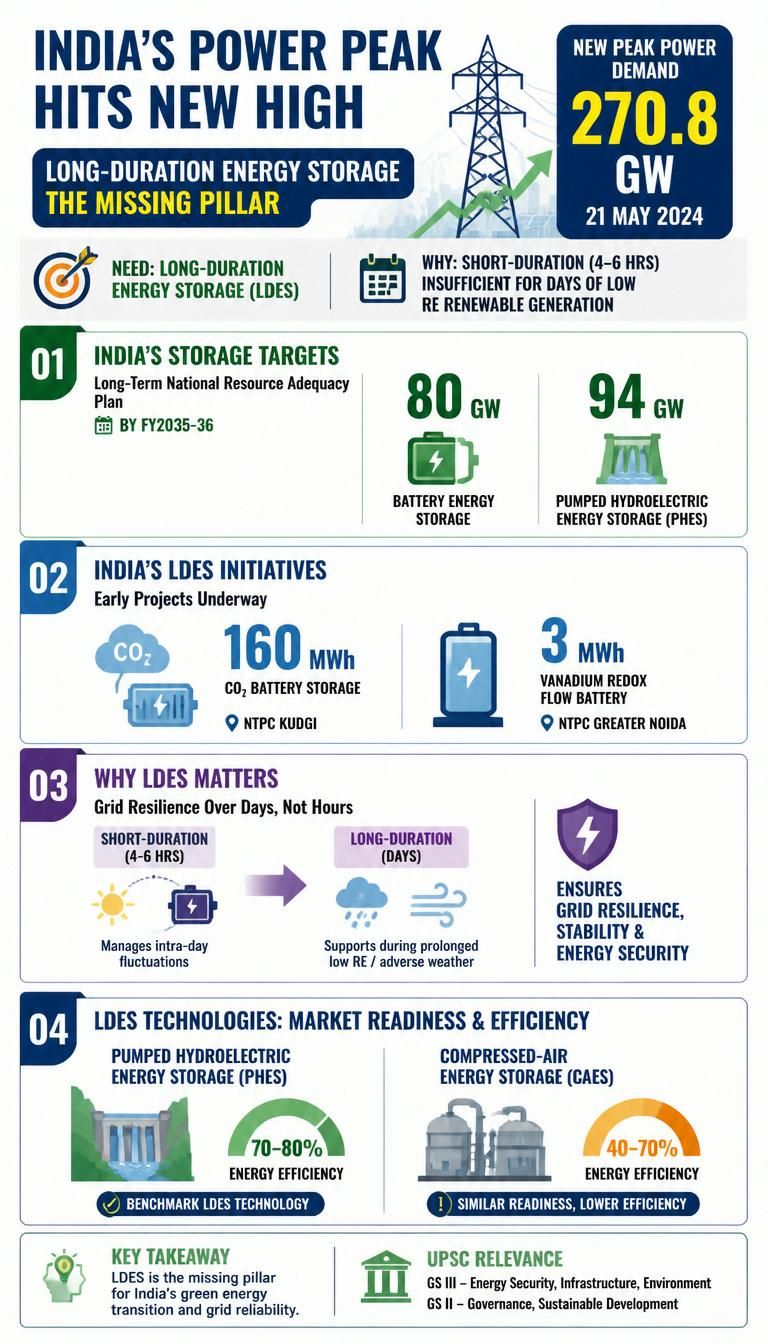
- India recorded its highest peak power demand of 270.8 gigawatts (GW) on May 21, highlighting the need for enhanced energy storage.
- The current Long-Term National Resource Adequacy Plan aims for 80 GW of battery energy storage and 94 GW of Pumped Hydroelectric Energy Storage (PHES) by FY2035-36.
- These plans offer short-duration storage (4-6 hours), which may be insufficient for prolonged periods of low renewable generation or adverse weather conditions.
- Long-Duration Energy Storage (LDES) technologies, capable of discharging power for days rather than hours, are identified as a missing pillar for India's green energy transition.
- India has initiated projects like a 160-MWh carbon dioxide battery storage system at NTPC Kudgi and a 3-MWh vanadium redox flow battery at NTPC Greater Noida.
Peak Power.jpg
Detailed Insights:
- LDES systems provide grid resilience and stability by balancing supply and demand over extended periods, unlike short-duration systems that manage intra-day fluctuations.
- PHES remains the benchmark LDES technology due to its mature infrastructure and high energy efficiency of 70-80%.
- Compressed-Air Energy Storage (CAES) offers similar market readiness but with lower efficiency (40-70%).
- Thermal storage, while still under development, shows promise with long discharge durations of around 200 hours and 55-90% efficiency.
- Vanadium flow batteries are commercially ready, offering 80-85% efficiency for 10-24 hour discharge durations.
- The Central Electricity Authority (CEA) reported India's PHES potential at 267 GW, with plans to install 100.8 GW by 2035-2036.
- Current national energy plans lack specific recognition and deployment pathways for LDES, necessitating its incorporation into the Ministry of Power's National Framework for Promoting Energy Storage Systems.
- Policy recommendations include faster environmental clearances, technology-agnostic incentives, and training for dispatch centers to manage LDES assets effectively.
Key Concepts Involved:
- Long-Duration Energy Storage (LDES): Technologies that store and discharge energy for extended periods, typically from 8 hours to several days or weeks.
- Pumped Hydroelectric Energy Storage (PHES): A mature LDES technology that stores energy by pumping water to an upper reservoir and releasing it to generate electricity when needed.
- Compressed-Air Energy Storage (CAES): An LDES technology that stores energy by compressing air into underground caverns and releasing it to drive turbines.
- Vanadium Flow Batteries: A type of electrochemical LDES that uses vanadium ions in different oxidation states to store and release electrical energy.

SuperKalam is your personal mentor for UPSC preparation, guiding you at every step of the exam journey.
Download the App


STUDY RESOURCES
CONTACT US
ⓒ Snapstack Technologies Private Limited