GS 2: GovernanceGS 2: PolityPrelims
APAAR: SC to direct CBSE to comply with HC order, Pg14
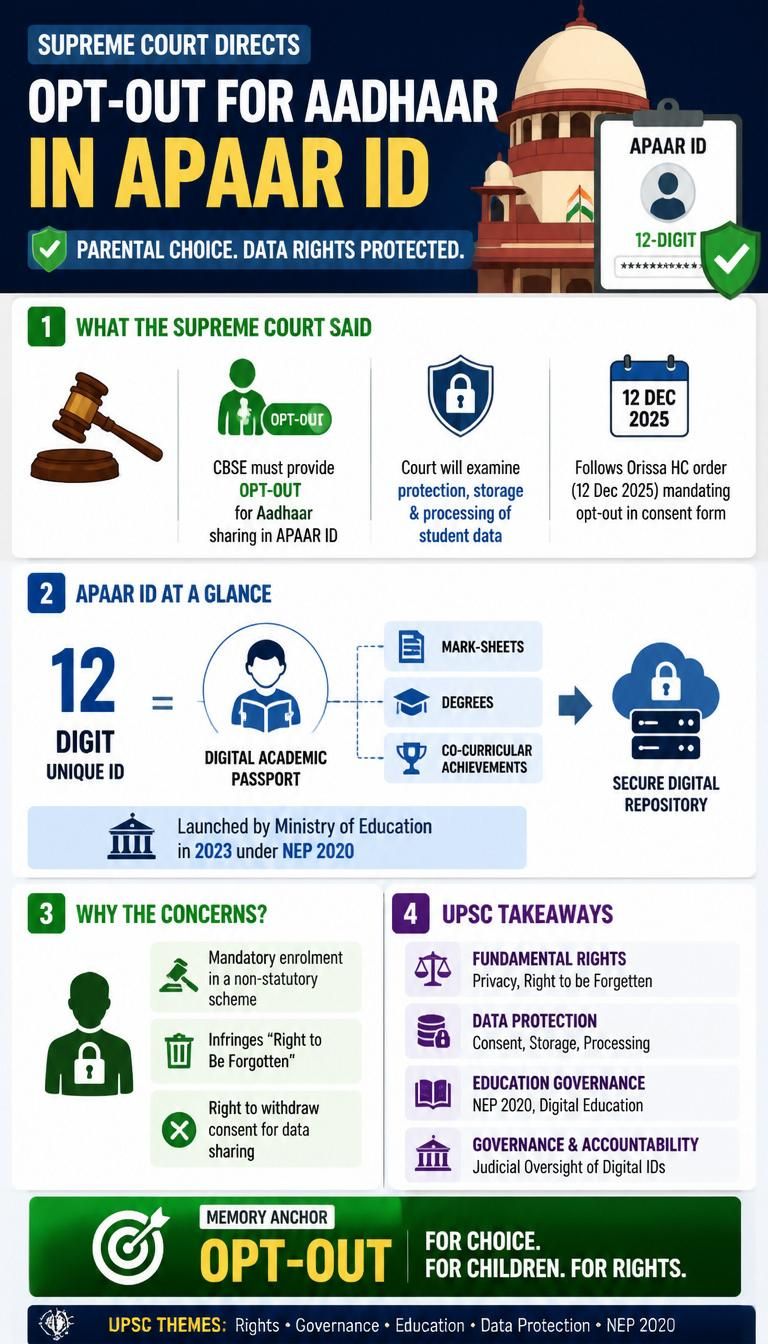
Supreme Court directs CBSE to make APAAR voluntary nationwide, enforcing an opt-out option for students, upholding Orissa High Court's privacy ruling.
Practice MCQs
739 Students attempted
Key Highlights:
- The Supreme Court will direct the Central Board of Secondary Education (CBSE) to ensure the Automated Permanent Academic Account Registry (APAAR) scheme is voluntary.
- This directive mandates CBSE to include a clear "opt-out/refusal option" in the APAAR consent forms nationwide.
- The decision follows an Orissa High Court judgment from December 12, 2025, in the case of Rohit Anand Das versus State Of Odisha, which the Centre did not challenge.
- The APAAR initiative, under the National Education Policy 2020, aims to provide a unique, lifelong 12-digit student ID for academic records.
APAAR ID.jpg
Detailed Insights:
- The Supreme Court bench, led by Chief Justice of India Surya Kant, emphasized that while APAAR is beneficial, its implementation must adhere to existing laws.
- Concerns were raised by petitioners regarding the scheme's mandatory nature, its linkage to Aadhaar, and potential violations of data privacy.
- The Orissa High Court had previously ruled that the absence of an explicit refusal option made the scheme effectively mandatory, infringing on the right to privacy.
- The Supreme Court also indicated that CBSE must address concerns related to the protection, storage, and processing of students' personal data.
- APAAR is designed to digitally store academic records, including mark sheets, degrees, and co-curricular achievements, facilitating seamless transitions between institutions.
- The scheme is part of the "One Nation, One Student ID" program, aligning with the government's Digital India mission.
Key Concepts Involved:
- Automated Permanent Academic Account Registry (APAAR): A unique 12-digit lifelong digital ID for students to store and manage academic records.
- National Education Policy (NEP) 2020: A comprehensive framework guiding the development of education in India, under which APAAR was launched.
- Digital Personal Data Protection Act, 2023: Legislation governing the processing of digital personal data in India, ensuring data privacy and consent.
- Right to Privacy (Article 21): A fundamental right under the Indian Constitution, invoked in challenges against mandatory data collection without explicit consent.

SuperKalam is your personal mentor for UPSC preparation, guiding you at every step of the exam journey.
Download the App


STUDY RESOURCES
CONTACT US
ⓒ Snapstack Technologies Private Limited