GS 2: GovernanceGS 3: Science & TechnologyGS 3: EconomyPrelimsGS 3: Infrastructure: Energy, Ports, Roads, Airports, Railways etc.
India’s minerals policy needs to move to material security, Pg10
India must shift its critical minerals policy from mere auctions to comprehensive material security, focusing on processing, refining, and recycling for industrial supply.
Practice MCQs
760 Students attempted
Key Highlights:
- India's government has significantly increased its focus on critical minerals policy over the last two years.
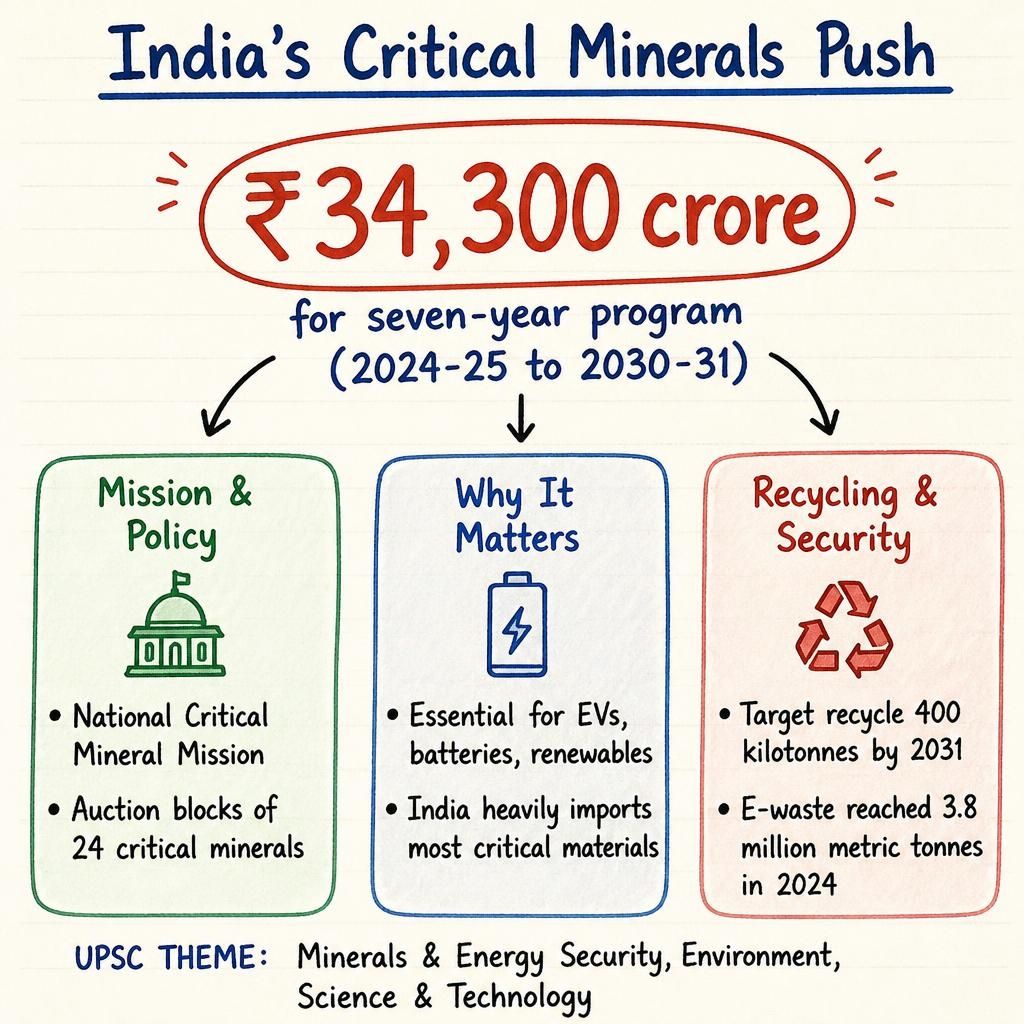
- The National Critical Mineral Mission has been allocated ₹34,300 crore for a seven-year program (2024-25 to 2030-31) covering exploration, mining, and processing of critical minerals and materials.
- Amended mining laws enable the government to auction blocks of 24 critical minerals, with more expected before 2031.
- A key challenge for India is to transition from merely auctioning mineral blocks to achieving material security, ensuring a usable supply for industries.
- Securing critical minerals like lithium, cobalt, nickel, and rare earth elements is crucial for Electric Vehicles (EVs), batteries, electronic devices, renewable energy, and strategic industries.
Critical Mineral Push.jpg
Detailed Insights:
- Global reliance on critical minerals is rapidly increasing due to their essential role in clean energy technologies and digital transformation.
- India is particularly vulnerable as it heavily imports most of its critical and processed materials, leading to supply chain dependencies.
- China's dominance in critical mineral supply chains is largely attributed to its advanced processing and refining capabilities, not just its mining capacity.
- Developing processing and refining infrastructure simultaneously with mining is crucial, as raw mineral extraction alone does not guarantee material supply.
- Challenges in establishing new mines and processing facilities include environmental concerns, land acquisition issues, and limited existing infrastructure.
- The National Critical Mineral Mission includes a target to recycle 400 kilotonnes of critical minerals from waste streams by 2031, supported by a ₹1,500 crore allocation.
- Recycling offers a quicker option than establishing new mines, especially given India's substantial and growing e-waste production, which reached 3.8 million metric tonnes in 2024.
- Key hurdles in the recycling sector include the fragmented nature of the scrap economy, ensuring predictable access to waste, and maintaining quality and consistency for manufacturers.
- While a national stockpile of selected critical minerals can mitigate short-term supply disruptions, it is not considered a sustainable long-term strategy for material security.
Key Concepts Involved:
- Critical Minerals: Minerals essential for economic development, national security, and strategic industries, whose supply chains are vulnerable to disruption.
- Material Security: Ensuring a reliable, sustainable, and diversified supply of processed materials required by industries for manufacturing and economic growth.
- Beneficiation: The process of treating raw ore or material to remove impurities and improve its quality for industrial use.
- E-waste: Discarded electrical or electronic devices, which serve as a significant secondary source for recovering critical minerals.

SuperKalam is your personal mentor for UPSC preparation, guiding you at every step of the exam journey.
Download the App


STUDY RESOURCES
CONTACT US
ⓒ Snapstack Technologies Private Limited