GS 2: GovernanceGS 2: PolityGS 2: Social JusticePrelimsGS 2: E Governance
It's Time To Ask: Do We Need The Affidavit Anymore?, Pg11
Experts question affidavit necessity, advocating for reform to ease citizen burden and streamline legal processes, proposing self-declarations with legal consequences.
Practice MCQs
753 Students attempted
Key Highlights:
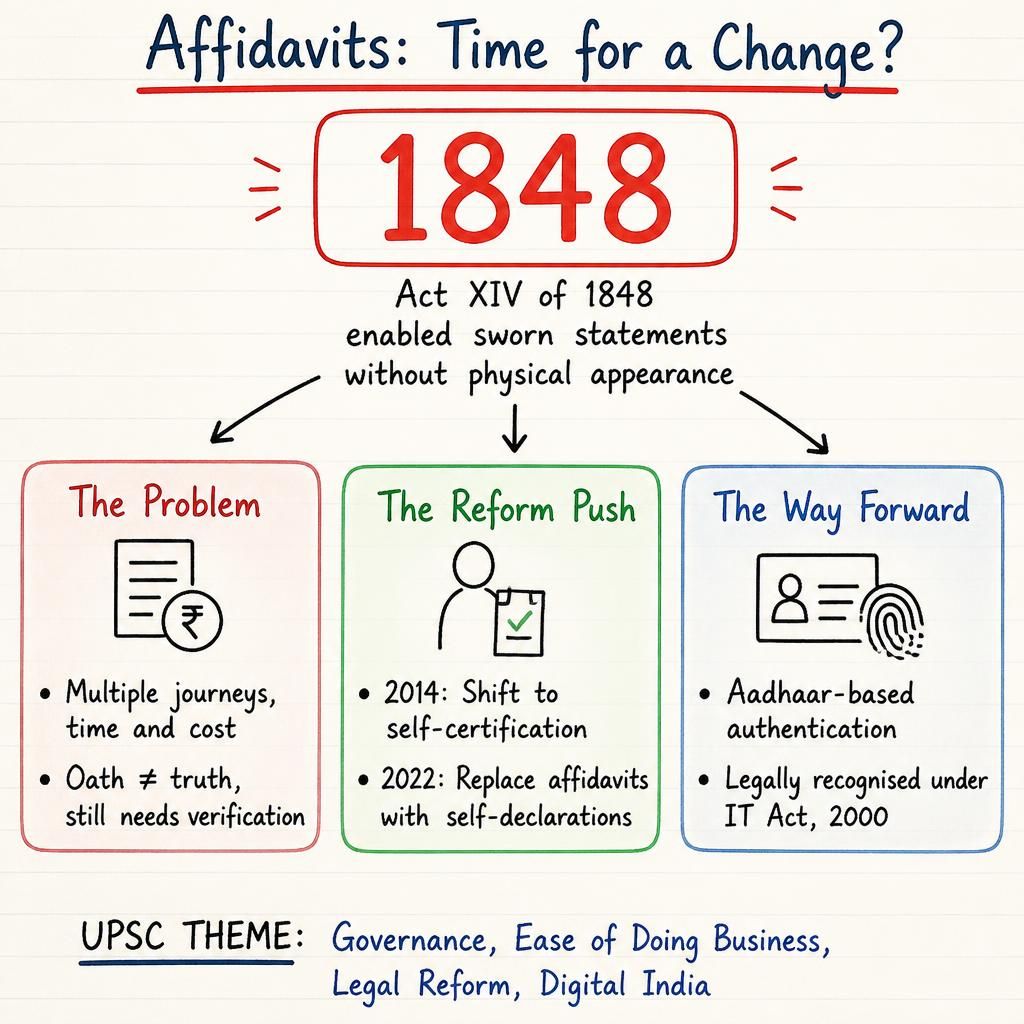
- The article questions the continued necessity of affidavits, a practice established in India by Act XIV of 1848, which allowed sworn statements to be treated as if made in court without physical appearance.
- Affidavits are routinely used for various declarations like caste, income, and residence, but the swearing process by a notary or magistrate does not verify the truth of the assertion.
- The process of obtaining an affidavit involves significant time and cost, especially for economically disadvantaged individuals seeking government services or welfare benefits.
- The article advocates for replacing affidavits with authenticated self-declarations that carry direct legal responsibility for falsehood, citing international examples from the US and Ireland.
- The Indian government has promoted self-certification since 2014 to simplify processes and reduce the need for affidavits and attestations.
Affidavit.jpg
Detailed Insights:
- The original purpose of affidavits was to save travel, but the current process often necessitates multiple journeys, creating an additional burden on citizens.
- The core issue is that an affidavit establishes the maker's belief in its truth under oath, not the actual veracity of the underlying fact, which often still requires separate verification.
- The Code of Civil Procedure and Supreme Court Rules govern affidavits in India, which are extensively used in civil and criminal proceedings.
- In 2014, Prime Minister Narendra Modi encouraged minimum use of affidavits and a shift to self-certification across Union Ministries and State Governments.
- States like Delhi, Punjab, Himachal Pradesh, Gujarat, Kerala, Madhya Pradesh, Rajasthan, and Goa have implemented measures to replace affidavits with self-declarations for many public services.
- The Company Law Committee in 2022 also recommended replacing affidavits with self-declarations to promote ease of doing business, noting that punishments for false evidence are similar.
- Aadhaar-based authentication is proposed as a means to establish identity for electronically authenticated statements of truth, which are legally recognized under the Information Technology Act, 2000.
Key Concepts Involved:
- Affidavit: A written sworn declaration of fact made voluntarily by an individual under an affirmation or oath administered by a person approved by law.
- Self-declaration: A formal written statement where an individual asserts facts to be true, without requiring an oath or attestation by a third party.
- Perjury: The act of deliberately making materially false or misleading statements while under oath or affirmation, punishable under the Indian Penal Code.
- Aadhaar-based authentication: A process using an individual's Aadhaar number and biometric or OTP verification to confirm identity for electronic transactions and signatures.

SuperKalam is your personal mentor for UPSC preparation, guiding you at every step of the exam journey.
Download the App


STUDY RESOURCES
CONTACT US
ⓒ Snapstack Technologies Private Limited