GS 2: GovernanceGS 2: PolityGS 2: Social JusticePrelimsGS 2: Government policies and interventions for development in various sectors
Internet access fundamental right for kids: What SC ruled, Pg13
Supreme Court declares internet access a fundamental right for all children, rejecting blanket bans and mandating Union to frame child-safe digital guidelines.
Practice MCQs
753 Students attempted
Key Highlights:
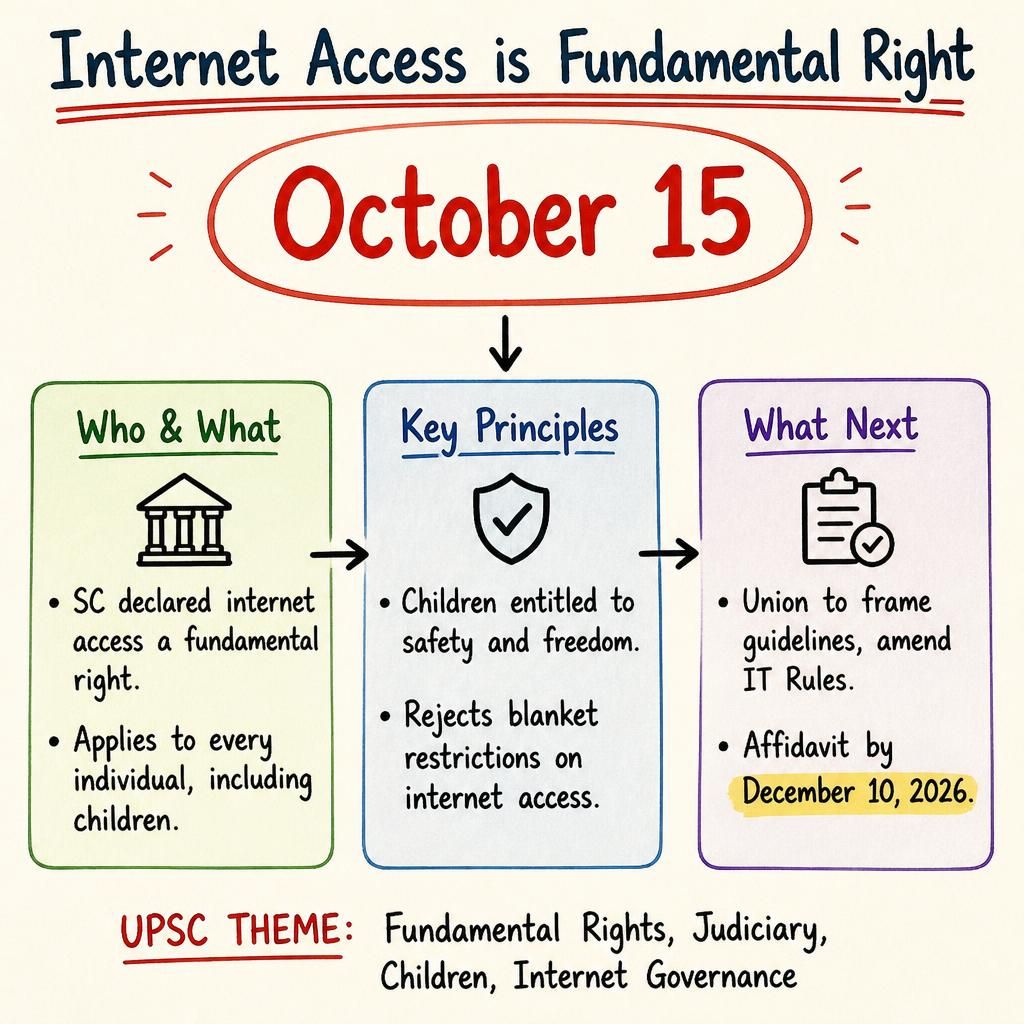
- The Supreme Court, on October 15, declared that the right to access and use the internet is a fundamental right for every individual, including children.
- Justices J B Pardiwala and K V Chandran emphasized that children are entitled to both safety and freedom, rejecting blanket restrictions on internet access.
- The ruling stemmed from a 2024 Supreme Court decision concerning child pornographic material under the Protection of Children from Sexual Offences (POCSO) Act and the Information Technology (IT) Act.
- The Court directed the Union to develop a parental-consent and "child mode" framework and to restrict inherently harmful content.
Right to Internet Access.jpg
Detailed Insights:
- The Supreme Court's decision underscores that children, regardless of age, possess the same fundamental rights as adults.
- The ruling cited previous landmark judgments, including Anuradha Bhasin v Union of India (2020), which recognized internet access as part of freedom of speech and trade.
- Another case, Pragya Prasun v Union of India (2025), was referenced for establishing digital access as an intrinsic component of the right to life for persons with disabilities.
- The Court rejected age-based limits on internet access, citing concerns about privacy, surveillance, and the ineffectiveness of such measures.
- It highlighted that for many children, especially in remote areas, the internet serves as a primary source of learning and information.
- Any restriction on fundamental rights must adhere to a three-pronged test: enacted legislation, legitimate state interest, and proportionality.
- The Union government is mandated to frame guidelines, potentially amend the IT Rules, and submit an affidavit by December 10, 2026.
- States enacting laws on screen time for minors must ensure these restrictions remain within constitutionally permissible limits.
Key Concepts Involved:
- Fundamental Rights: Basic human rights guaranteed by the Constitution, enforceable by courts.
- Three-pronged Test: A legal standard requiring restrictions on fundamental rights to be legislative, serve a legitimate state interest, and be proportionate.
- Digital KYC: Know Your Customer process conducted digitally, often involving identity verification.
- Child Sexual Exploitation and Abuse Material (CSEAM): Any material depicting the sexual abuse or exploitation of children.

SuperKalam is your personal mentor for UPSC preparation, guiding you at every step of the exam journey.
Download the App


STUDY RESOURCES
CONTACT US
ⓒ Snapstack Technologies Private Limited