GS 3: Science & TechnologyGS 2: International RelationsPrelimsGS 2: Bilateral, Regional and Global Groupings and AgreementsGS 2: Effect of Policies and Politics of Developed and Developing Countries on India's Interests
Why has U.S. deployed ‘space weapons’?, Pg12
US Air Force discloses deployment of 'space control' weapons in Earth orbit, sparking international concern and debate over space militarization and treaties.
Practice MCQs
746 Students attempted
Key Highlights:
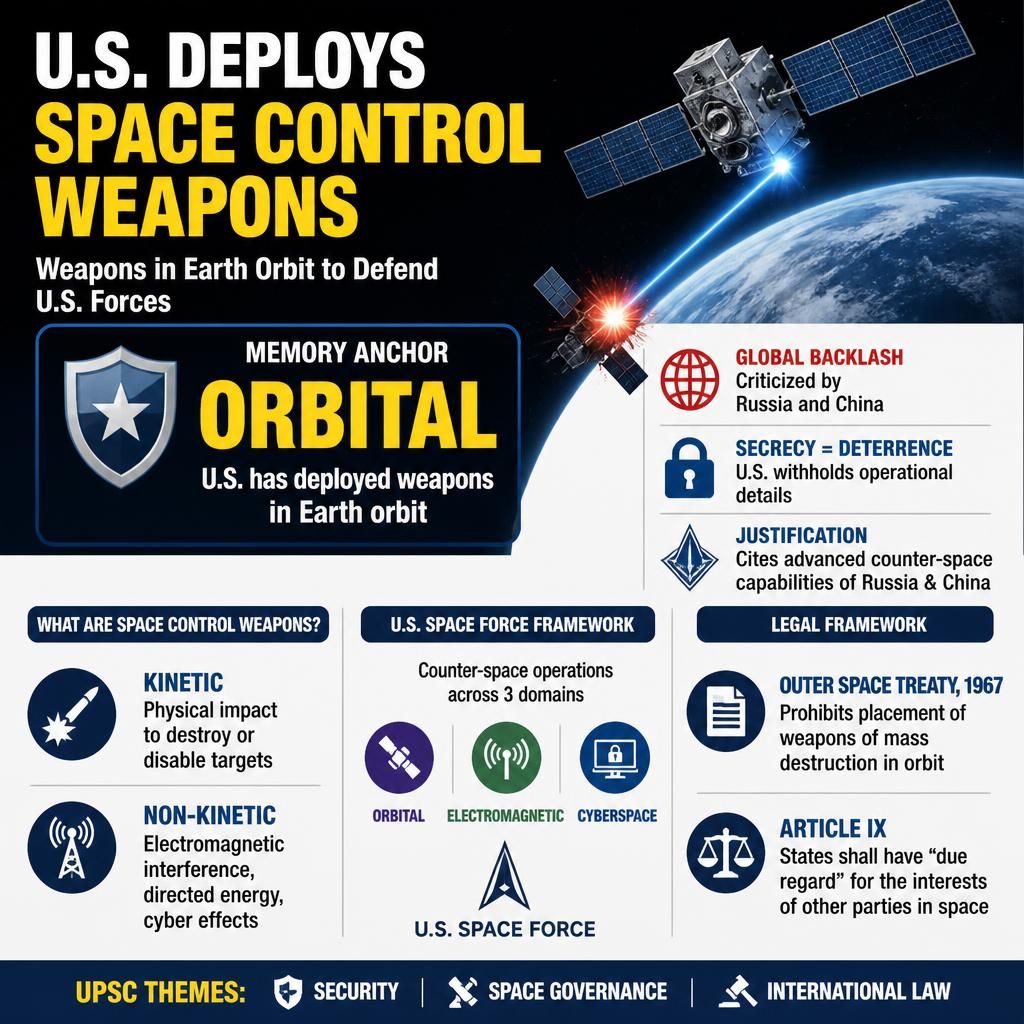
- U.S. Air Force Secretary Troy Meink announced the deployment of "space control" weapons in Earth orbit on September 14.
- These weapons are intended to defend U.S. forces against "hostile adversary action" in the space domain.
- The disclosure of these orbital weapons drew significant backlash and criticism from countries like Russia and China.
- The U.S. has withheld operational details of these weapons, stating that secrecy contributes to deterrence.
Space Weapons.jpg
Detailed Insights:
- Space control encompasses military activities necessary to control the space domain, as defined by the U.S. Space Force.
- Such weapons can employ both kinetic capabilities, involving physical impact, and non-kinetic methods like electromagnetic interference or directed energy.
- The U.S. Space Force war-fighting framework categorizes counter-space operations into orbital, electromagnetic, and cyberspace domains.
- The U.S. justifies its development and deployment by citing advanced counter-space capabilities demonstrated by Russia and China.
- The Outer Space Treaty of 1967 prohibits placing weapons of mass destruction in orbit but does not restrict conventional weapons.
- Article IX of the Outer Space Treaty mandates states to have "due regard" for the interests of other parties in space.
- Diplomatic avenues, such as the UN process on the Prevention of an Arms Race in Outer Space, exist for negotiating restraints.
- Countries can also raise concerns about threats to international peace and security before the UN Security Council or General Assembly under Article 35 of the UN Charter.
Key Concepts Involved:
- Space Control: Military activities required to control the space domain, including protecting one's own assets and denying adversaries.
- Kinetic Weapons: Devices that physically damage an object through impact or collision.
- Non-Kinetic Weapons: Systems that disrupt or degrade an adversary's capabilities without physical impact, such as jamming or directed energy.
- Outer Space Treaty (1967): An international agreement prohibiting weapons of mass destruction in outer space and regulating celestial body activities.

SuperKalam is your personal mentor for UPSC preparation, guiding you at every step of the exam journey.
Download the App


STUDY RESOURCES
CONTACT US
ⓒ Snapstack Technologies Private Limited