GS 3: Science & TechnologyPrelimsGS 3: BiotechnologyGS 3: Science and Technology in Everyday LifeGS 2: Health Sector
Rattlesnake serum could reinvent fight against deadly venoms, Pg11
New research reveals rattlesnake serum proteins, Fetuin-A, demonstrate tenfold higher potency than commercial antivenom against deadly snake venoms, promising a revolution in treatment.
Practice MCQs
746 Students attempted
Key Highlights:
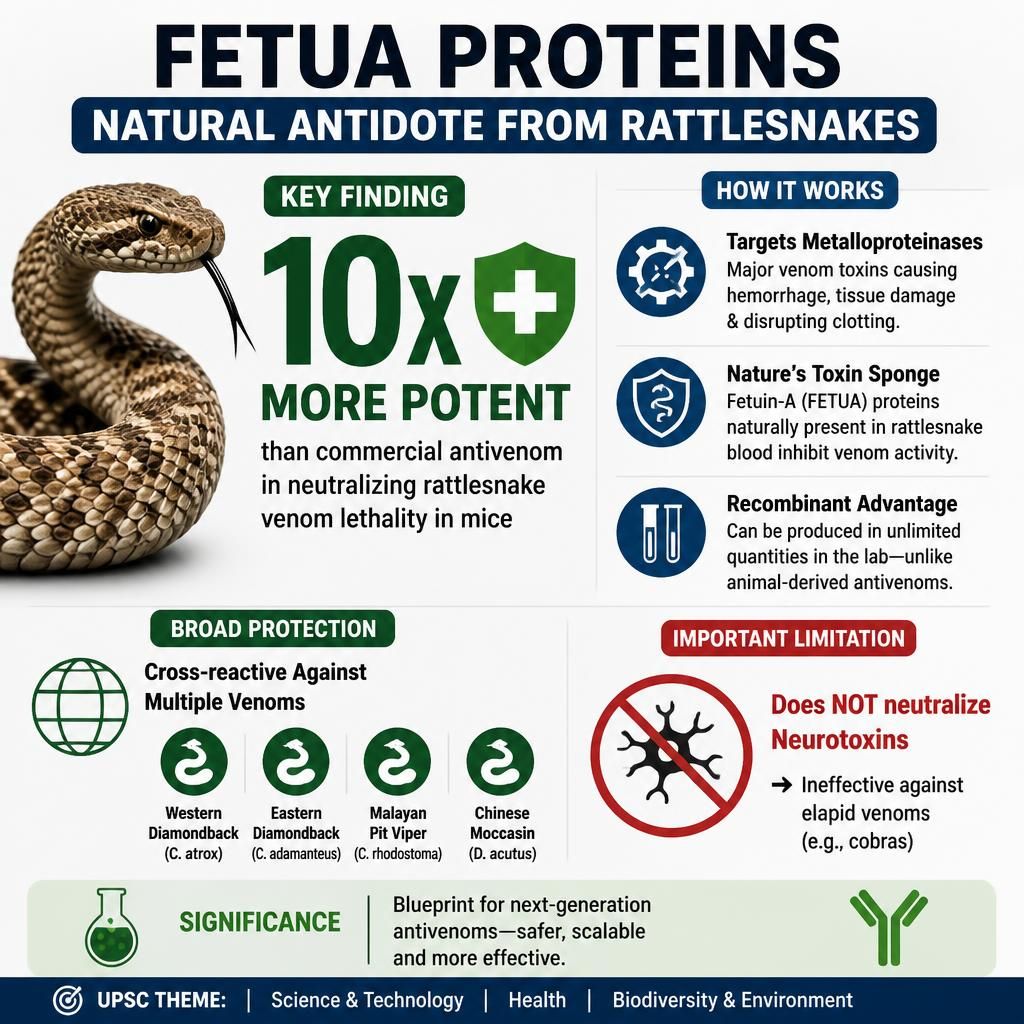
- Researchers have discovered that specific FETUA proteins found in rattlesnakes can effectively neutralize rattlesnake venom lethality in mice.
- The study, led by Dr. Sean B. Carroll at the University of Maryland, was published in the Proceedings of the National Academy of Sciences.
- These naturally occurring proteins demonstrated a potency roughly 10 times greater than commercial antivenom in neutralizing venom.
- The FETUA proteins primarily target metalloproteinases, a major class of venom toxins, surprisingly blocking overall venom lethality.
Rattle Snake.jpg
Detailed Insights:
- Vipers, including rattlesnakes, possess "toxin sponges" like Fetuin-A in their bloodstream that inhibit venom activity.
- Metalloproteinases are highly abundant toxins in rattlesnake venoms, responsible for causing hemorrhage, tissue damage, and disrupting blood coagulation.
- The research team specifically identified four FETUA proteins from the western diamondback rattlesnake (Crotalus atrox) for their investigation.
- The FETUA proteins exhibited cross-reactivity, neutralizing venoms from other species such as the eastern diamondback rattlesnake (Crotalus adamanteus), Malayan pit viper (Calloselasma rhodostoma), and Chinese moccasin (Deinagkistrodon acutus).
- A significant advantage of these proteins is their potential for recombinant production in unlimited quantities, unlike traditional antivenoms derived from immunized animals.
- A key limitation is that FETUA proteins do not neutralize neurotoxins, which are critical components of venoms from elapids like cobras.
- For countries like India, which host both vipers and elapids, a comprehensive strategy would involve identifying FETUAs from native vipers and combining them with agents targeting neurotoxic elapids.
- Partial protection was observed against the venom of Sochurek’s saw-scaled viper (Echis carinatus sochureki), which is one of India's Big Four venomous snakes.
Scientific/Technical Concepts Involved:
- FETUA proteins: A family of serum proteins found in vipers that act as "toxin sponges" to neutralize specific venom components.
- Metalloproteinases: A class of venom toxins that cause hemorrhage, tissue damage, and disrupt blood coagulation.
- Antivenom: A biological product containing antibodies used to treat venomous bites or stings.
- Neurotoxins: Toxins that specifically target and disrupt the function of nerve cells or nerve tissue.

SuperKalam is your personal mentor for UPSC preparation, guiding you at every step of the exam journey.
Download the App


STUDY RESOURCES
CONTACT US
ⓒ Snapstack Technologies Private Limited