GS 3: Science & TechnologyGS 2: International RelationsGS 3: EconomyPrelims
Why domestic reserves are not enough to fuel India's nuclear ambitions, Pg14
India secures crucial uranium deals with Australia, Canada, and Kazakhstan, boosting its ambitious 100 GWe nuclear power target by 2047 amidst domestic supply shortfalls.
Practice MCQs
731 Students attempted
Key Highlights:
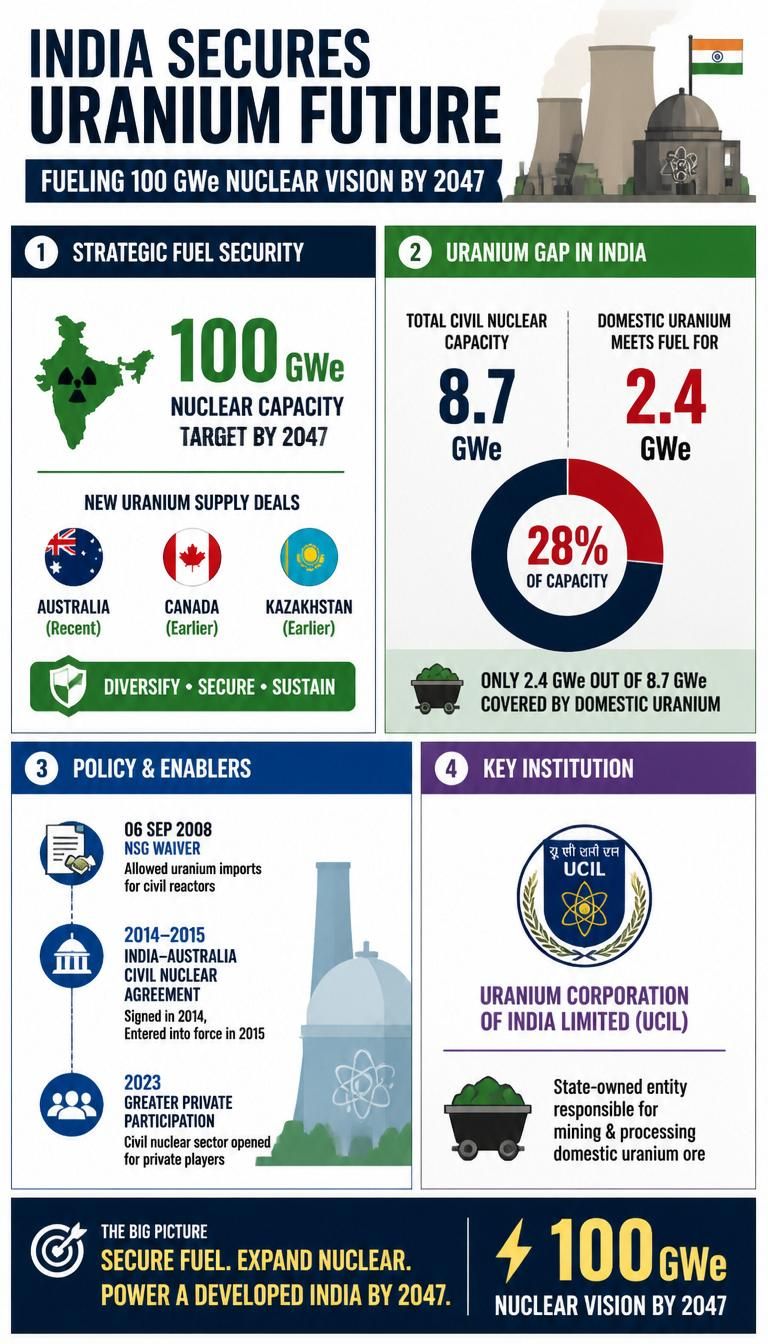
- India recently secured a long-term uranium supply deal with Australia, following similar agreements with Canada and Kazakhstan.
- The country aims to expand its civil nuclear power capacity to 100 gigawatt-electric (GWe) by 2047.
- Domestic uranium reserves currently meet the fuel requirements for only 2.4 GWe out of India's total 8.7 GWe capacity.
- The Nuclear Suppliers Group (NSG) granted India a waiver on September 6, 2008, enabling uranium imports for civil reactors.
- India's civil nuclear sector was opened to greater private participation last year to achieve its ambitious capacity targets.
Uranium Futures.jpg
Detailed Insights:
- The recent deal is the first major outcome of the India-Australia Civil Nuclear Cooperation Agreement, which was signed in 2014 and entered into force in 2015.
- India's strategy involves diversifying and securing fuel supplies for its planned nuclear power expansion.
- Uranium Corporation of India Ltd (UCIL) is the state-owned entity responsible for mining and processing domestic uranium ore.
- India's indigenous Pressurised Heavy Water Reactors (PHWRs) use natural uranium, while Light Water Reactors (LWRs) require entirely imported enriched uranium.
- A committee constituted by the Ministry of Power estimated an annual need for an additional 8,629 tonnes of natural uranium and 1,945 tonnes of enriched uranium by 2047.
- The NSG waiver made India the only non-signatory to the Nuclear Non-Proliferation Treaty (NPT) to have such trading privileges.
- Between 2008-09 and 2024-25, India imported over 18,842 metric tonnes of uranium for International Atomic Energy Agency (IAEA) safeguarded reactors.
- Current uranium imports are primarily from Russia and Uzbekistan, with future supplies expected from Canada and Kazakhstan.
Key Concepts Involved:
- Yellowcake: A concentrated form of uranium oxide, an intermediate product in uranium processing.
- Nuclear Suppliers Group (NSG): A group of nuclear-supplier countries that aims to prevent nuclear proliferation by controlling nuclear exports.
- Nuclear Non-Proliferation Treaty (NPT): An international treaty aimed at preventing the spread of nuclear weapons and promoting peaceful uses of nuclear energy.
- International Atomic Energy Agency (IAEA): An international organization promoting the peaceful use of nuclear energy and verifying safeguards against its misuse.

SuperKalam is your personal mentor for UPSC preparation, guiding you at every step of the exam journey.
Download the App


STUDY RESOURCES
CONTACT US
ⓒ Snapstack Technologies Private Limited