GS 2: GovernanceGS 3: Science & TechnologyGS 3: EconomyPrelims
The materials and methods that made the Vikram-1 launch unique, Pg2
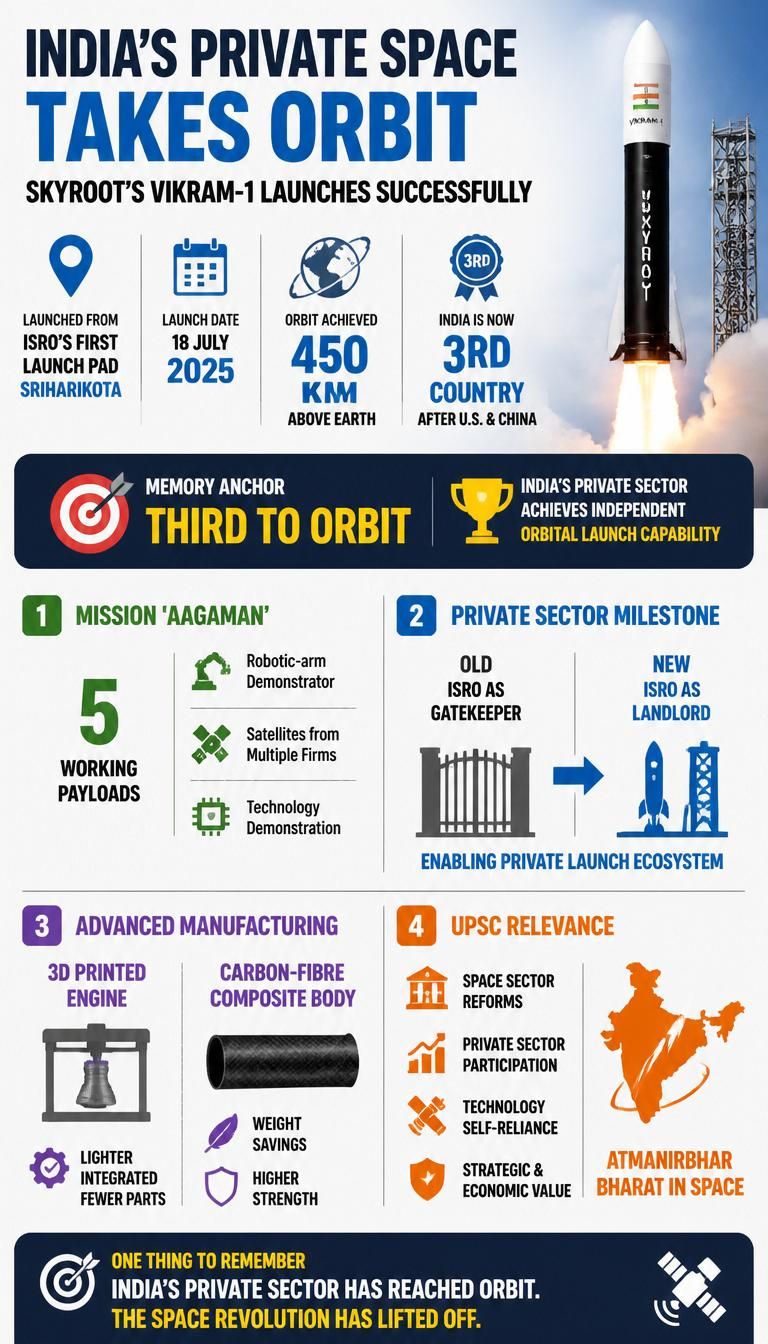
Skyroot's Vikram-1, with 3D-printed engines and carbon-composite body, successfully launches, making India third nation with private orbital launch capability.
Practice MCQs
731 Students attempted
Key Highlights:
- Skyroot Aerospace, a Hyderabad-based firm, successfully launched its Vikram-1 rocket on July 18 from ISRO’s First Launch Pad at Sriharikota.
- The mission, named 'Aagaman', placed its payloads into an orbit approximately 450 km above Earth.
- This achievement makes India the third country, after the U.S. and China, where a private industry can independently achieve orbital launch capability.
- Vikram-1 utilized advanced manufacturing techniques, including 3D printing for its engine and a carbon-fibre composite airframe.
- The rocket carried five working payloads, including a robotic-arm demonstrator and satellites from various firms.
Vikram.jpg
Detailed Insights:
- The successful launch signifies a major milestone for India's private space sector, transitioning ISRO from a gatekeeper to a landlord for launch services.
- 3D printing allows for lighter, more integrated rocket engines with fewer components, reducing manufacturing time and potential failure points.
- The carbon-fibre composite body of Vikram-1 offers significant weight savings and enhanced strength compared to traditional aerospace metals.
- Vikram-1 is a four-stage expendable rocket, similar to PSLV and SSLV, but designed specifically for small satellite launches.
- While ISRO's SSLV has a higher payload capacity (500 kg vs. Vikram-1's 350 kg), Vikram-1's all-carbon airframe is leaner.
- The mission's success, including the 'long coast' phase, is notable as many maiden flights of new rockets often encounter initial setbacks.
- Other private players like AgniKul Cosmos are also advancing, with their Agnibaan SOrTeD vehicle featuring a 3D-printed semi-cryogenic engine.
- The 2020 reforms and the creation of IN-SPACe in 2022 have significantly boosted the growth of Indian space startups, now numbering over 400.
Scientific/Technical Concepts Involved:
- 3D Printing (Additive Manufacturing): A process of creating three-dimensional objects by building layers of material from a digital design.
- Carbon-fibre Composite: A material made of carbon fibers embedded in a polymer resin, known for its high strength-to-weight ratio.
- Orbital Adjustment Module (OAM): A small, restartable liquid-fueled stage used for precise orbital insertion and adjustments of payloads.
- Semi-cryogenic Engine: A rocket engine that uses liquid oxygen as an oxidizer and a refined form of kerosene (RP-1) as fuel, operating at less extreme temperatures than fully cryogenic engines.

SuperKalam is your personal mentor for UPSC preparation, guiding you at every step of the exam journey.
Download the App


STUDY RESOURCES
CONTACT US
ⓒ Snapstack Technologies Private Limited