EthicsGS 3: Science & TechnologyPrelimsGS 4: Ethics and Human InterfaceGS 3: Biotechnology
Rosalind Franklin’s Notes Reveal Secret Behind Iconic DNA Photo, Pg II
New analysis of Rosalind Franklin's notes reveals she understood DNA's helical structure before Watson and Crick, challenging historical narratives of scientific credit.
Practice MCQs
753 Students attempted
Key Highlights:
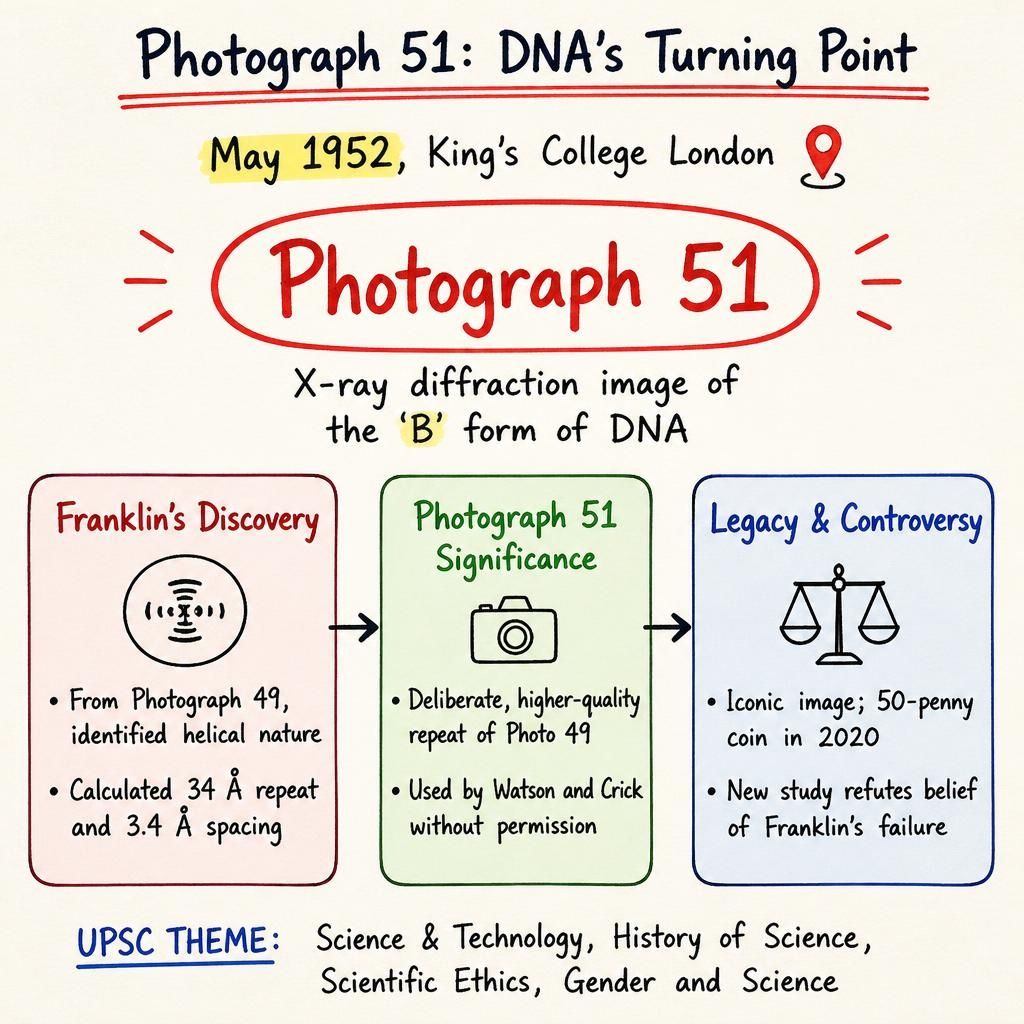
- In May 1952, Rosalind Franklin and her PhD student Raymond Gosling captured Photograph 51, a crucial X-ray diffraction image of the 'B' form of DNA, at King's College London.
- This image was instrumental for James Watson and Francis Crick in their subsequent determination of DNA's double helical structure.
- Recent research published in the Journal of the History of Biology reveals that Franklin had already identified the helical nature of DNA from an earlier image, Photograph 49.
- Photograph 51 was a deliberate, higher-quality repeat of Photograph 49, intended for publication after Franklin had already performed key structural calculations.
- The use of Photograph 51 by Watson and Crick, reportedly without Franklin's explicit knowledge or permission, remains a significant point of historical controversy regarding scientific credit.
DNA's Turning Point.jpg
Detailed Insights:
- Photograph 51 is recognized as one of the most iconic scientific images, even inspiring a British 50-penny coin in 2020.
- Prior to the DNA structure discovery, Erwin Chargaff's rules established that in DNA, the amount of adenine equals thymine, and guanine equals cytosine, providing a vital clue.
- James Watson's 1968 autobiographical book, The Double Helix, presented his controversial account of the discovery, drawing criticism for its disparaging and sexist portrayal of Franklin.
- Franklin was a leading expert in X-ray crystallography, a technique essential for visualizing molecular structures.
- Professional tensions and personality clashes between Franklin and Maurice Wilkins at King's College London complicated their collaborative research environment.
- Franklin was the first to clearly distinguish between the 'A' (drier) and 'B' (wetter) forms of DNA and demonstrated their interconversion by altering humidity.
- From Photograph 49, Franklin calculated crucial parameters for the DNA helix, including a repeating length of 34 angstroms (Å) and a base spacing of 3.4 Å.
- The new study, co-authored by Alistair Sponsel and Brian Sutton, refutes the long-held belief that Franklin failed to interpret the significance of her own X-ray data.
- While Photograph 51 was pivotal, Watson and Crick independently deduced other key aspects of the double helix, such as complementary base pairing and the anti-parallel nature of the DNA strands.
Scientific/Technical Concepts Involved:
- X-ray Crystallography: A technique that uses the diffraction pattern of X-rays passing through a crystal to determine its atomic and molecular structure.
- DNA 'A' and 'B' forms: Two distinct structural conformations of DNA, with the 'B' form being the more hydrated and biologically prevalent form.
- Chargaff's Rules: Principles stating that in DNA, the amount of adenine (A) equals thymine (T), and guanine (G) equals cytosine (C), forming the basis of base pairing.
- Double Helix: The iconic two-stranded, twisted-ladder structure of DNA, which carries genetic instructions in all known living organisms.

SuperKalam is your personal mentor for UPSC preparation, guiding you at every step of the exam journey.
Download the App


STUDY RESOURCES
CONTACT US
ⓒ Snapstack Technologies Private Limited