GS 3: Science & TechnologyGS 3: Environment & EcologyPrelimsGS 3: Conservation, Pollution and DegradationGS 1: Changes in Critical Geographical Features, Water Bodies, Ice Caps, Flora and Fauna
Asian elephants’ social fabric fraying to a ‘tipping point’, Pg II
New study reveals human-induced stress fragments Asian elephant herds, jeopardizing generational knowledge and pushing their social fabric to a critical tipping point.
Practice MCQs
753 Students attempted
Key Highlights:
- A recent study published in Science reveals that Asian elephants are reaching a "tipping point" due to human-induced stress, causing their social fabric to fray.
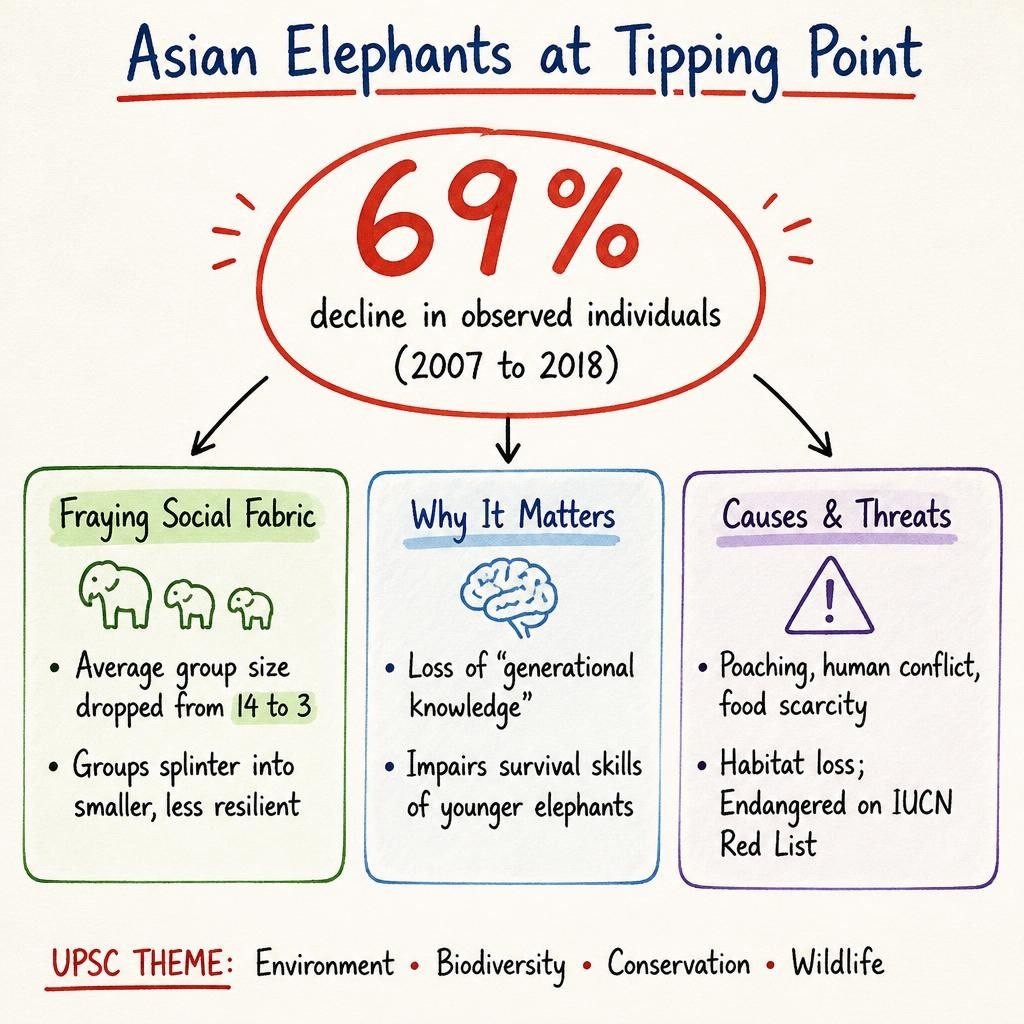
- Unlike African elephants, Asian elephants respond to stress by splintering into smaller, less resilient groups, with average group sizes in Udawalawe National Park, Sri Lanka, dropping from 14 to 3 individuals between 2007 and 2018.
- The study, conducted over a decade on 443 female elephants in Sri Lanka, observed a 69% decline in observed individuals, attributed to deaths and permanent dispersals.
- This fragmentation leads to a significant loss of "generational knowledge," crucial for younger elephants to learn survival skills from older individuals.
- Asian elephants are classified as Endangered on the IUCN Red List, primarily threatened by habitat loss, human-elephant conflict, and poaching.
Asian Elephants.jpg
Detailed Insights:
- The research highlights that when larger elephant herds lose too many members, they fracture into isolated groups, diminishing their ability to cope with adversity.
- The "tipping point" signifies that the number of individual elephants lost now exceeds the number gained, leading to smaller and less connected social communities.
- Causes for population disturbance include poaching, conflict with humans, and food scarcity due to native grass replacement by unpalatable shrubs and invasive species.
- Loss of generational knowledge impairs younger elephants' ability to adapt to changing environments, affecting their familiarity with geographical spaces, food choices, water sources, and danger avoidance.
- Social isolation in captive Asian elephants has been linked to "stereotypies," repetitive abnormal behaviors, as noted in a 2010 study in Tamil Nadu.
- Asian elephants (Elephas maximus) have seen their population decline by at least 50% over the last three generations, with estimates ranging from 30,000 to 50,000 in the wild.
Key Concepts Involved:
- Tipping Point: A critical threshold in a system where a small perturbation can lead to large, often irreversible, changes.
- Generational Knowledge: The accumulated wisdom, skills, and information passed down through successive generations within a social group.
- Stereotypies: Repetitive, invariant behaviors with no obvious goal or function, often observed in animals under stress or in deprived environments.
Previous13/13

SuperKalam is your personal mentor for UPSC preparation, guiding you at every step of the exam journey.
Download the App


STUDY RESOURCES
CONTACT US
ⓒ Snapstack Technologies Private Limited