GS 2: GovernanceGS 2: Social JusticePrelimsGS 2: Government policies and interventions for development in various sectorsGS 2: Education Sector
Delhi Mental Health: 1 Counsellor Per 500 Children, 100 College, Pg4
Delhi government launches ambitious Mental Health Policy, mandating 1 counsellor per 500 school students and 100 college students across all institutions.
Practice MCQs
753 Students attempted
Key Highlights:
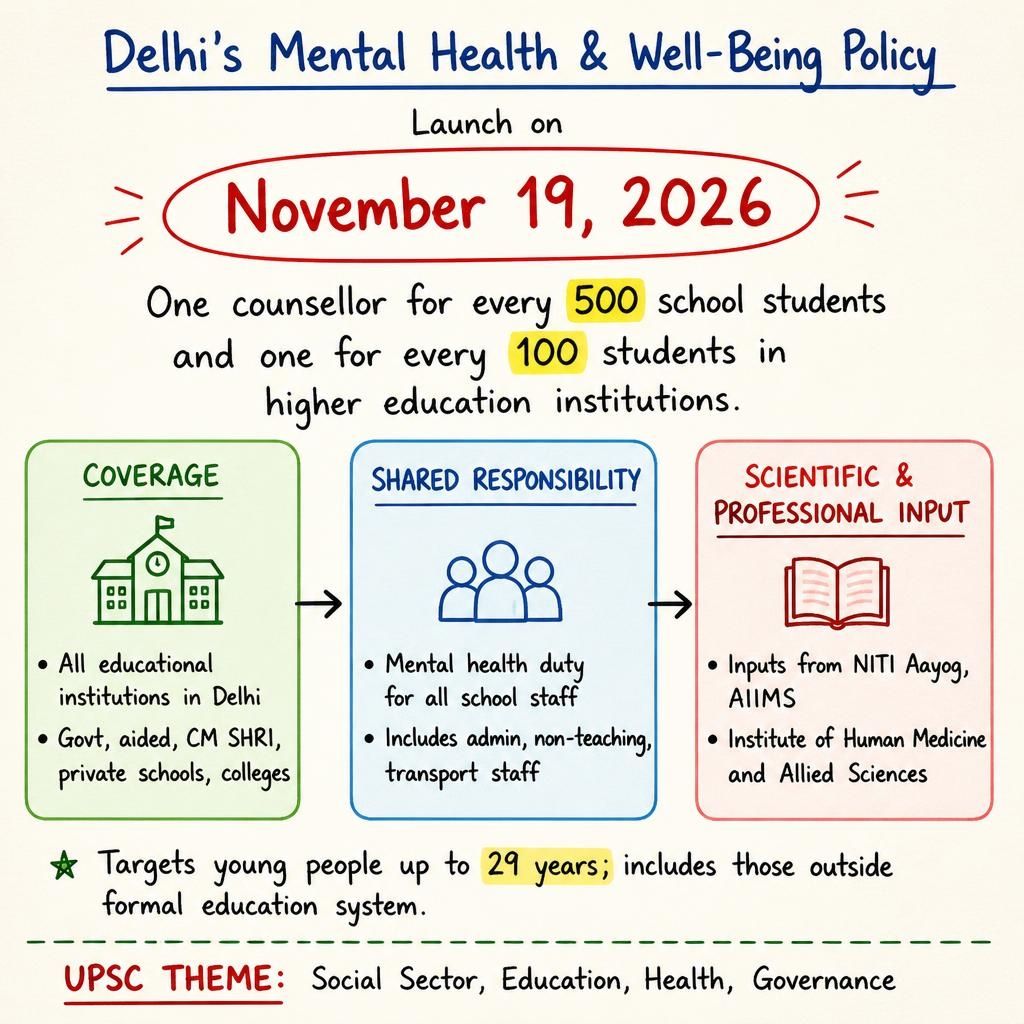
- The Delhi government is set to launch its Mental Health and Well-Being Policy on November 19, 2026.
- The policy proposes appointing one counsellor for every 500 school students and one for every 100 students in higher education institutions.
- It will cover all educational institutions in Delhi, including government, government-aided, CM SHRI schools, private schools, and colleges.
- The policy aims to make mental health support a shared responsibility among all school staff, not solely counsellors.
- Development involved scientific and technical inputs from NITI Aayog, AIIMS, and the Institute of Human Medicine and Allied Sciences.
Mental Health.jpg
Detailed Insights:
- The policy extends mental health responsibility to administrative, non-teaching, and transport staff who regularly interact with children.
- Educational institutions will receive dedicated handbooks with structured questions and activities to identify early signs of emotional distress.
- Implementation includes a multi-stage assessment process to identify students needing support, followed by counselling if required.
- The initiative seeks to proactively integrate mental well-being into the education system, moving beyond crisis-triggered interventions.
- It aims to foster a culture where discussing emotions and seeking help is normalized without stigma.
- The policy also targets young people up to 29 years of age, including those outside the formal education system.
- CM SHRI schools are a Delhi Government initiative launched in 2025-26, designated as specialized public schools aligned with NEP 2020.
Key Concepts Involved:
- Mental Health Policy: A strategic framework outlining government approaches to promote mental well-being and address mental health conditions.
- Psychosocial Support: Providing psychological and social resources to individuals to enhance their coping mechanisms and overall well-being.
- Stakeholder Engagement: Involving all relevant parties, such as teachers, administrative staff, and transport personnel, in policy implementation and responsibility.

SuperKalam is your personal mentor for UPSC preparation, guiding you at every step of the exam journey.
Download the App


STUDY RESOURCES
CONTACT US
ⓒ Snapstack Technologies Private Limited