GS 2: GovernanceGS 2: Social JusticePrelimsGS 2: Government policies and interventions for development in various sectorsGS 2: Education Sector
11 states, UTs are ‘fully literate’, MP leads in adult learners, Pg9
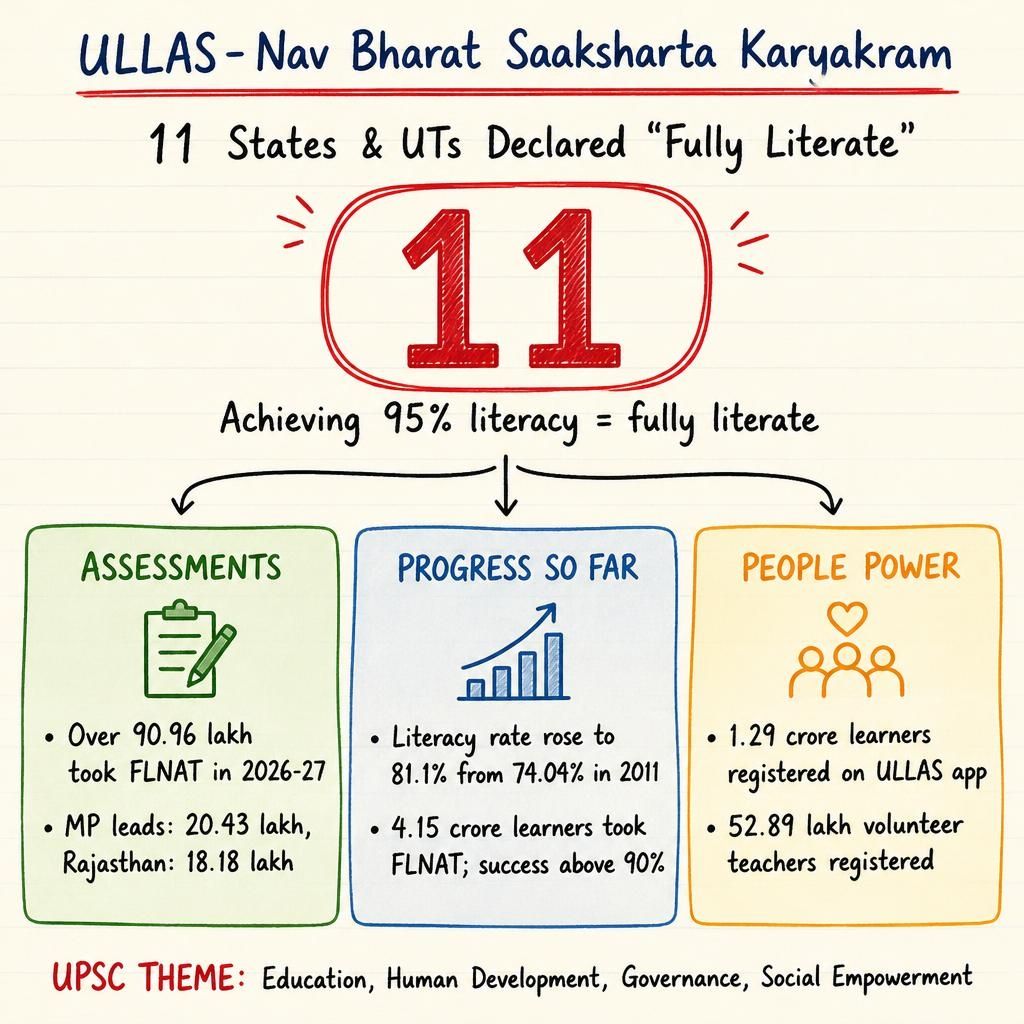
11 states and UTs achieve 'fully literate' status under ULLAS scheme, boosting India's literacy to 81.1%; Madhya Pradesh leads adult learners.
Practice MCQs
753 Students attempted
Key Highlights:
- Eleven states and Union Territories (UTs) have declared themselves "fully literate" under the Centre's ULLAS–Nav Bharat Saaksharta Karyakram.
- These include Ladakh, Mizoram, Goa, Tripura, Himachal Pradesh, Chandigarh, Andaman and Nicobar Islands, Sikkim, Uttarakhand, Jammu and Kashmir, and Lakshadweep.
- Achieving 95% literacy in a state or UT is considered equivalent to being fully literate.
- Over 90.96 lakh learners aged 15 and above have taken the Foundational Literacy and Numeracy Assessment Test (FLNAT) in the current academic year (2026-27).
- Madhya Pradesh leads with 20.43 lakh adult learners, followed by Rajasthan (18.18 lakh) and Odisha (12 lakh).
- India's literacy rate has risen to 81.1% from 74.04% in 2011.
ULLAS.jpg
Detailed Insights:
- The ULLAS–Nav Bharat Saaksharta Karyakram has been implemented by the Department of School Education and Literacy since 2022-23.
- The scheme targets non-literate persons aged 15 and above, aligning with the National Education Policy (NEP) 2020.
- It is implemented in a hybrid mode, leveraging volunteerism, online platforms, higher education institutions, and community engagement.
- The program comprises five key components: foundational literacy and numeracy, critical life skills, basic education, vocational skills, and continuing education.
- The FLNAT is conducted twice a year to evaluate learners' reading, writing, and numeracy skills, with successful candidates certified by the National Institute of Open Schooling.
- A total of 4.15 crore learners across 34 states and UTs have taken the FLNAT, achieving a success rate above 90%.
- More than 1.29 crore learners and 52.89 lakh volunteer teachers are registered on the ULLAS mobile application.
Key Concepts Involved:
- ULLAS–Nav Bharat Saaksharta Karyakram: A central government scheme for adult education aimed at promoting foundational literacy and numeracy among non-literate individuals aged 15 and above.
- Foundational Literacy and Numeracy Assessment Test (FLNAT): An evaluation mechanism under the ULLAS scheme to assess and certify adult learners' basic reading, writing, and arithmetic skills.
- National Education Policy (NEP) 2020: A comprehensive framework introduced by the Government of India to guide the development of education in the country, emphasizing lifelong learning and skill development.

SuperKalam is your personal mentor for UPSC preparation, guiding you at every step of the exam journey.
Download the App


STUDY RESOURCES
CONTACT US
ⓒ Snapstack Technologies Private Limited