GS 2: GovernanceGS 1: Indian SocietyGS 3: Disaster ManagementPrelimsGS 3: Disaster and Disaster Management
How stampedes happen, how they can be prevented, Pg13
Kolkata Durga Puja stampede highlights critical need for effective crowd management, with NDMA outlining key prevention strategies for large gatherings.
Practice MCQs
746 Students attempted
Key Highlights:
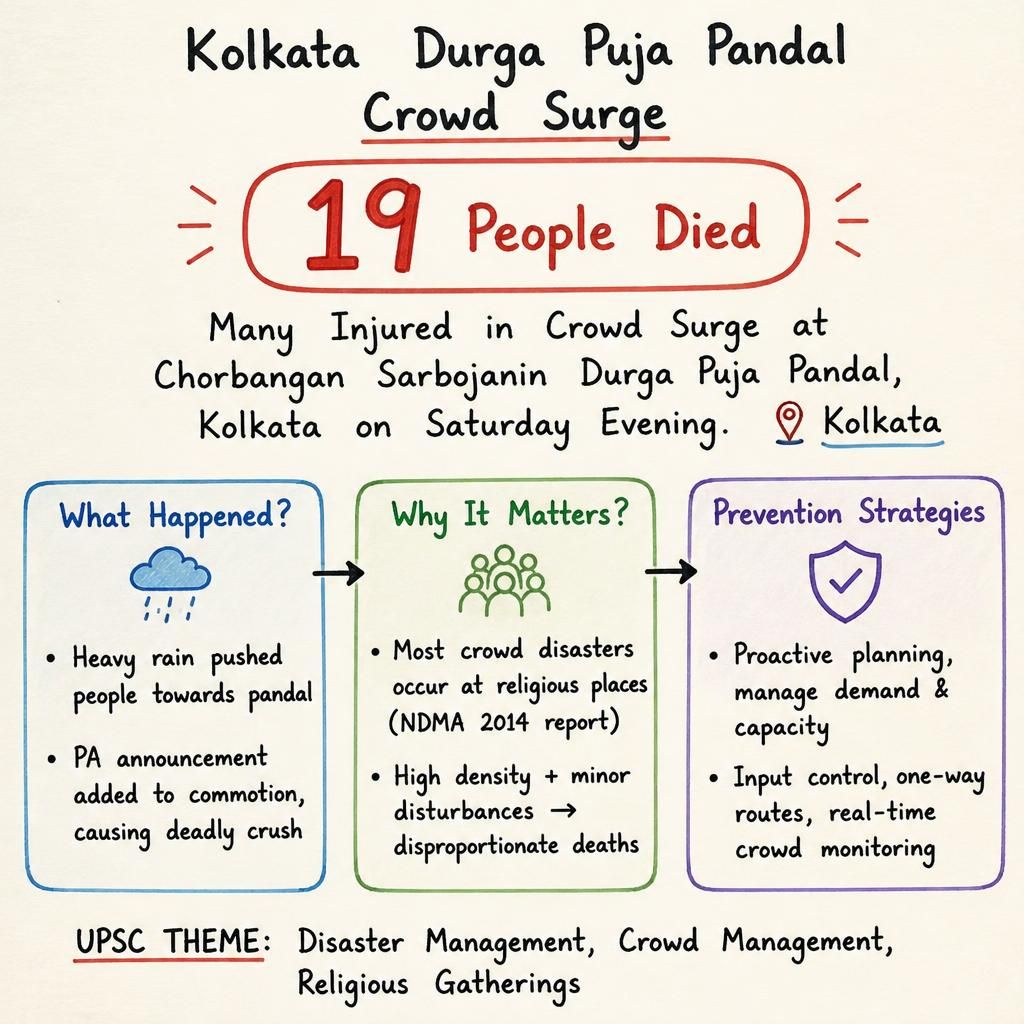
- At least 19 people died and many were injured in a crowd surge at a Durga Puja pandal in Kolkata on Saturday evening.
- The incident occurred at the Chorbangan Sarbojanin Durga Puja pandal amidst heavy rain and a large gathering.
- Preliminary reports suggest rain pushed people towards the pandal, and a public-address system announcement added to the commotion, leading to a deadly crush.
- The National Disaster Management Authority (NDMA) 2014 report highlights that most crowd disasters in India occur at religious places.
Crowd Control.jpg
Detailed Insights:
- What is commonly termed a "stampede" is often a crowd crush, where high density prevents individuals from controlling their movement.
- Causes include structural issues like weak barricades, narrow exits, and poor lighting, as well as failures in crowd management.
- NDMA identifies inadequate crowd control, exceeding venue capacity, and insufficient holding areas as key problems.
- High crowd density makes even minor disturbances, like someone falling or sudden rain, lead to disproportionate consequences.
- Compressive asphyxia, where pressure around the chest prevents breathing, is historically the most common cause of death in such disasters.
- Crowd behavior is influenced by others, and poorly worded announcements can cause simultaneous, dangerous movements.
- Inappropriate crowd-control measures, such as police pushing against an incoming stream, can worsen emergencies.
- Past incidents like the 2003 Nashik Kumbh (29 deaths) and 2005 Kalubai Yatra (293 deaths) show multiple weaknesses combining to cause disasters.
- NDMA advocates proactive planning, managing demand and capacity, and regulating entry and movement to prevent such events.
- Strategies include input control (restricting entry), one-way routes, separate entrances/exits, and real-time crowd monitoring.
Key Concepts Involved:
- Crowd Crush: A situation where high human density leads to individuals losing control over their movement, often resulting in injury or death.
- Compressive Asphyxia: A cause of death in crowd disasters where external pressure on the chest prevents breathing.
- Input Control: A crowd management strategy involving restricting or staggering entry to a venue to prevent overcrowding.
- National Disaster Management Authority (NDMA): The apex body in India responsible for formulating disaster management policies.

SuperKalam is your personal mentor for UPSC preparation, guiding you at every step of the exam journey.
Download the App


STUDY RESOURCES
CONTACT US
ⓒ Snapstack Technologies Private Limited