GS 3: Science & TechnologyGS 2: International RelationsPrelimsGS 2: Important International Institutions, Agencies and ForaGS 3: Space Technology
A journey to Phobos: Japan's mission to uncover origins of Mars' mysterious moons, Pg12
Japan's MMX mission launches to Phobos, Mars' moon, for first-ever sample return, aiming to uncover origins of Martian moons and solar system life.
Practice MCQs
746 Students attempted
Key Highlights:
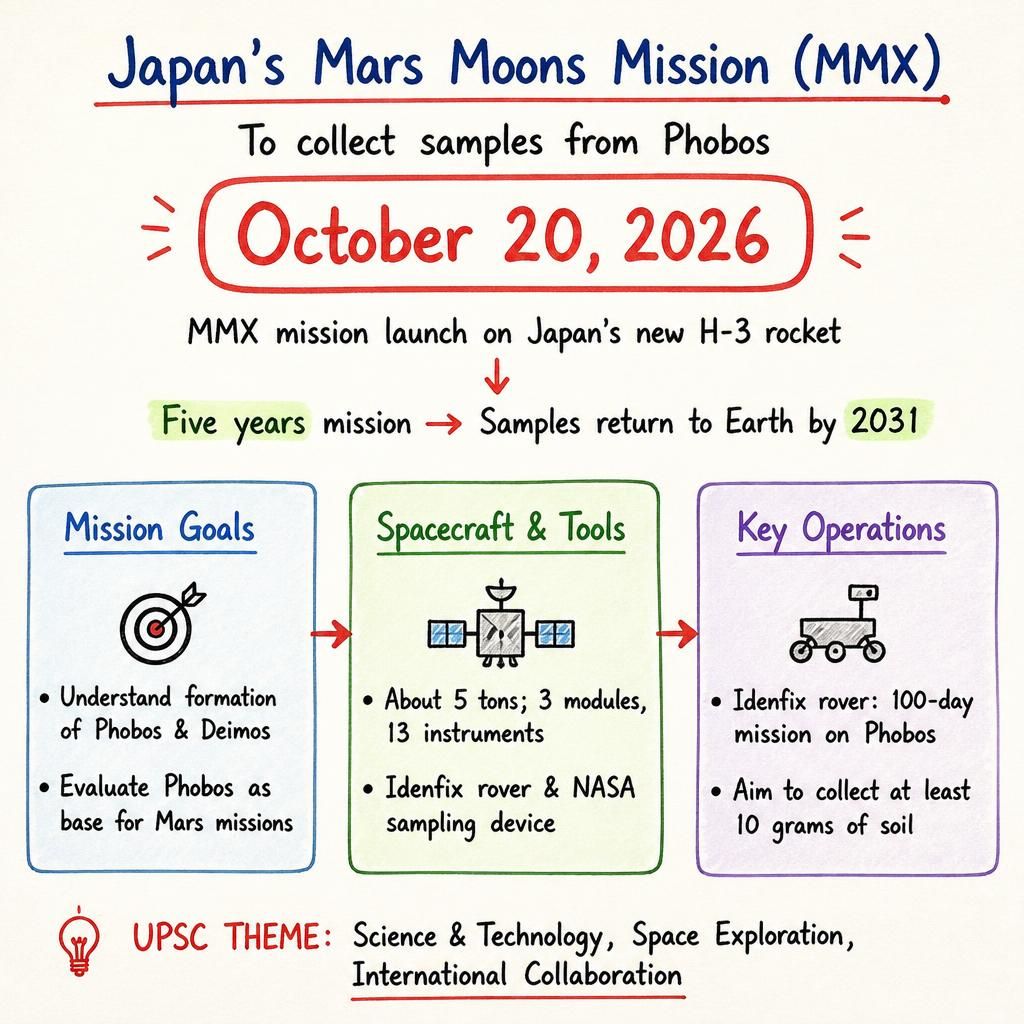
- Japan is set to launch the Mars Moons eXploration (MMX) mission on October 20, 2026, to collect samples from Phobos, one of Mars's moons.
- The mission aims to uncover the formation of Phobos and Deimos, potentially shedding light on the origins of life in the solar system.
- The spacecraft will be launched on Japan's new H-3 rocket and is expected to take five years, with samples returning to Earth by 2031.
- The MMX mission is an international collaboration, including equipment and communication support from NASA and ESA.
Phobos Mission.jpg
Detailed Insights:
- The MMX mission seeks to understand if Phobos and Deimos are remnants of a celestial object impact on Mars or captured asteroids.
- Samples from Phobos are crucial for evaluating the moon's potential as a base for future manned missions to Mars.
- Phobos, approximately 20-30 kilometers in diameter, orbits Mars at about 6,000 kilometers, completing three orbits daily.
- The mission includes a flyby of Deimos to gather observations, as both moons are believed to have similar origins.
- The spacecraft, weighing about 5 tons, comprises three modules for propulsion, exploration, and sample return.
- It carries 13 instruments, including a French-German rover named Idenfix and a NASA sampling device.
- The Idenfix rover will land on Phobos first for a 100-day mission to explore the surface before the main sampling attempts.
- JAXA aims to collect at least 10 grams of soil from Phobos using both U.S. and Japanese sampling methods.
- Previous attempts by Russia to land on Phobos, including one in 2011, have been unsuccessful.
Scientific/Technical Concepts Involved:
- MMX Mission: Japan's Mars Moons eXploration mission, designed to collect samples from Phobos and study Deimos.
- Phobos: The larger and inner of Mars's two natural satellites, characterized by an irregular, potato-like shape.
- Deimos: The smaller and outer of Mars's two natural satellites, also irregularly shaped and believed to have a similar origin to Phobos.
- H-3 rocket: Japan's new flagship launch vehicle, developed by JAXA and Mitsubishi Heavy Industries, designed for various satellite launches.

SuperKalam is your personal mentor for UPSC preparation, guiding you at every step of the exam journey.
Download the App


STUDY RESOURCES
CONTACT US
ⓒ Snapstack Technologies Private Limited