EthicsGS 3: Science & TechnologyGS 3: Environment & EcologyPrelimsGS 3: Conservation, Pollution and Degradation
Deep-sea discovery, environmental responsibility, Pg8
India's deep-sea exploration raises critical questions about environmental responsibility and the ethical dilemma of exploiting poorly understood ocean ecosystems for mineral wealth.
Practice MCQs
739 Students attempted
Key Highlights:
- India holds three International Seabed Authority (ISA) exploration contracts covering approximately 95,000 sq km in the Central Indian Ocean Basin, Central Indian Ridge, and Carlsberg Ridge.
- These exploration areas contain an estimated 366 million tonnes of polymetallic nodules, rich in metals like nickel, copper, cobalt, and manganese.
- Under the Deep Ocean Mission, India is developing advanced deep-sea mining technology, underwater robotics, and the MATSYA-6000 human submersible.
- The National Institute of Ocean Technology (NIOT) has successfully tested a deep-sea mining machine at depths of about 5,270 meters.
- India's deep-sea biodiversity surveys have identified around 1,300 deep-sea organisms, including nearly 23 species new to science.
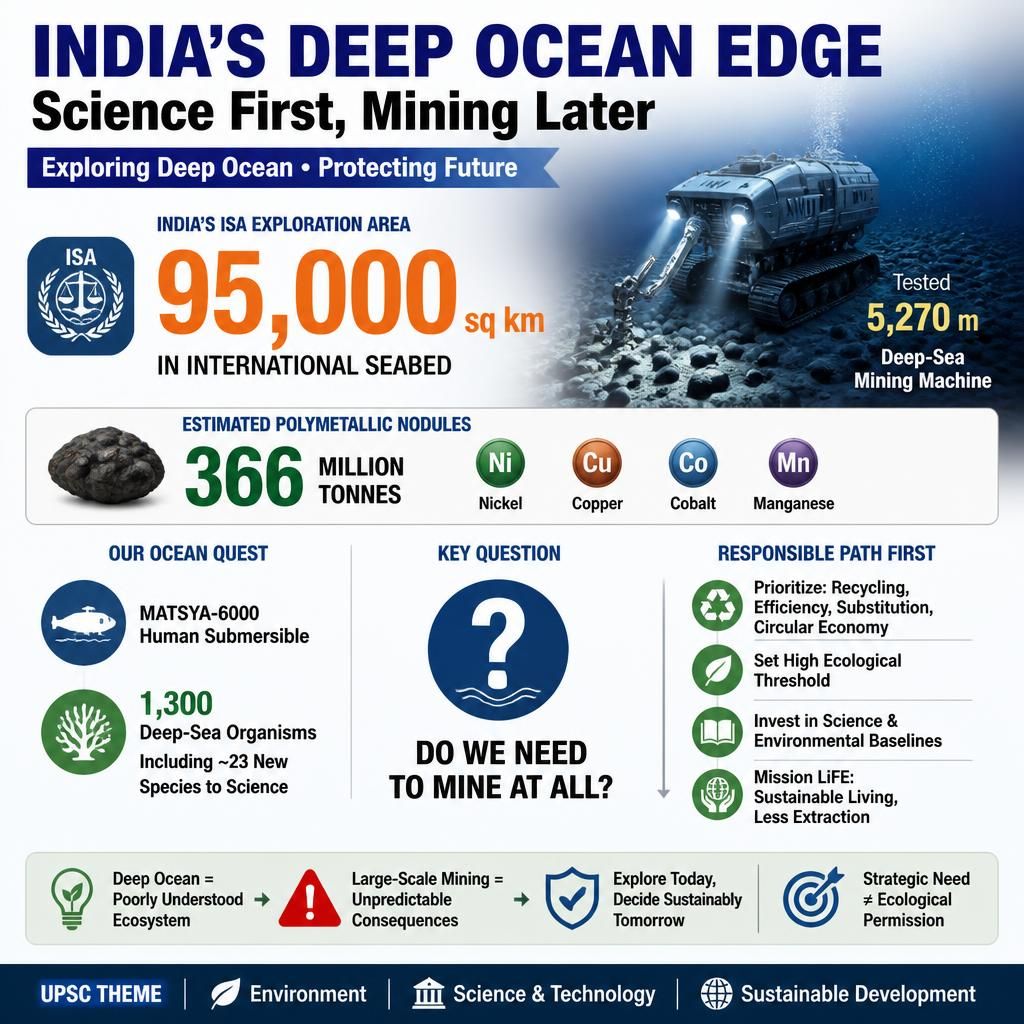
Deep Sea Ocean Mission.jpg
Detailed Insights:
- The article questions whether technological capability for deep-sea exploitation should automatically lead to its implementation.
- The deep ocean is a poorly understood ecosystem, making the consequences of large-scale seabed disturbance unpredictable.
- India's investment in deep-ocean science can focus on knowledge and environmental baselines without committing to commercial mining.
- The current exploration phase allows India to set a high ecological threshold for any future decision on deep-sea exploitation.
- The core question should be "Do we need to mine at all?" rather than "How can we mine with minimum damage?".
- Strategic importance for renewable energy should not automatically justify ecological permission for deep-sea mining.
- India should prioritize alternatives like recycling, efficiency, substitution, and a circular economy before extraction.
- Mission LiFE aligns with reducing dependence on extraction through promoting sustainable consumption and resource efficiency.
- India can lead in deep-sea ecological governance by recognizing the ocean as a precious ecological asset, not just a mineral reserve.
- Sustainable development requires preserving natural capital and reducing resource consumption, as highlighted by Sustainable Development Goals (SDGs) and Nature-based Solutions.
Key Concepts Involved:
- International Seabed Authority (ISA): An intergovernmental body regulating mineral-related activities in the international seabed area.
- Polymetallic Nodules: Mineral concretions on the deep seabed, rich in metals like manganese, nickel, copper, and cobalt.
- Deep Ocean Mission: India's initiative for deep-sea exploration, resource assessment, and technology development for ocean sustainability.
- Mission LiFE: India's global initiative promoting an environmentally conscious lifestyle, focusing on mindful and sustainable consumption.

SuperKalam is your personal mentor for UPSC preparation, guiding you at every step of the exam journey.
Download the App


STUDY RESOURCES
CONTACT US
ⓒ Snapstack Technologies Private Limited