GS 2: GovernancePrelimsGS2: Government policies and interventions for development in various sectorsGS2: Important Aspects of Governance, Transparency and AccountabilityGS4: Accountability and Ethical Governance
PM CARES donations have dropped, and utilisation is abysmal, Pg7
PM-CARES Fund faces scrutiny as donations drop and utilization remains abysmal, raising transparency concerns over delayed financial statements and unexplained refunds.
Practice MCQs
731 Students attempted
Key Highlights:
- The PM-CARES Fund released its audited financial statements for the financial years 2023-24 and 2024-25 after a two-year delay.
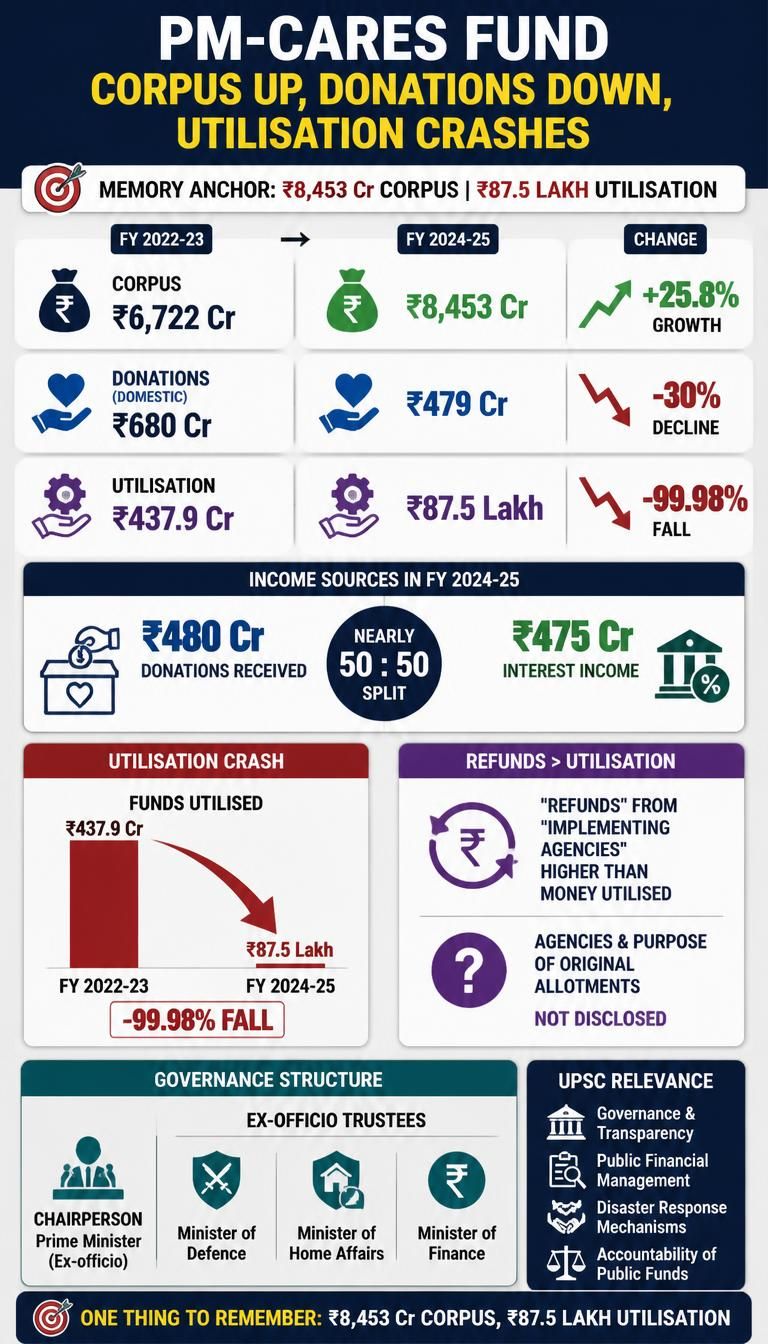
- The fund's corpus grew by 25.8% to ₹8,453 crore by March 31, 2025.
- Donations to the fund saw a significant drop, with domestic donations falling by 30% to ₹479 crore in FY 2024-25.
- The utilization of available funds was exceptionally low, amounting to just ₹87.5 lakh in FY 2024-25.
- The growth in the corpus was primarily driven by interest earnings, which were almost equal to donations in FY 2024-25.
PMCARES Fund.jpg
Detailed Insights:
- The PM-CARES Fund was established on March 27, 2020, as a public charitable trust to address emergency and distress situations, particularly the COVID-19 pandemic.
- The corpus increased from ₹6,722 crore in 2022-23 to ₹8,453 crore in 2024-25, while utilization dropped from ₹437.9 crore to ₹87.5 lakh in the same period.
- In FY 2024-25, the income received through interest payments was ₹475 crore, nearly matching the ₹480 crore received through donations.
- The sharp increase in interest income is attributed to the fund moving its corpus from savings accounts to fixed deposits in 2023-24.
- The statements indicated that "refunds" from "implementing agencies" were higher than the money utilized, with no public disclosure of these agencies or the purpose of the original allotments.
- The fund is chaired by the Prime Minister as ex-officio Chairperson, with the Ministers of Defence, Home Affairs, and Finance serving as ex-officio trustees.
- Despite its public nature, the PM-CARES Fund is not subject to audit by the Comptroller and Auditor General (CAG) and remains outside the purview of the Right to Information (RTI) Act.
Key Concepts Involved:
- PM-CARES Fund: A public charitable trust created in March 2020 to provide relief and assistance during emergencies and public health crises.
- Public Charitable Trust: A legal entity formed for charitable purposes, often benefiting from tax exemptions, and governed by specific trust laws.
- Right to Information (RTI) Act: A 2005 Indian law that empowers citizens to access information from public authorities, promoting transparency and accountability.
- Comptroller and Auditor General (CAG): India's supreme audit institution responsible for auditing all government receipts and expenditures at both Union and State levels.

SuperKalam is your personal mentor for UPSC preparation, guiding you at every step of the exam journey.
Download the App


STUDY RESOURCES
CONTACT US
ⓒ Snapstack Technologies Private Limited