Education Must Change to Account for AI, Pg7
AI's rapid transformation of work demands fundamental education reform, emphasizing adaptive learning and practical experience to prepare students for an unpredictable future.
Practice MCQs
731 Students attempted
Key Highlights:
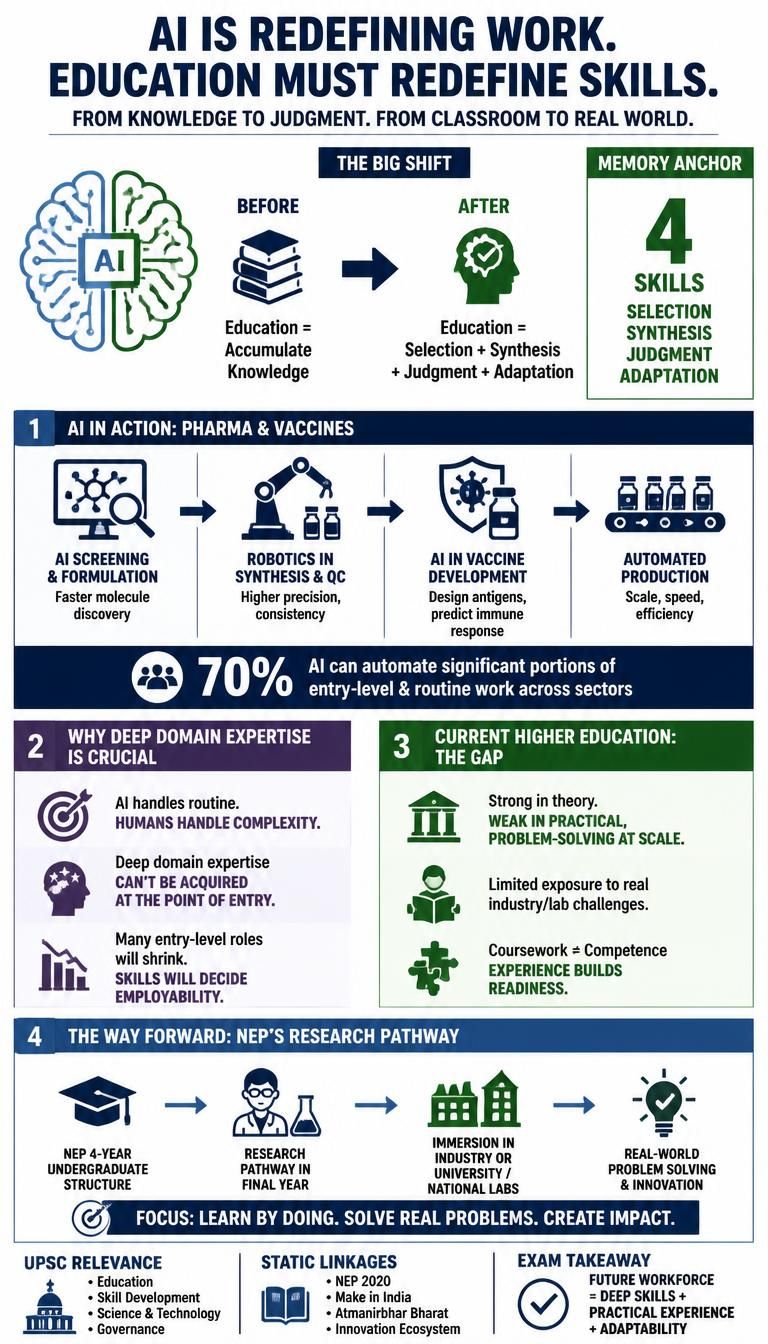
- Artificial Intelligence (AI) is rapidly transforming the nature of work across all sectors, including manufacturing, generic drugs, biosimilars, and vaccine development.
- Traditional education models, which emphasize accumulating knowledge, are becoming obsolete as AI systems advance.
- Education must shift its focus to developing skills in selection, synthesis, judgment, and adaptation to prepare students for an unpredictable future.
- The National Education Policy's four-year undergraduate structure, particularly its research pathway, is identified as a potential model for fostering practical learning.
- The article advocates for students to gain practical experience through immersion in industry or university/national laboratories, rather than solely through coursework.
AI in Education.jpg
Detailed Insights:
- AI's impact extends beyond routine coding, making even important work routine and potentially reducing the need for many entry-level positions.
- In the pharmaceutical sector, AI is revolutionizing molecule screening and formulation, while robotics enhances synthesis and quality control.
- Vaccine development benefits from AI in designing antigens and predicting immune responses, alongside automated production lines for efficiency.
- The evolving job market necessitates that employees possess deep domain expertise, which cannot be acquired solely at the point of entry into the workforce.
- The current higher education system, despite its strengths, struggles to provide the necessary practical, problem-solving experience at scale.
- The National Education Policy envisions a research pathway in the final year of undergraduate studies, which could facilitate real-world problem-solving.
- Universities should prioritize practical immersion by allowing essential coursework to be completed online, freeing students for industry or lab placements.
Key Concepts Involved:
- Artificial Intelligence (AI): The simulation of human intelligence processes by machines, especially computer systems, for tasks like learning and problem-solving.
- National Education Policy (NEP): A comprehensive framework guiding the development of education in India, aiming for holistic, multidisciplinary, and skill-based learning.
- Biosimilars: Biological products highly similar to an already approved biological product, with no clinically meaningful differences in terms of safety and effectiveness.
- Domain Expertise: Deep, specialized knowledge and skills within a particular field or area of study, crucial for complex problem-solving.

SuperKalam is your personal mentor for UPSC preparation, guiding you at every step of the exam journey.
Download the App


STUDY RESOURCES
CONTACT US
ⓒ Snapstack Technologies Private Limited