GS 2: International RelationsGS 3: Environment & EcologyGS 3: EconomyPrelimsGS2: Bilateral, Regional and Global Groupings and Agreements
BRICS calls EU’s carbon tax ‘punitive, unilateral’, Pg12
BRICS nations strongly oppose EU's Carbon Border Adjustment Mechanism (CBAM) as punitive, demanding increased adaptation finance for developing countries.
Practice MCQs
731 Students attempted
Key Highlights:
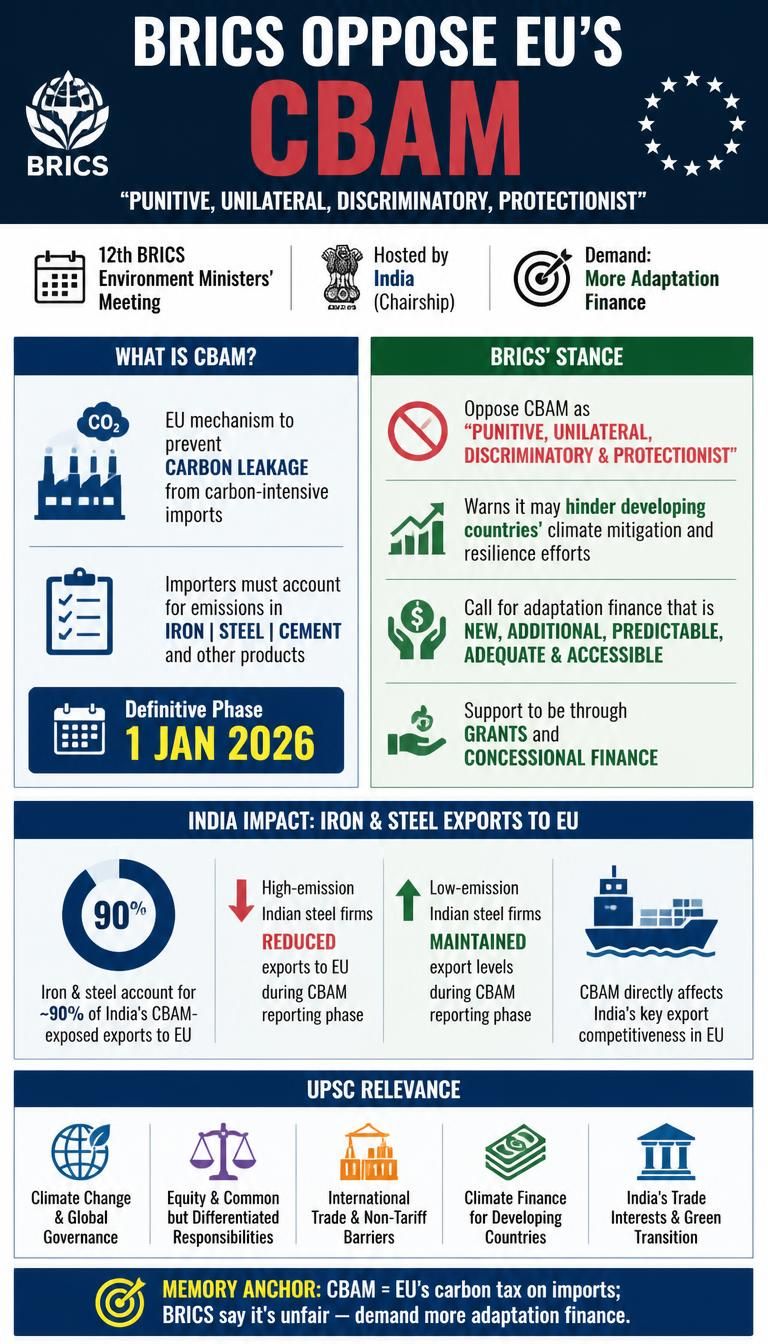
- BRICS countries collectively opposed the European Union’s Carbon Border Adjustment Mechanism (CBAM), labeling it "punitive, unilateral, discriminatory, and protectionist".
- This stance was articulated in a joint statement from the 12th BRICS Environment Ministers’ Meeting held in New Delhi under India's chairship.
- CBAM officially entered its definitive phase on January 1, 2026, requiring importers of carbon-intensive products like iron, steel, and cement to account for associated emissions.
- BRICS nations also called for a significant increase in international adaptation finance from developed countries for developing nations.
BRICS CBAM.jpg
Detailed Insights:
- The BRICS statement highlighted concerns that measures like CBAM could hinder developing countries' efforts in climate change mitigation and building resilience.
- CBAM is designed by the EU to prevent "carbon leakage," which is the relocation of carbon-intensive production to regions with less stringent climate policies.
- India is particularly exposed to CBAM, with iron and steel exports accounting for approximately 90% of its affected trade with the EU.
- Analysis indicates that high-emission Indian steel firms reduced exports to the EU during the CBAM reporting phase, while lower-emission firms maintained their levels.
- The call for increased adaptation finance specifies that support should be "new, additional, predictable, adequate, and accessible," provided through grants and concessional finance.
- Ministers urged developed countries to fulfill the commitment made at the 2025 UN climate conference (COP30) to triple adaptation finance for developing countries by 2035.
Key Concepts Involved:
- Carbon Border Adjustment Mechanism (CBAM): An EU policy that imposes a carbon price on imported goods to ensure that the carbon cost of production is equivalent to that within the EU.
- Carbon Leakage: The phenomenon where companies move carbon-intensive production to countries with weaker emission regulations to avoid domestic carbon costs.
- Adaptation Finance: Financial resources provided to help countries and communities adjust to the adverse impacts of climate change, such as through infrastructure and water security projects.
- BRICS: An intergovernmental organization comprising Brazil, Russia, India, China, South Africa, Egypt, Ethiopia, Iran, Saudi Arabia, United Arab Emirates, and Indonesia, aiming to enhance cooperation among emerging economies.
Previous9/9

SuperKalam is your personal mentor for UPSC preparation, guiding you at every step of the exam journey.
Download the App


STUDY RESOURCES
CONTACT US
ⓒ Snapstack Technologies Private Limited