GS 2: PolityGS 2: GovernanceGS 1: Modern HistoryPrelimsGS1: Modern History Significant Events, Personalities and Issues
A secular republic’s sacrilege problem: the legal price of criticising holy writ in India, Pg9
Punjab's stringent sacrilege law, imposing life imprisonment for religious criticism, sparks debate on India's secularism, free speech, and colonial legal legacy.
Practice MCQs
731 Students attempted
Key Highlights:
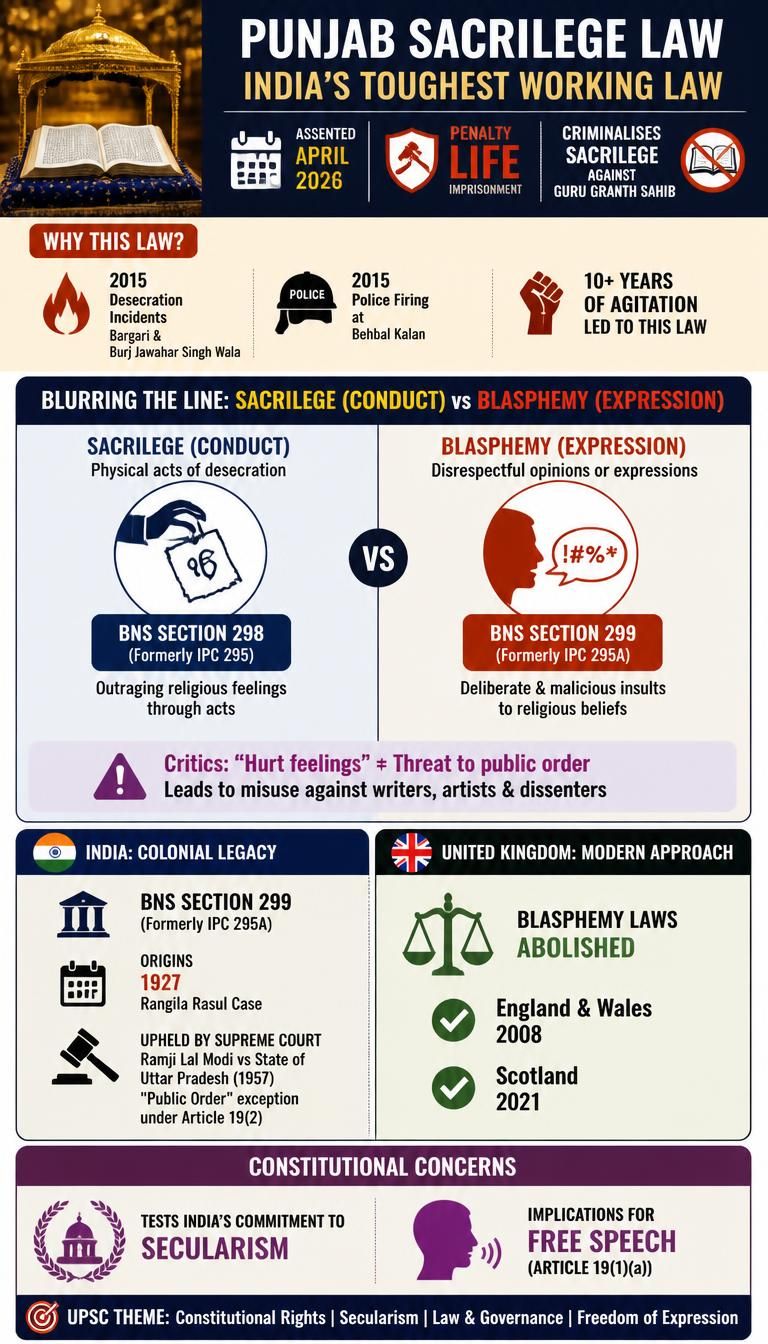
- In April 2026, the Governor of Punjab assented to the Jaagat Jot Sri Guru Granth Sahib Satkar (Amendment) Act.
- This Act criminalizes sacrilege against the Guru Granth Sahib with penalties including life imprisonment.
- The law emerged following a decade of agitation after desecration incidents in 2015 at Bargari and Burj Jawahar Singh Wala, and police firing at Behbal Kalan.
- It is considered India’s most severe working sacrilege law, punishing physical desecration of a sacred text with life imprisonment.
- The law raises concerns regarding India's constitutional commitment to secularism and the fundamental right to free speech.
Sacrilege Law.jpg
Detailed Insights:
- The new Punjab law blurs the distinction between sacrilege (conduct) and blasphemy (expression) by criminalizing both physical acts and disrespectful opinions.
- Indian law traditionally distinguishes between sacrilege-type offenses under Bharatiya Nyaya Sanhita (BNS) Section 298 (formerly Indian Penal Code (IPC) Section 295) and blasphemy-type offenses under BNS Section 299 (formerly IPC Section 295A).
- BNS Section 299, which prohibits deliberate and malicious insults to religious beliefs, has colonial origins, stemming from the 1927 Rangila Rasul case.
- The Supreme Court in Ramji Lal Modi vs State of Uttar Pradesh (1957) upheld the constitutionality of Section 295A, citing the "public order" exception under Article 19(2).
- Critics argue that equating "hurt feelings" with a threat to public order has led to the misuse of these laws against writers and artists.
- In contrast, the United Kingdom, from which India inherited these laws, abolished common law blasphemy offenses in England and Wales in 2008 and in Scotland in 2021.
Key Concepts Involved:
- Secularism: A fundamental principle of the Indian Constitution, part of its Basic Structure Doctrine, implying state neutrality towards all religions.
- Freedom of Speech and Expression: Guaranteed by Article 19(1)(a) of the Constitution, subject to reasonable restrictions under Article 19(2), including public order.
- Blasphemy: An expressive wrong involving contemptuous or irreverent speech, writing, or imagery about religious figures or beliefs.
- Sacrilege: A conduct-based wrong involving the violation or defilement of something considered sacred, such as a place of worship or a holy object.

SuperKalam is your personal mentor for UPSC preparation, guiding you at every step of the exam journey.
Download the App


STUDY RESOURCES
CONTACT US
ⓒ Snapstack Technologies Private Limited