GS 1: Art & CulturePrelims
Stone Age to Sangam era, Tenkasi settlement thrived across millennia, Pg10
Tenkasi excavation unearths continuous Stone Age to Sangam era settlement, revealing ancient Tamil society's industrial prowess and sophisticated water management.
Practice MCQs
724 Students attempted
Key Highlights:
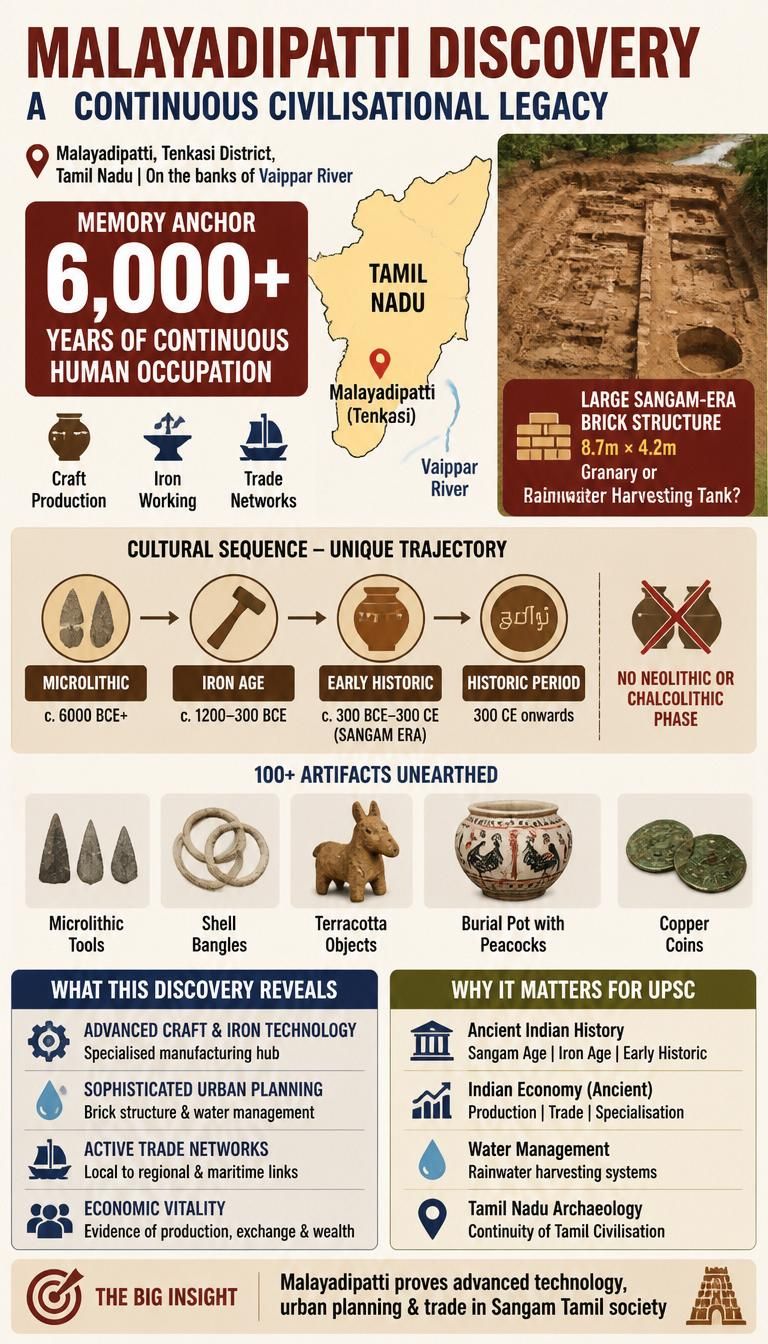
- An archaeological excavation at Malayadipatti near Karivalamvanthanallur in Tamil Nadu's Tenkasi district has revealed a settlement with continuous human occupation from the Microlithic period to the Sangam era.
- The site on the banks of the Vaippar river shows evidence of advanced craft production, iron-working, and trade networks.
- Significant finds include a large Sangam-era brick structure, possibly a granary or rainwater harvesting tank, and a burial pot decorated with painted peacocks.
- The excavation, conducted by the Tamil Nadu State Department of Archaeology (TNSDA), has unearthed over 100 artifacts, including microlithic tools, shell bangles, terracotta items, and copper coins.
- This discovery suggests the settlement was a specialized manufacturing hub, contributing to the understanding of ancient Tamil society's technological sophistication and economic vitality.
Sangam.jpg
Detailed Insights:
- The site's unique cultural sequence shows continuous occupation from the Microlithic period through the Iron Age and into the Early Historic and historic periods, notably bypassing the Neolithic or Chalcolithic phases.
- This trajectory mirrors findings at other significant sites in Tamil Nadu such as Mangudi, Sivagalai, and Adichanallur.
- The large brick structure, measuring 8.7m by 4.2m, with bricks similar to those found at Keeladi, Alagankulam, and Poompuhar, indicates sophisticated urban planning and water management.
- The red-slipped burial pot with painted peacocks resonates with ancient Tamil literature like Akananuru, which mentions decorating memorial stones with peacock feathers.
- Artifacts like hematite for iron extraction, iron implements, glass beads, terracotta figurines, graffiti-marked pottery, and black-and-red ware highlight diverse economic activities.
- The evidence points to organized workshops for iron tool-making, bead manufacturing, shell bangle production, and weaving during the Sangam period.
- The findings further strengthen the growing body of archaeological evidence from Tamil Nadu, alongside sites like Keeladi and Sivagalai, which have pushed back the antiquity of the Sangam era and early iron technology.
Key Concepts Involved:
- Microlithic Period: An archaeological period characterized by the production and use of small, geometric stone tools, typically associated with the Mesolithic Age.
- Sangam Era: A period in the history of ancient Tamilakam (South India) spanning roughly from 300 BCE to 300 CE, known for its rich literature and urban centers.
- Iron Age: A prehistoric period characterized by the widespread use of iron for tools and weapons, succeeding the Bronze Age.
- Black-and-red ware: A distinctive type of pottery with a black interior and rim, and a red exterior, produced by a specific firing technique and found across various ancient Indian cultures.
- Akananuru: A classical Tamil poetic work, part of the Sangam literature, comprising 400 poems on Akam (inner life, love).

SuperKalam is your personal mentor for UPSC preparation, guiding you at every step of the exam journey.
Download the App


STUDY RESOURCES
CONTACT US
ⓒ Snapstack Technologies Private Limited