GS 3: EconomyPrelims
India's 3 inflations: Clues from prices on consumption, profits & China dependence, Pg15
India's June inflation breaches 4% target, revealing subdued consumption, China's deflationary impact, and profit margin squeeze on businesses.
Practice MCQs
724 Students attempted
Key Highlights:
- India's Consumer Price Index (CPI), Wholesale Price Index (WPI), and Producer Price Index (PPI) all showed increased inflation in June compared to May.
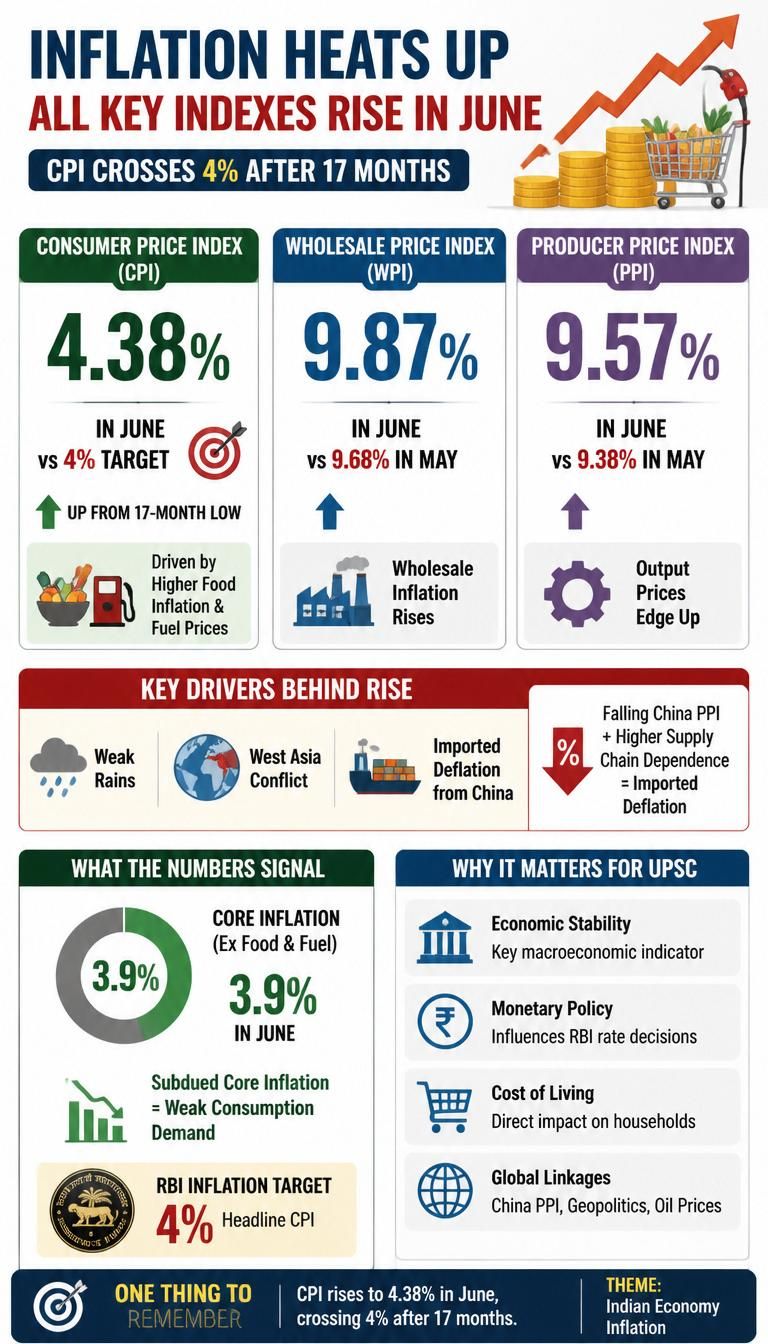
- CPI inflation rose to 4.38% in June, crossing the 4% mark for the first time in 17 months.
- The rise was primarily driven by higher food inflation and elevated fuel prices, influenced by weak rains and the West Asia war.
- Core inflation, which excludes volatile food and fuel prices, remained subdued at 3.9% in June.
- India is experiencing "imported deflation" from China due to falling Chinese Producer Price Index (PPI) and increased supply chain dependence.
Inflation.jpg
Detailed Insights:
- WPI inflation increased to 9.87% in June from 9.68% in May, while output PPI edged up to 9.57% from 9.38%.
- The Reserve Bank of India (RBI) targets headline CPI inflation at 4%.
- Economists suggest that subdued core inflation indicates weak consumption demand in the economy.
- India's economic growth, exceeding 7%, has been primarily driven by investments, specifically Gross Fixed Capital Formation (GFCF), rather than private consumption.
- China's PPI has been in negative territory since October 2022, contributing to lower prices for non-food, non-fuel, non-precious metal goods imported by India.
- India's goods imports from China now exceed $130 billion annually, representing close to 3.5% of India's GDP.
- GST rate cuts also contributed to subdued core inflation over the past year, though this low base effect is expected to diminish.
- Restaurant and cafe inflation sharply rose to 6.94% in June due to higher commercial LPG prices, indicating a second-round impact.
- The manufacturing sector has absorbed increased input prices, as evidenced by a decline in output PPI despite a jump in input PPI, suggesting weak consumer demand.
Key Concepts Involved:
- Consumer Price Index (CPI): Measures the average change over time in the prices paid by urban consumers for a market basket of consumer goods and services.
- Wholesale Price Index (WPI): Measures the average change in the prices of goods at the wholesale level, reflecting producer prices.
- Producer Price Index (PPI): Measures the average change over time in the selling prices received by domestic producers for their output.
- Core Inflation: A measure of inflation that excludes volatile items like food and energy prices to provide a clearer picture of underlying price trends.
- Gross Fixed Capital Formation (GFCF): A macroeconomic indicator that measures the total value of a country's new or existing fixed assets acquired by businesses, governments, and households.

SuperKalam is your personal mentor for UPSC preparation, guiding you at every step of the exam journey.
Download the App


STUDY RESOURCES
CONTACT US
ⓒ Snapstack Technologies Private Limited