GS 3: Science & TechnologyPrelimsGS 3: Space Technology
Voyager 1, One Light-Day Away From Earth Today, Is A Marvel Of Science, Pg II
Voyager 1, now 26 billion km from Earth, continues its scientific marvel, revealing cosmic ray insights and challenging fundamental physics theories, informing future space missions.
Practice MCQs
746 Students attempted
Key Highlights:
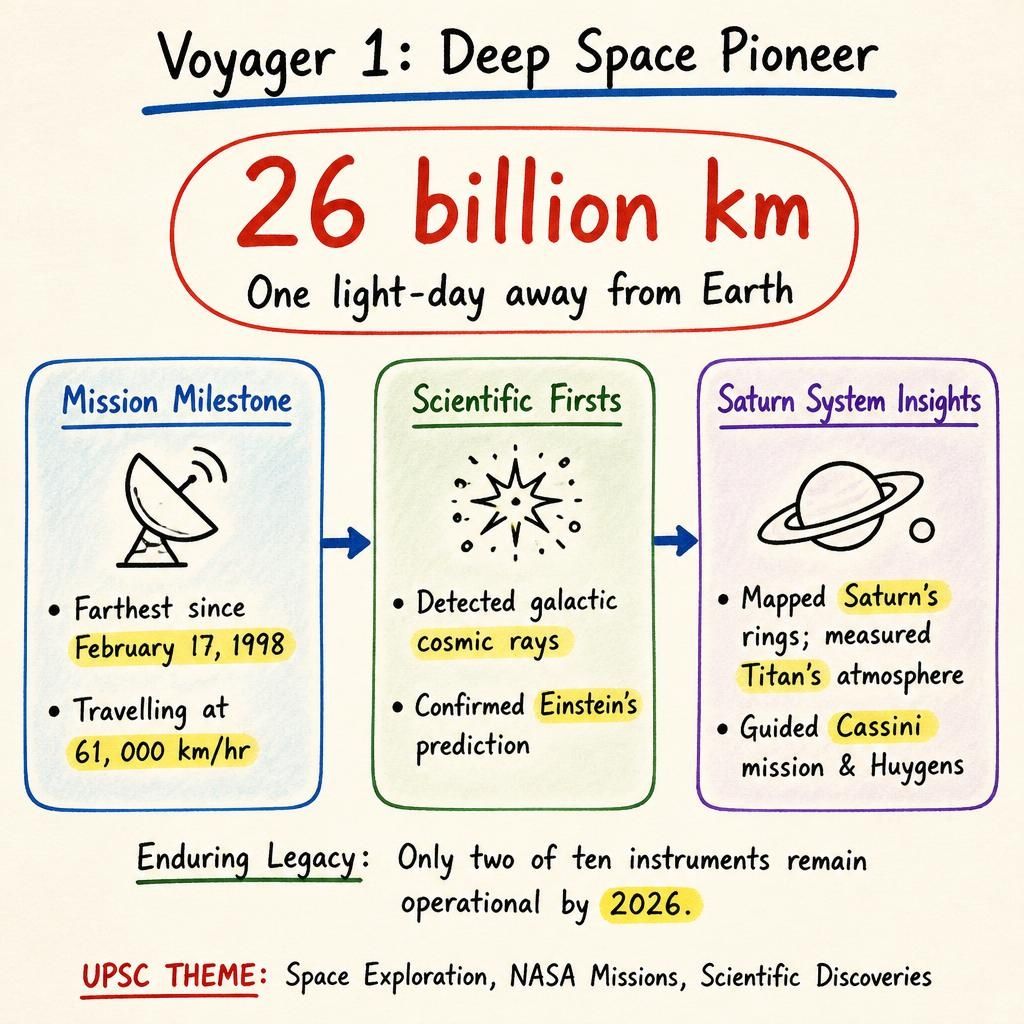
- Voyager 1 is currently one light-day away from Earth, a distance of approximately 26 billion kilometres.
- Traveling at 61,000 km/hr, it has been the farthest space mission from Earth since February 17, 1998.
- The spacecraft's ultraviolet spectrometer unexpectedly detected galactic cosmic rays between 1992 and 2013.
- Data from Voyager 1 independently confirmed Albert Einstein's prediction regarding the frequency change of electromagnetic radiation in a gravitational field.
- Its observations of Saturn's rings and moon Titan provided crucial data for future missions like NASA's Cassini mission.
Voyager 1.jpg
Detailed Insights:
- Voyager 1 was launched by NASA in an era before the World Wide Web and smartphones, reflecting its remarkable longevity.
- Its cameras were deactivated in 1990, and by 2026, only two of its ten original science instruments remained operational.
- The discovery of galactic cosmic rays by an instrument not designed for it provided new insights into the space environment beyond the solar system.
- This unexpected data also raised questions about the region immediately inside the heliopause, suggesting the solar wind might slow down there due to interactions with interstellar atoms.
- The mission's contribution to fundamental physics, published in Physical Review Letters, offered an independent verification of Einstein's theory under distinct planetary conditions.
- Scientists utilized Voyager 1's radio signals to map the distribution of materials and fine structures within Saturn's rings.
- The same radio occultation technique was used to measure the temperature and pressure of Titan's substantial atmosphere.
- These early findings were instrumental in planning and executing the Cassini mission and its Huygens probe, which further explored the Saturnian system.
- The enduring operational life of Voyager 1 allows continuous data collection, enabling new generations of researchers to derive fresh scientific insights.
Scientific/Technical Concepts Involved:
- Light-day: The distance light travels in one Earth day, approximately 26 billion kilometers.
- Heliopause: The boundary in space where the solar wind is slowed and deflected by the interstellar medium.
- Galactic Cosmic Rays: High-energy particles originating from outside the solar system, traveling through interstellar space.
- Solar Wind: A continuous flow of charged particles, primarily electrons and protons, emitted from the Sun's corona.

SuperKalam is your personal mentor for UPSC preparation, guiding you at every step of the exam journey.
Download the App


STUDY RESOURCES
CONTACT US
ⓒ Snapstack Technologies Private Limited