GS 3: Science & TechnologyGS 2: International RelationsPrelimsGS 3: Achievements of Indians in Science and TechnologyGS 3: Indigenization of Technology and New Technology Development
LineShine Stays Defending Champ, Pg II
China's LineShine supercomputer retains world's top spot, breaking 2 quintillion calculations per second, showcasing indigenous tech amidst US chip restrictions.
Practice MCQs
746 Students attempted
Key Highlights:
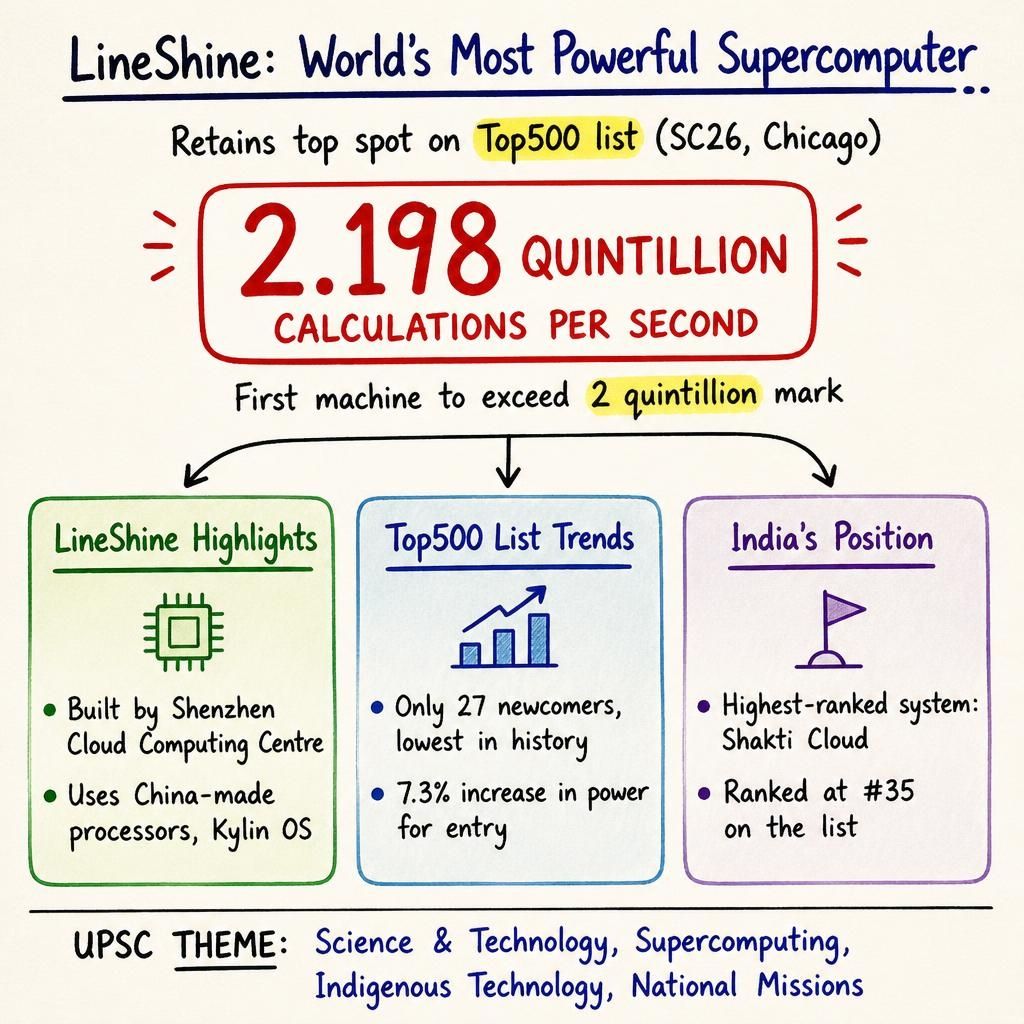
- China's LineShine supercomputer has retained its position as the world's most powerful supercomputer on the Top500 list, announced at the SC26 conference in Chicago.
- LineShine, built by the Shenzhen Cloud Computing Centre, achieved a performance of 2.198 quintillion calculations per second, becoming the first machine to exceed the 2 quintillion mark.
- It utilizes China-made processors and the Kylin operating system, demonstrating China's advancements in indigenous computing technology amidst U.S. chip restrictions.
- The Top500 list saw minimal changes in its top 10, with only 27 newcomers, the lowest in history, due to a 7.3% increase in computing power required for entry.
- India's highest-ranked supercomputer on the list is Shakti Cloud, placed at #35.
LineShine Supercomputer.jpg
Detailed Insights:
- LineShine first claimed the top spot in June, displacing the U.S. El Capitan, and has maintained its lead.
- The supercomputer consumes approximately 42 MW of power and is primarily used for atmospheric and ocean research.
- Its indigenous components, including processors and the Kylin OS, highlight China's strategic push for technological self-reliance.
- The Top500 list, published biannually since 1993, ranks supercomputers based on their performance using the LINPACK benchmark.
- Supercomputers are crucial for scientific discovery, climate modeling, AI research, and national security.
- India's National Supercomputing Mission (NSM), launched in 2015, aims to build a robust indigenous supercomputing ecosystem.
- The NSM focuses on design, development, manufacturing, and specialized applications to reduce dependence on imported technologies.
Scientific/Technical Concepts Involved:
- Supercomputer: A high-performance computing system designed to process massive amounts of data and perform complex calculations at extremely high speeds.
- Exascale Computing: Refers to supercomputers capable of performing at least one quintillion (10^18) floating-point operations per second (exaFLOPS).
- LINPACK Benchmark: A standardized test used by the Top500 list to measure a supercomputer's performance by solving a dense system of linear equations.
- Kylin Operating System: A Linux-based operating system developed in China, primarily for government, military, and critical infrastructure, emphasizing security and indigenous development.
Previous16/16

SuperKalam is your personal mentor for UPSC preparation, guiding you at every step of the exam journey.
Download the App


STUDY RESOURCES
CONTACT US
ⓒ Snapstack Technologies Private Limited