GS 2: GovernanceGS 3: Science & TechnologyGS 3: Internal SecurityPrelimsGS 2: Government policies and interventions for development in various sectors
India Needs a Comprehensive Doctrine On Space Security, Pg8
India must formulate a robust space security doctrine to safeguard its vital space assets against emerging threats, ensuring national resilience and strategic autonomy.
Practice MCQs
746 Students attempted
Key Highlights:
- India's increasing dependence on space infrastructure for civilian and military functions necessitates a comprehensive space security doctrine.
- Space threats have evolved from physical destruction to disruption methods like jamming, spoofing, cyber interference, and electronic warfare, complicating attribution.
- Existing frameworks such as the Indian Space Policy 2023 and ISRO's Indian Space Situational Awareness Report for 2025 (ISSAR-2025) lack clear guidelines for hostile disruption, attribution, and crisis response.
- A comprehensive doctrine should prioritize resilience, space-domain awareness, reconstitution, and recovery, involving robust government-industry coordination.
- The objective is to deter, withstand, attribute, and recover from disruption while preserving the peaceful use of outer space, preventing Earth-based vulnerabilities.
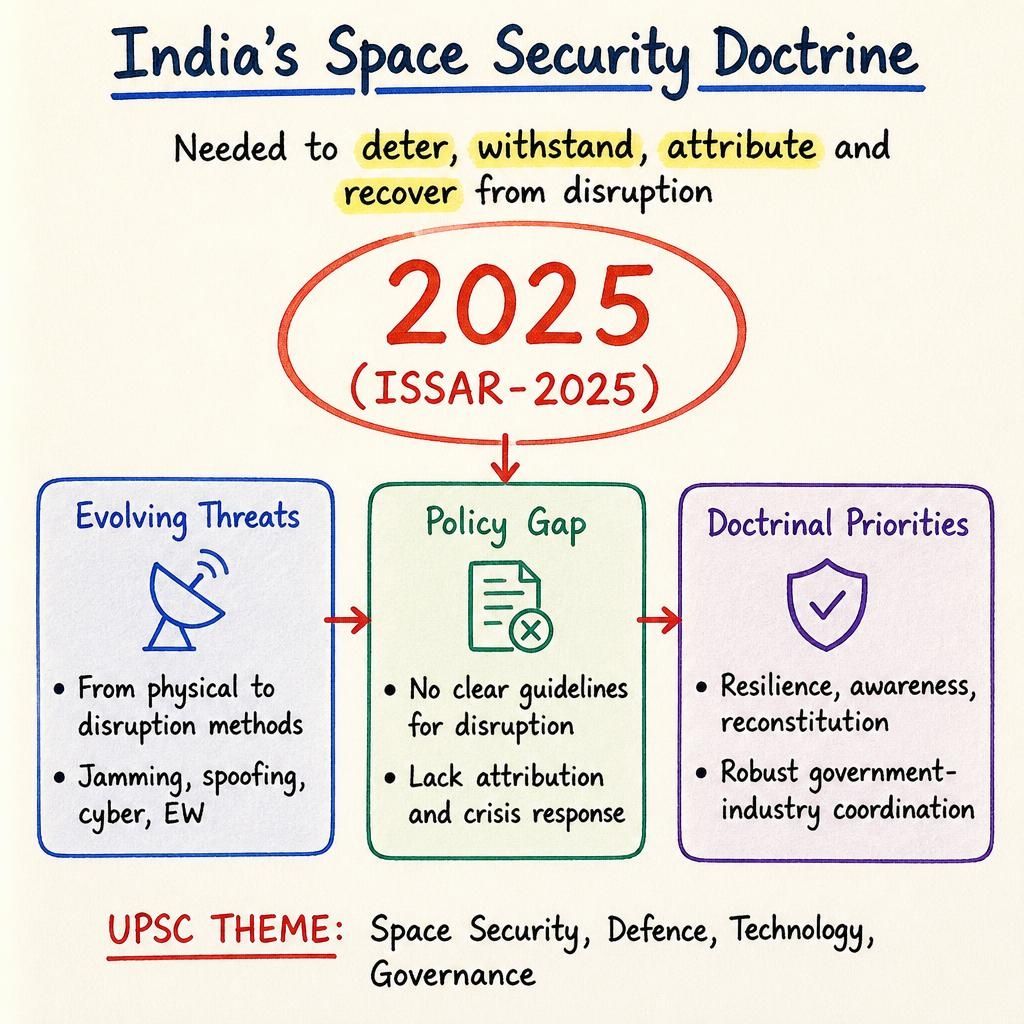
Space Security Doctrine.jpg
Detailed Insights:
- Space capabilities are crucial for India's armed forces, providing communications, positioning, surveillance, timing, and situational awareness.
- Disruption in any part of the interconnected space architecture can have significant consequences for markets, governance, security, and society.
- The shift towards non-kinetic threats makes distinguishing accidental interference from deliberate attacks and determining appropriate responses more complex.
- India needs clarity on what constitutes an attack on a space system and how to attribute responsibility when interference involves complex networks.
- Space security is a shared responsibility, as commercial entities operate a growing portion of the space ecosystem supporting critical civilian infrastructure.
- Sustained government-industry coordination is vital for information sharing, identifying vulnerabilities, responding to disruptions, and maintaining essential services.
- The measure of space security lies in the capacity to preserve functions, withstand shocks, and recover quickly, rather than solely accumulating capabilities.
Key Concepts Involved:
- Space Security: Protecting space assets and services from hostile interference to ensure their continuous and reliable operation.
- Space-Domain Awareness: The ability to understand activities in space, identify anomalies, and track objects to inform decision-making.
- Resilience (in space): The capacity of space systems to withstand disruptions, maintain essential functions, and recover quickly.
- Attribution: The process of identifying the perpetrator responsible for an attack or interference in space.

SuperKalam is your personal mentor for UPSC preparation, guiding you at every step of the exam journey.
Download the App


STUDY RESOURCES
CONTACT US
ⓒ Snapstack Technologies Private Limited