GS 2: GovernanceGS 2: Social JusticePrelimsGS 2: Government policies and interventions for development in various sectorsGS 2: Statutory, Regulatory and Quasi Judicial Bodies
Govt. caps trade margins on 137 drugs against cancer, Pg9
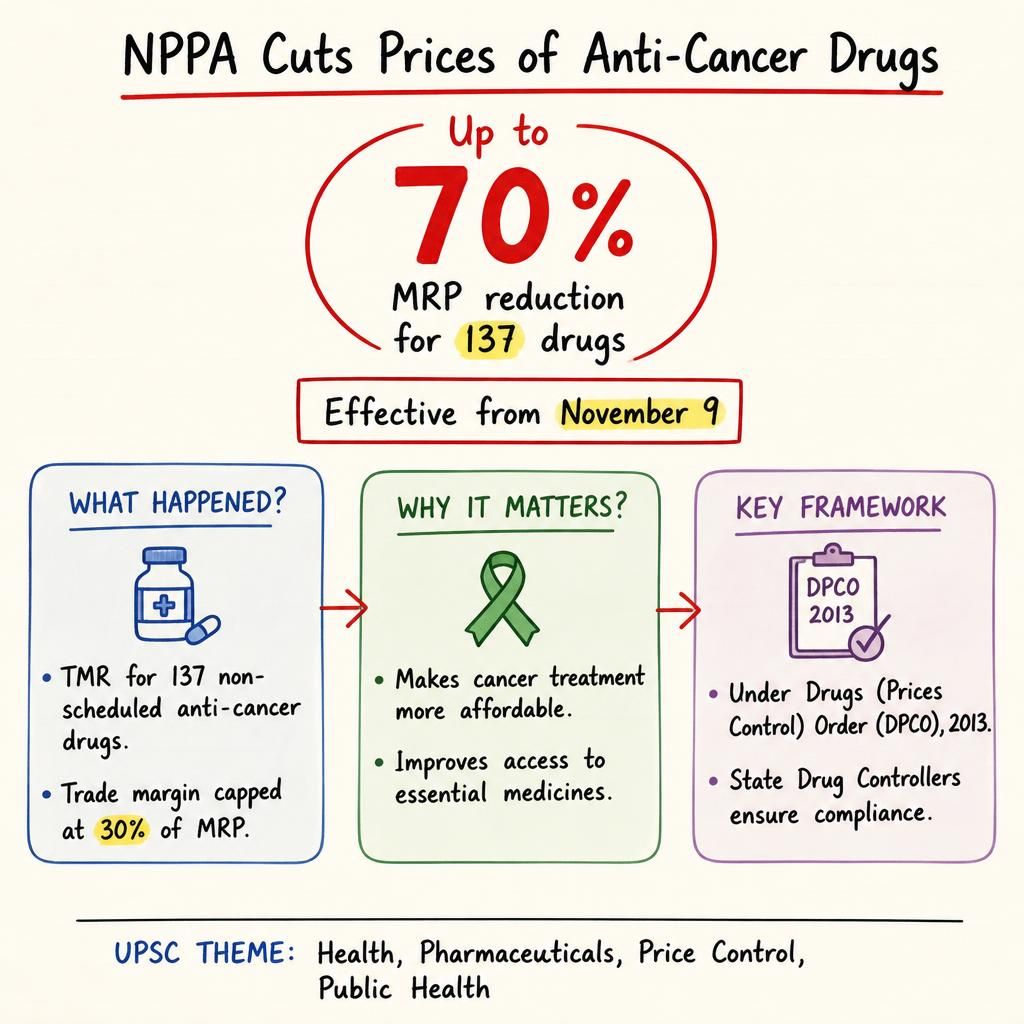
NPPA caps trade margins on 137 anti-cancer drugs, reducing prices by up to 70% for affordable treatment, effective November 9.
Practice MCQs
739 Students attempted
Key Highlights:
- The National Pharmaceutical Pricing Authority (NPPA) has implemented Trade Margin Rationalisation (TMR) for 137 non-scheduled anti-cancer drugs.
- This measure aims to make cancer treatment more affordable and improve access to essential medicines.
- The initiative is expected to reduce the Maximum Retail Price (MRP) of these drugs by up to 70%.
- The revised prices will be effective from November 9.
- The trade margin has been capped at 30% of the MRP, in accordance with the Drugs (Prices Control) Order (DPCO), 2013.
Cancer Drug Price Cut.jpg
Detailed Insights:
- The NPPA operates under the Department of Pharmaceuticals, Ministry of Chemicals and Fertilizers.
- This intervention builds upon a successful 2019 pilot TMR exercise where trade margins for 42 anti-cancer drugs were capped, leading to up to 90% MRP reduction for 526 brands.
- An expert committee under the Directorate General of Health Services (DGHS) recommended the 137 drugs for inclusion in this TMR framework.
- Non-scheduled drugs are pharmaceutical formulations not listed in the First Schedule of the Drugs (Prices Control) Order (DPCO), 2013, or the National List of Essential Medicines (NLEM).
- While manufacturers of non-scheduled drugs can initially set prices, their annual price increase is capped at 10%.
- The DPCO, 2013 empowers the government to fix ceiling prices for essential medicines and regulate prices in public interest under extraordinary circumstances.
- State Drug Controllers are tasked with ensuring compliance by manufacturers, dealers, retailers, hospitals, and medical institutions.
Key Concepts Involved:
- National Pharmaceutical Pricing Authority (NPPA): An independent regulatory body established in 1997 to fix and revise drug prices, enforce price control orders, and monitor drug availability and prices.
- Trade Margin Rationalisation (TMR): A mechanism to control excessive profit margins in the distribution and retail channels of pharmaceutical products.
- Drugs (Prices Control) Order (DPCO), 2013: An order issued under the Essential Commodities Act, 1955, to regulate drug prices and ensure the availability and affordability of essential medicines.
- Non-scheduled drugs: Drugs not under direct price control, meaning their prices are not subject to government-mandated ceiling prices, unlike scheduled drugs.

SuperKalam is your personal mentor for UPSC preparation, guiding you at every step of the exam journey.
Download the App


STUDY RESOURCES
CONTACT US
ⓒ Snapstack Technologies Private Limited