GS 2: GovernanceGS 2: Social JusticeGS 3: Environment & EcologyPrelimsGS 2: Government policies and interventions for development in various sectors
FSSAI proposes pesticide residue restrictions for tea, Pg9
FSSAI proposes strict new maximum residue limits for acetamiprid and imidacloprid pesticides in tea, enhancing India's food safety standards.
Practice MCQs
739 Students attempted
Key Highlights:
- The Food Safety and Standards Authority of India (FSSAI) has proposed new Maximum Residue Limits (MRLs) for two pesticides, acetamiprid and imidacloprid, in tea.
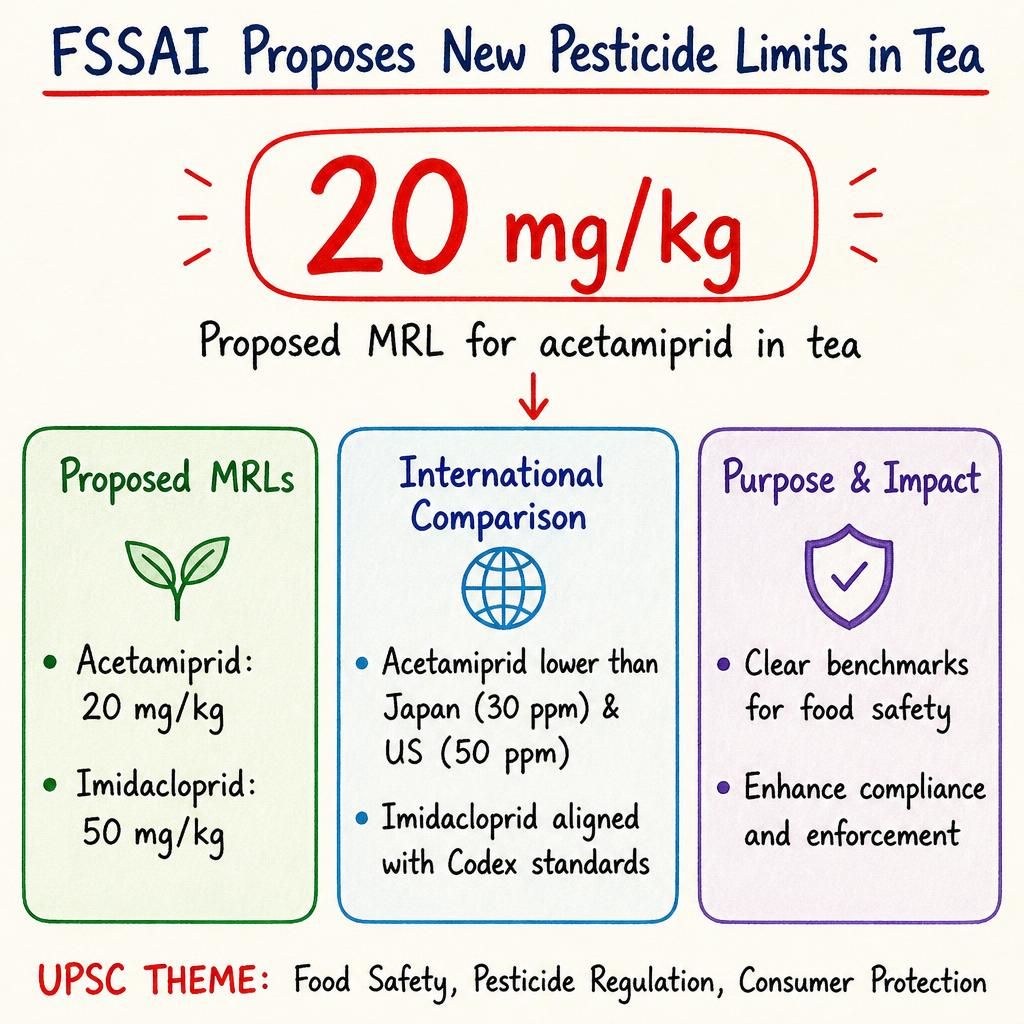
- The draft Food Safety and Standards (Contaminants, Toxins and Residues) Amendment Regulations, 2026, specifies MRLs of 20 mg/kg for acetamiprid and 50 mg/kg for imidacloprid.
- The proposed limit for acetamiprid is lower than existing limits in Japan (30 ppm) and the United States (50 ppm).
- The imidacloprid limit is aligned with international Codex Alimentarius Commission standards.
- These regulations aim to establish clear benchmarks for food safety, facilitate compliance, and enhance monitoring and enforcement in the tea industry.
FSSAI Proposal.jpg
Detailed Insights:
- The proposed MRLs are part of FSSAI's ongoing efforts to review and update pesticide residue standards based on scientific assessments and international practices.
- India's average pesticide use in agriculture is less than 0.5 kg per hectare, which is significantly below the estimated global average of 2.38 kg per hectare.
- The new limits are intended to provide greater regulatory clarity for tea growers, processors, businesses, testing laboratories, and enforcement authorities.
- FSSAI's mandate includes laying down science-based standards for food articles and regulating their manufacture, storage, distribution, sale, and import to ensure safe food for consumption.
- Earlier regulatory measures by FSSAI also included the delisting of 13 pesticides identified as having higher toxicity, reflecting a continuous focus on consumer protection.
Scientific/Technical Concepts Involved:
- Maximum Residue Limits (MRLs): The highest concentration of a pesticide residue legally permitted in or on food commodities, established based on scientific risk assessments.
- Acetamiprid: A neonicotinoid insecticide used to control sucking and chewing pests, known for its systemic action and moderate toxicity to mammals.
- Imidacloprid: Another neonicotinoid insecticide, widely used against sucking insects and soil pests, which acts on the insect nervous system.
- Codex Alimentarius Commission: An international body that sets food standards, guidelines, and codes of practice to protect consumer health and ensure fair practices in food trade.

SuperKalam is your personal mentor for UPSC preparation, guiding you at every step of the exam journey.
Download the App


STUDY RESOURCES
CONTACT US
ⓒ Snapstack Technologies Private Limited