GS 3: Science & TechnologyGS 3: Environment & EcologyPrelimsGS 3: Conservation, Pollution and DegradationGS 1: Changes in Critical Geographical Features, Water Bodies, Ice Caps, Flora and Fauna
In Bolivia, a new cat species identified— first in over a century, Pg4
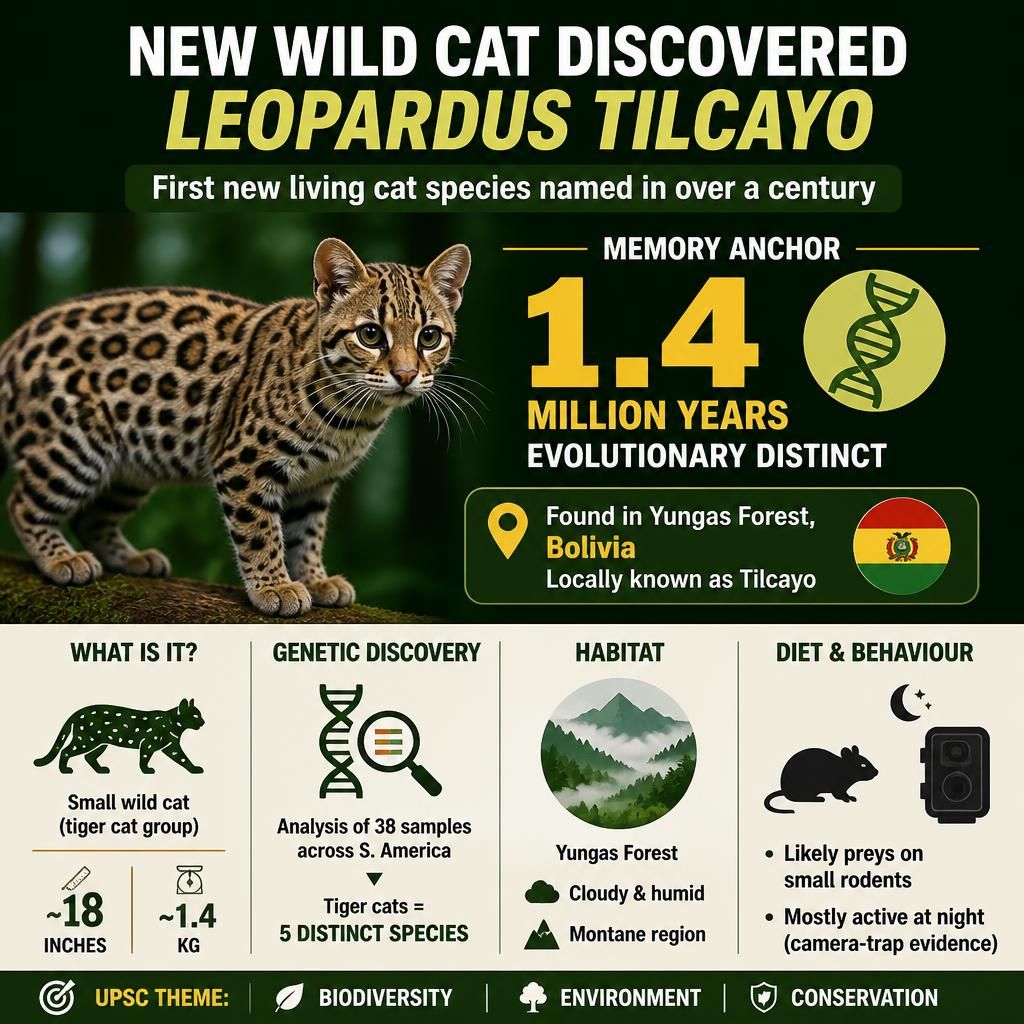
A diminutive wild cat, Leopardus tilcayo, discovered in Bolivia's cloud forest, marks the first new cat species identified in over a century.
Practice MCQs
731 Students attempted
Key Highlights:
- A new wild cat species, Leopardus tilcayo, has been identified in Bolivia's Yungas forest.
- This discovery marks the first formal naming of a new living cat species in over a century.
- Researchers used genetic data to confirm its distinctness, publishing their findings in the journal Current Biology.
- The cat, locally known as Tilcayo, is smaller than an average domestic cat, measuring about 18 inches long and weighing around 1.4 kg.
New Cat Species.jpg
Detailed Insights:
- The newly identified species belongs to a group known as tiger cats, found across much of South America.
- Its fur is light brown with irregularly shaped rosettes across its body, as described by Paola Nogales-Ascarrunz.
- Genetic analysis of 38 cat samples from various South American countries revealed that tiger cats comprise five genetically distinct species.
- The lineage of Leopardus tilcayo separated from other tiger cats approximately 1.4 million years ago.
- The Yungas forest is a mountainous region characterized by frequent cloud cover and high humidity.
- Limited information suggests its diet includes small rodents, and camera-trap evidence indicates it may be more active at night.
Scientific/Technical Concepts Involved:
- Cryptic species: Species that are morphologically similar and difficult to distinguish by appearance but are genetically distinct.
- Genetic data/analysis: The use of DNA sequencing and other molecular techniques to study evolutionary relationships and identify distinct species.
- Cloud forest: A type of tropical or subtropical moist forest characterized by persistent, frequent, or seasonal low-level cloud cover, often found in mountainous regions.

SuperKalam is your personal mentor for UPSC preparation, guiding you at every step of the exam journey.
Download the App


STUDY RESOURCES
CONTACT US
ⓒ Snapstack Technologies Private Limited