GS 2: International RelationsGS 3: EconomyPrelimsGS 3: Infrastructure: Energy, Ports, Roads, Airports, Railways etc.GS 2: Bilateral, Regional and Global Groupings and Agreements
China urges Iran to rein in Houthis after Saudi appeal, Pg4
China urges Iran to curb Houthi aggression near Red Sea after Saudi appeal, fearing disruption to vital global energy routes and shipping.
Practice MCQs
731 Students attempted
Key Highlights:
- China has privately urged Iran to exert influence over Yemen's Houthis following an appeal from Saudi Arabia.
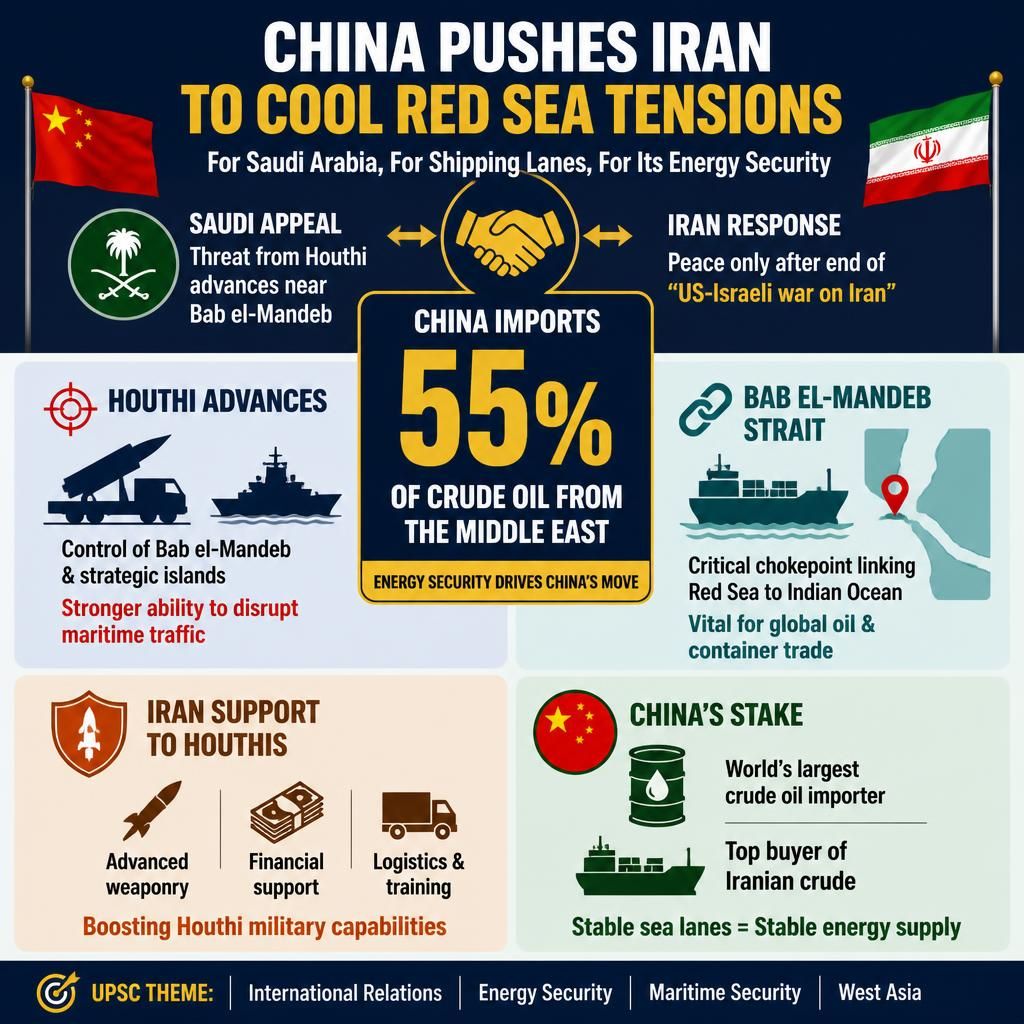
- The Saudi appeal came after recent Houthi military advances along the Red Sea coast and around the Bab el-Mandeb Strait, which threaten Saudi oil exports and shipping.
- China's intervention is driven by its significant reliance on stable energy routes, as it is the world's largest crude oil importer.
- Iran responded by stating that regional stability and peace are contingent on ending the "US-Israeli war on Iran."
Red Sea Tensions.jpg
Detailed Insights:
- The Houthis recently gained control over the Yemeni side of the Bab el-Mandeb Strait and strategic islands, enhancing their capacity to disrupt maritime traffic.
- The Bab el-Mandeb Strait is a critical global chokepoint, linking the Red Sea to the Gulf of Aden and the Indian Ocean, essential for global oil and container trade.
- Iran provides substantial military, financial, and logistical support to the Houthis, including advanced weaponry, bolstering their operational capabilities.
- China imports over 55% of its crude oil from the Middle East and is the primary buyer of Iranian crude, making the security of these maritime passages vital for its energy security.
- The "US-Israeli war on Iran" refers to a conflict initiated around February 2026, involving US-Israeli airstrikes on Iran and subsequent Iranian retaliatory attacks, which also led to the closure of the Strait of Hormuz and escalated the Bab el-Mandeb Strait crisis.
Key Concepts Involved:
- Houthis: An Iran-backed armed political movement in Yemen that controls significant territory and influences critical maritime routes.
- Bab el-Mandeb Strait: A narrow, strategically vital waterway connecting the Red Sea to the Gulf of Aden and the Indian Ocean, crucial for global shipping and oil trade.
- Chokepoint: A narrow channel or passage, such as a strait, where traffic can be restricted or controlled, making it strategically important for global trade and security.

SuperKalam is your personal mentor for UPSC preparation, guiding you at every step of the exam journey.
Download the App


STUDY RESOURCES
CONTACT US
ⓒ Snapstack Technologies Private Limited