The road to E20 is not without bumps, Pg8
India's rapid E20 fuel transition faces significant challenges, including mileage drops, vehicle compatibility issues, and contamination risks, sparking a complex policy debate.
Practice MCQs
724 Students attempted
Key Highlights:
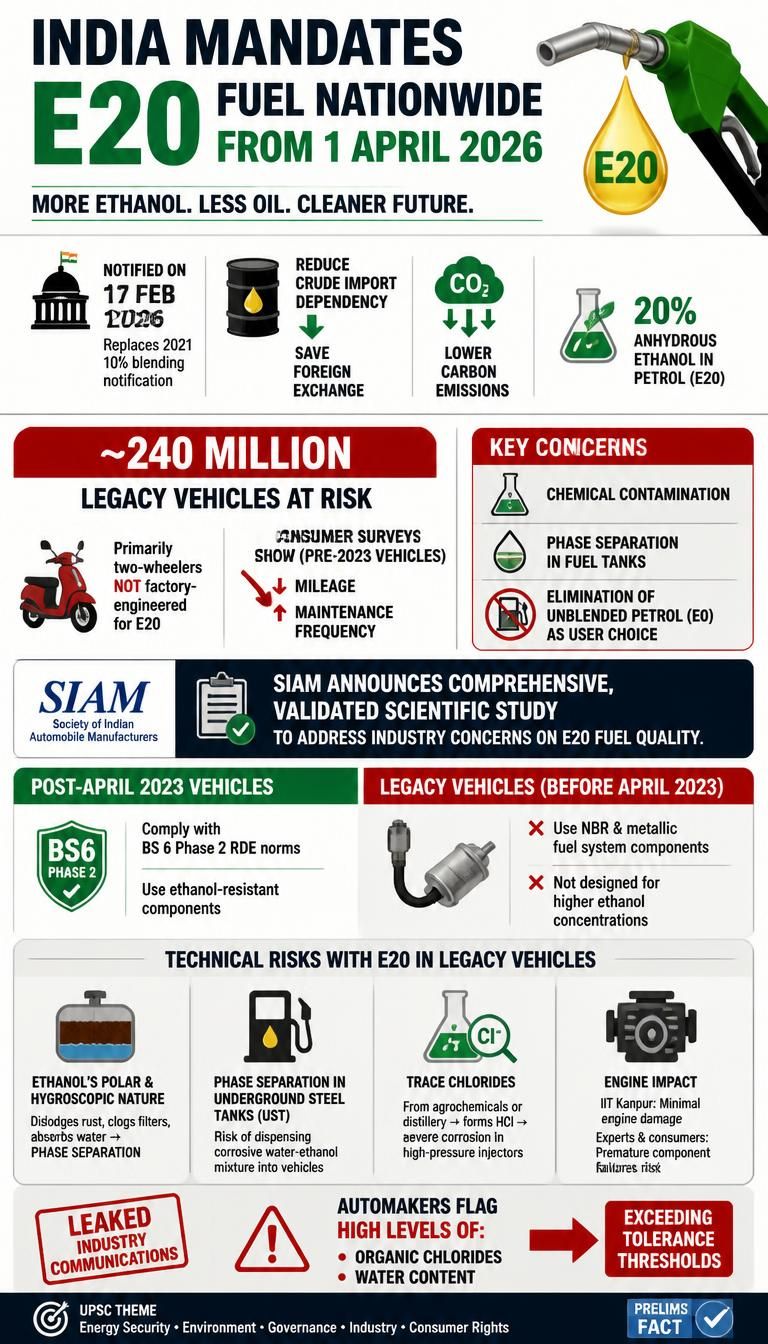
- India mandated the sale of E20 fuel (petrol blended with 20% anhydrous ethanol) across all States and Union Territories from April 1, 2026.
- The policy aims to reduce crude oil import dependency, save foreign exchange, and lower carbon emissions.
- The Government of India notified this change on February 17, 2026, replacing the earlier 2021 notification for up to 10% ethanol blending.
- Approximately 240 million legacy vehicles, primarily two-wheelers, are not factory-engineered for E20 compatibility.
- Consumer surveys indicate significant mileage loss and increased maintenance frequency for pre-2023 vehicles.
- Concerns include chemical contamination, phase separation in fuel tanks, and the elimination of unblended petrol (E0) as a user choice.
- SIAM announced a comprehensive, validated scientific study to address industry concerns regarding E20 fuel quality.
E20 Mandate.jpg
Detailed Insights:
- Vehicles manufactured post-April 2023 comply with Bharat Stage 6 Phase 2 Real Driving Emissions (BS 6 Phase 2 RDE) norms, incorporating ethanol-resistant components.
- Legacy vehicles, built before April 2023, utilize Nitrile Butadiene Rubber (NBR) and metallic fuel system components not designed for higher ethanol concentrations.
- Ethanol's properties as a polar solvent and hygroscopic agent can dislodge rust, clog filters, and cause water absorption leading to phase separation in older vehicles.
- Phase separation in Underground Steel Tanks (UST) at retail pumps risks dispensing corrosive water-ethanol mixtures into customer vehicles.
- Trace chlorides, potentially from agrochemical residues or distillery processes, can form hydrochloric acid, causing severe corrosion in high-pressure fuel injectors.
- While IIT Kanpur's Engine Research Laboratory reported minimal engine damage, independent experts and consumer groups highlight material science limitations and premature component failures.
- Leaked industry communications revealed automakers' concerns over high levels of organic chlorides and water content in E20 fuel samples, exceeding tolerance thresholds.
- Proposed solutions include mandating dual-dispensing infrastructure for E0/E10, clear pump labelling, and incentivizing aftermarket retrofit kits for legacy vehicles.
- India can learn from Brazil's experience in navigating similar challenges during its biofuel journey.
Key Concepts Involved:
- E20 Fuel: Petrol blended with 20% anhydrous ethanol, mandated for sale across India.
- Bharat Stage 6 Phase 2 Real Driving Emissions (BS 6 Phase 2 RDE): Vehicle emission standards requiring specific engineering for E20 compatibility.
- Phase Separation: The process where an ethanol-water mixture separates from gasoline and settles in the fuel tank.
- Hygroscopic: The property of a substance to absorb moisture from the air.

SuperKalam is your personal mentor for UPSC preparation, guiding you at every step of the exam journey.
Download the App


STUDY RESOURCES
CONTACT US
ⓒ Snapstack Technologies Private Limited