GS 3: Science & TechnologyPrelimsGS3: Achievements of Indians in Science and TechnologyGS3: Indigenization of Technology and New Technology DevelopmentGS3: Space Technology
Rotating Detonation Engines: The Science and The Promises, Pg9
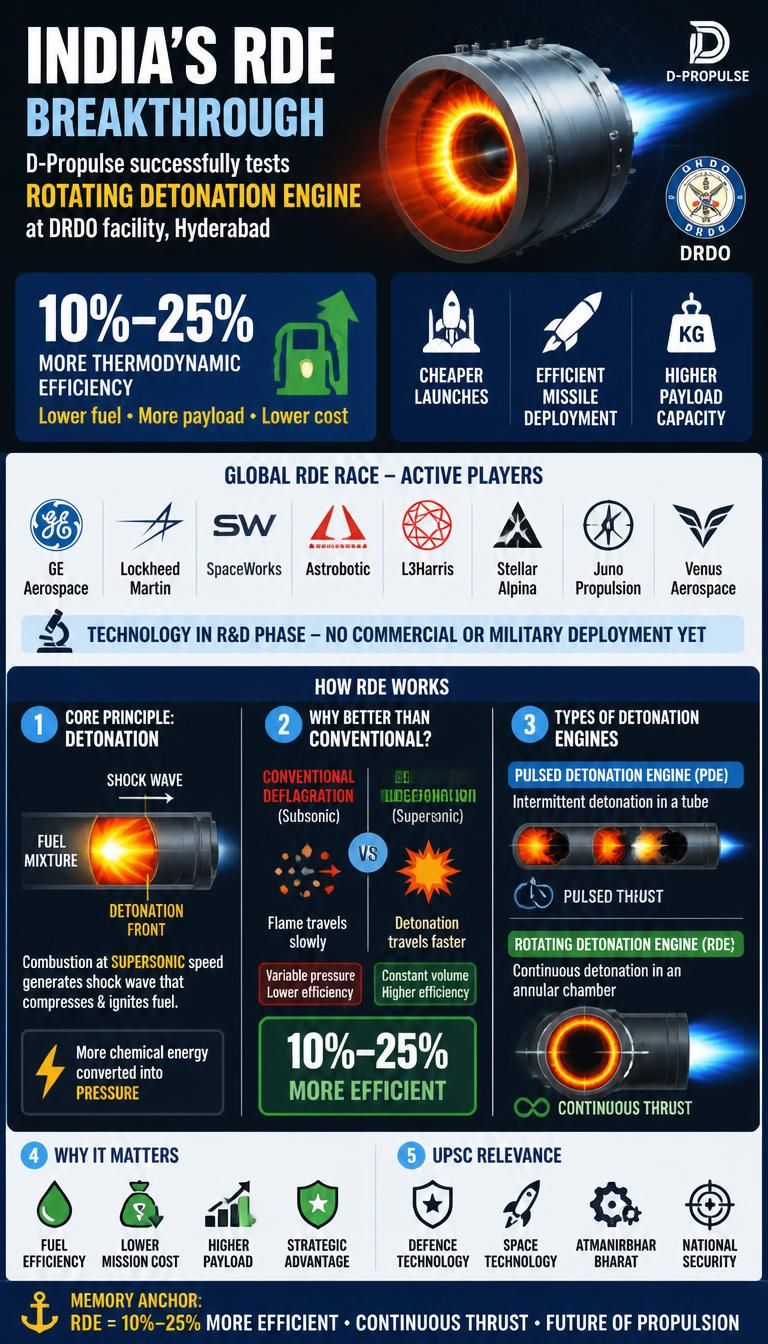
Indian defence start-up D-Propulse successfully demonstrates advanced Rotating Detonation Engine at DRDO, promising significant fuel efficiency for rockets and missiles.
Practice MCQs
724 Students attempted
Key Highlights:
- Indian defence start-up D-Propulse successfully demonstrated a rotating detonation engine (RDE) at a Defence Research & Development Organisation (DRDO) facility in Hyderabad.
- RDEs promise 10% to 25% more thermodynamic efficiency compared to conventional combustors, potentially reducing fuel requirements for missions.
- Global entities like GE Aerospace, Lockheed Martin, SpaceWorks, Astrobotic, L3Harris, Stellar Alpina, Juno Propulsion, and Venus Aerospace are actively developing RDE technology.
- The technology is currently in the research and development phase, with no RDE models yet ready for commercial or military deployment.
RDE.jpg
Detailed Insights:
- RDEs aim to enhance fuel efficiency, making satellite launches and missile deployments more cost-effective and increasing payload capacity.
- The core principle involves detonation, where combustion occurs at supersonic speeds, generating a shock wave that compresses and ignites the fuel mixture.
- Unlike conventional engines that use deflagration (subsonic combustion), RDEs achieve combustion at constant volume, converting more chemical energy into pressure.
- Pulsed Detonation Engines (PDEs) use intermittent detonation in a tube, while RDEs achieve continuous thrust by maintaining a detonation wave in an annular chamber.
- Significant challenges in RDE development include designing materials capable of withstanding extreme temperatures exceeding 2,000°C and precise control of fuel injection.
- Advances in high-speed computing, diagnostics, fuel injection systems, materials science, and manufacturing have been critical for the progress of RDE technology.
Scientific/Technical Concepts Involved:
- Rotating Detonation Engine (RDE): An engine design utilizing continuous, supersonic combustion (detonation) in an annular chamber for enhanced fuel efficiency.
- Detonation: A combustion process where a flame front propagates at supersonic speeds, creating a shock wave that compresses and ignites the unburned mixture.
- Deflagration: A combustion process where a flame front propagates at subsonic speeds, allowing the mixture to expand at constant pressure.
- Thermodynamic Efficiency: A measure of how effectively an engine converts the chemical energy stored in its fuel into useful mechanical work.

SuperKalam is your personal mentor for UPSC preparation, guiding you at every step of the exam journey.
Download the App


STUDY RESOURCES
CONTACT US
ⓒ Snapstack Technologies Private Limited