GS 3: Environment & EcologyGS 2: PolityGS 2: GovernancePrelimsGS1: Changes in Critical Geographical Features, Water Bodies, Ice Caps, Flora and Fauna
States can't block elephant corridors fearing crop damage: SC, Pg9
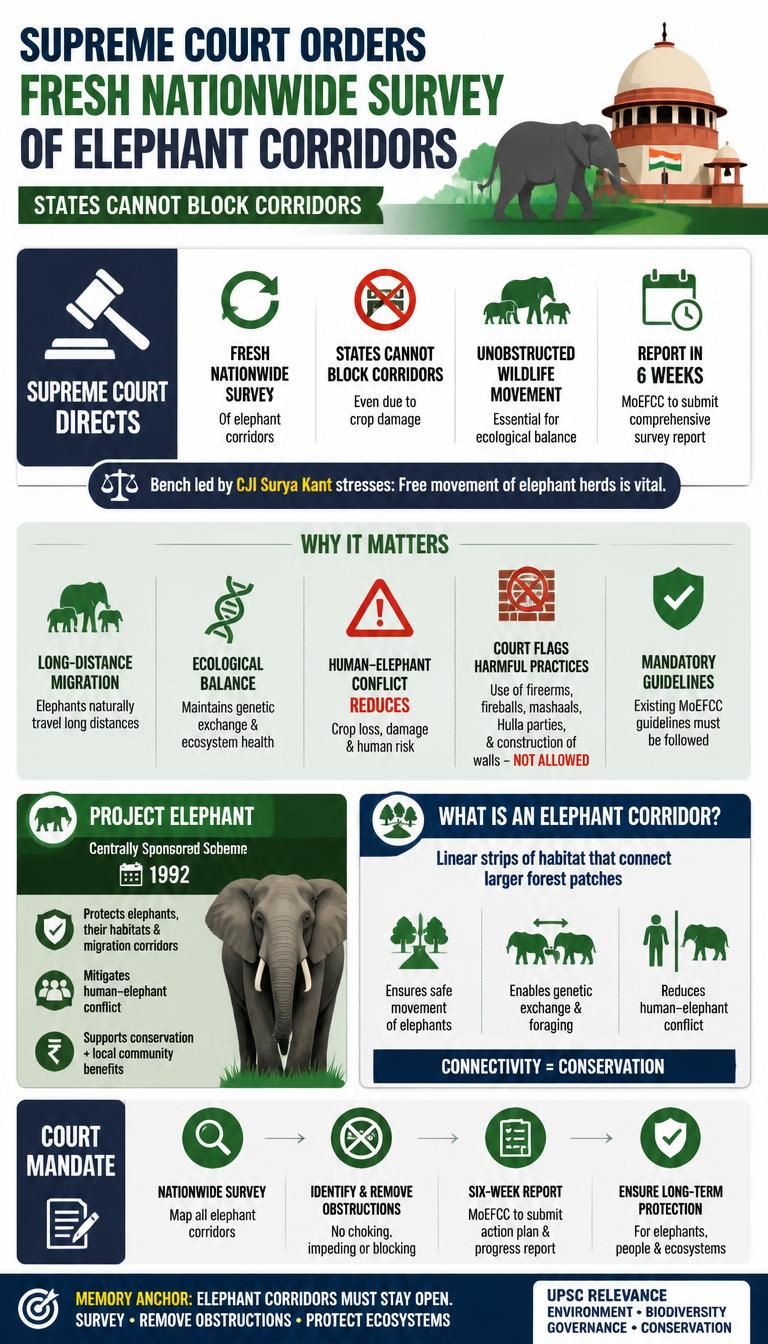
Supreme Court orders Centre to conduct fresh survey of elephant corridors, asserting states cannot block them over crop damage fears, prioritizing wildlife movement.
Practice MCQs
724 Students attempted
Key Highlights:
- The Supreme Court of India has directed the Centre to conduct a fresh nationwide survey of elephant corridors.
- The Court explicitly stated that states cannot block these corridors, even if it is due to concerns over crop damage.
- A three-judge bench, presided over by Chief Justice of India Surya Kant, emphasized the critical importance of unobstructed wildlife movement.
- The Ministry of Environment, Forest and Climate Change has been mandated to submit a comprehensive survey report detailing steps to prevent obstructions within six weeks.
Elephant Corridor.jpg
Detailed Insights:
- The Supreme Court's ruling addresses the ongoing issue of states impeding, choking, or obstructing elephant corridors despite existing mandatory guidelines from the Ministry of Environment, Forest and Climate Change.
- The bench underscored that elephant herds naturally travel long distances, making their free movement essential for maintaining ecological balance.
- The Court also sought a report on the use of aggressive methods such as firearms, fireballs, mashaals, and "Hulla parties" to drive away elephants, noting that some states have even constructed walls.
- Project Elephant, a Centrally Sponsored Scheme launched in 1992 by the MoEFCC, aims to protect elephants, their habitats, and migration corridors, while also mitigating human-elephant conflict.
- Elephant corridors are crucial linear strips of habitat that connect larger forest patches, enabling genetic exchange, foraging, and reducing instances of human-elephant conflict.
- The Elephant Corridors of India 2023 report, released by the MoEFCC, has ground-validated 150 such corridors across 15 elephant-range states.
- Elephants are designated as a Schedule I species under the Wildlife Protection Act, 1972, which provides them with the highest level of legal protection against hunting and trade.
- Human-elephant conflict, often exacerbated by habitat fragmentation and agricultural expansion, leads to significant annual losses for both human lives and elephant populations.
Key Concepts Involved:
- Elephant Corridors: Defined linear pathways connecting larger elephant habitats, crucial for their movement, genetic diversity, and survival.
- Human-Elephant Conflict (HEC): Adverse interactions between humans and elephants, primarily stemming from habitat loss, fragmentation, and competition for resources.
- Schedule I Species: A classification under the Wildlife Protection Act, 1972, denoting species afforded the highest degree of legal protection against exploitation.

SuperKalam is your personal mentor for UPSC preparation, guiding you at every step of the exam journey.
Download the App


STUDY RESOURCES
CONTACT US
ⓒ Snapstack Technologies Private Limited