GS 3: Science & TechnologyGS 2: International RelationsPrelimsGS2: Bilateral, Regional and Global Groupings and AgreementsGS2: Effect of Policies and Politics of Developed and Developing Countries on India's Interests
After January launch vehicle debacle, GISAT-1A take-off in September to end ISRO's seven-month operational hiatus, Pg6
ISRO ends seven-month launch hiatus with GISAT-1A, while strategically joining NASA's Moon Base program and Artemis Accords for advanced space exploration.
Practice MCQs
724 Students attempted
Key Highlights:
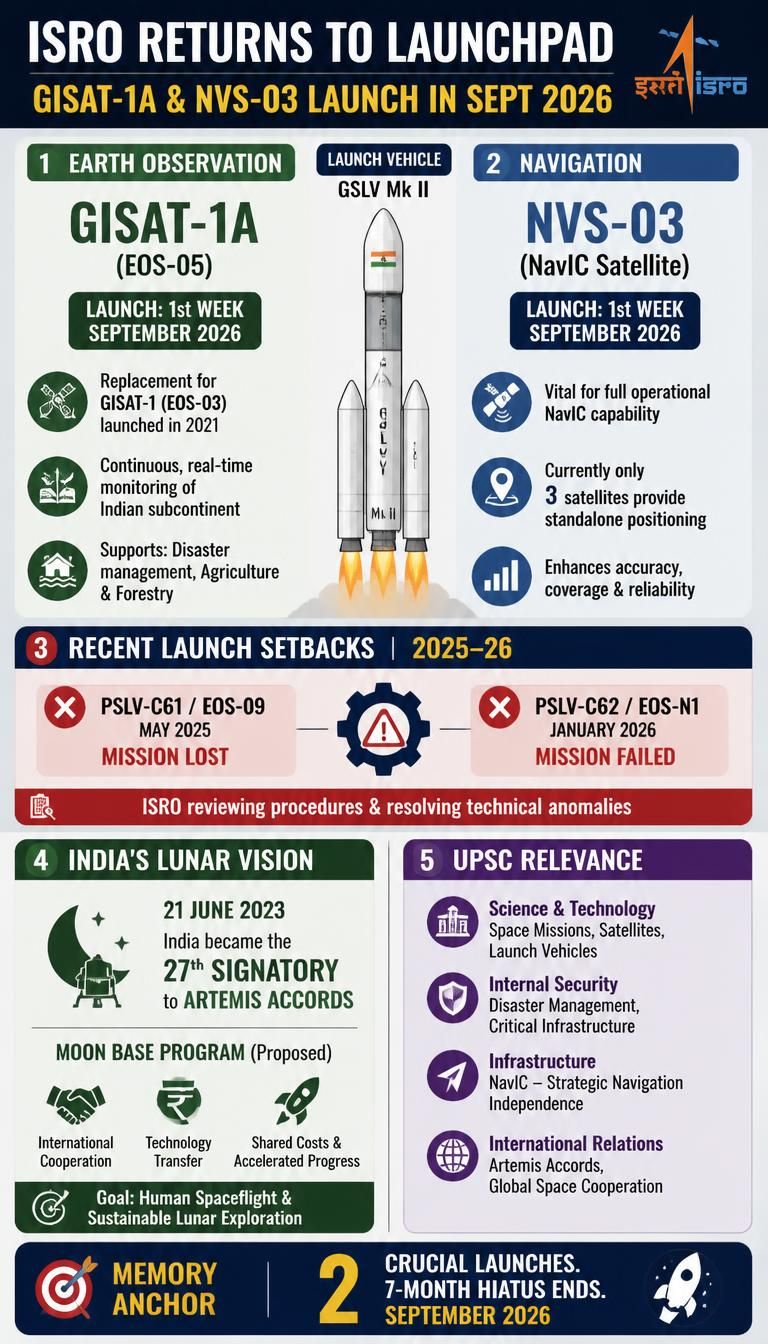
- The Indian Space Research Organisation (ISRO) is set to end a seven-month operational hiatus with the launch of the earth observation satellite GISAT-1A in the first week of September 2026.
- GISAT-1A, also known as EOS-05, is a replacement for the 2021-launched GISAT-1 (EOS-03) and will be launched by a GSLV Mk II rocket.
- The navigation satellite NVS-03, crucial for India's NavIC system, is also prepared for launch in the first week of September 2026.
- ISRO experienced multiple launch setbacks in 2025 and 2026, including the failure of the PSLV-C62/EOS-N1 mission in January 2026 and the loss of EOS-09 aboard PSLV-C61 in May 2025.
- India became the 27th signatory to the Artemis Accords on June 21, 2023, signaling its commitment to international cooperation in lunar exploration.
ISRO Launches.jpg
Detailed Insights:
- The launch of GISAT-1A is critical for continuous, real-time monitoring of the Indian subcontinent, aiding in natural disaster management, agriculture, and forestry.
- The NVS-03 launch is vital for restoring the full operational capability of NavIC, India's indigenous satellite navigation system, which currently has only three satellites providing standalone positioning services.
- The recent failures of launch vehicles like PSLV and GSLV have prompted a review of ISRO's operational procedures and a focus on resolving technical anomalies.
- India's participation in the Artemis Accords and the potential Moon Base Program offers opportunities for technology transfer, shared costs, and accelerated progress in human spaceflight and lunar exploration.
- The Artemis Accords are a set of non-legally binding principles established by the U.S. to guide peaceful and sustainable space exploration among signatory nations.
- Joining international collaborations like the Artemis Program can help ISRO gain valuable experience and overcome the financial and technological challenges of independent large-scale space missions.
Key Concepts Involved:
- NavIC (Navigation with Indian Constellation): India's independent regional satellite navigation system providing positioning, navigation, and timing services.
- Artemis Accords: A set of non-binding principles for cooperation in civil space exploration and the peaceful use of the Moon, Mars, comets, and asteroids.
- PSLV (Polar Satellite Launch Vehicle): ISRO's workhorse launch vehicle primarily used for placing satellites into polar sun-synchronous orbits.
- GSLV (Geosynchronous Satellite Launch Vehicle): ISRO's launch vehicle designed to inject satellites into geostationary transfer orbits.

SuperKalam is your personal mentor for UPSC preparation, guiding you at every step of the exam journey.
Download the App


STUDY RESOURCES
CONTACT US
ⓒ Snapstack Technologies Private Limited