GS 3: Science & TechnologyGS 2: GovernancePrelimsGS2: Government policies and interventions for development in various sectorsGS3: Science and Technology in Everyday Life
Understanding Anthropic’s move to watermark Claude AI content, Pg11
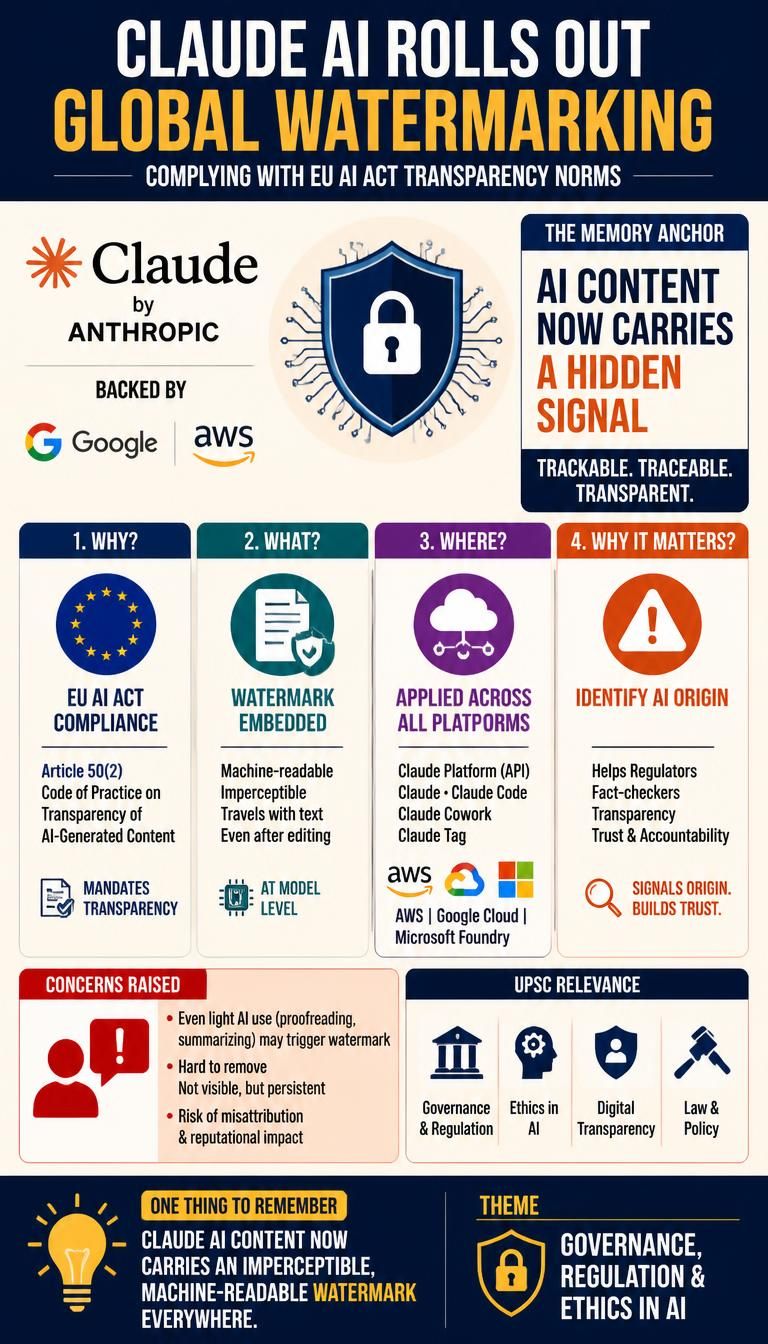
Anthropic's new global policy embeds invisible watermarks in Claude AI text, raising user concerns over content authenticity and potential reputational damage.
Practice MCQs
898 Students attempted
Key Highlights:
- Anthropic, backed by Google and Amazon, has implemented a global watermarking system for its Claude AI content.
- This initiative is a measure to comply with the EU AI Act and its Article 50(2) Code of Practice on Transparency of AI-Generated Content.
- The watermarking applies to both text and multimedia content generated by Claude, including its API and cloud access points.
- The text watermark is embedded at the model level, is machine-readable, and is imperceptible to users, but travels with the text.
- The move has raised concerns among users regarding potential misattribution and reputational risks, even for content lightly edited by Claude.
Claude AI.jpg
Detailed Insights:
- Anthropic signed the EU AI Act’s Article 50(2) Code of Practice on Transparency of AI-Generated Content, which mandates transparency for AI outputs.
- The watermarking aims to provide signals about the origin of content, helping regulators and fact-checkers identify AI-generated material.
- The embedded text watermark persists even when content is copied, pasted, or undergoes some editing, making it difficult to remove.
- Watermarks will be applied to output from Claude Platform (API), Claude, Claude Code, Claude Cowork, and Claude Tag, including when accessed via AWS, Google Cloud, and Microsoft Foundry.
- Critics argue that even minor AI involvement, such as proofreading or summarization, could result in content being marked as AI-generated, potentially affecting user credibility.
- Anthropic acknowledges the possibility of false positives and false negatives in watermark detection, depending on factors like text length or post-generation changes.
- The EU AI Act imposes transparency obligations on providers and deployers of AI systems, with compliance for Article 50(2) becoming enforceable from August 2, 2026.
Key Concepts Involved:
- AI Watermarking: Embedding invisible, machine-readable identifiers into AI-generated content to indicate its artificial origin.
- EU AI Act: A comprehensive regulatory framework by the European Union to ensure AI systems are safe, transparent, and ethical.
- Code of Practice on Transparency of AI-Generated Content: A voluntary framework under the EU AI Act guiding AI providers on marking and detecting AI-generated content.

SuperKalam is your personal mentor for UPSC preparation, guiding you at every step of the exam journey.
Download the App


STUDY RESOURCES
CONTACT US
ⓒ Snapstack Technologies Private Limited