GS 2: PolityPrelimsGS1: Women and Women's OrganizationsGS2: Indian Constitutional Evolution, Features, Amendments, Basic Structure DoctrineGS2: Union State Relations and Federal Structure
The federal dilemma of delimitation, Pg10
Tamil Nadu's resolution to freeze Lok Sabha seats at 543 ignites federalism debate, challenging future delimitation and women's reservation implementation.
Practice MCQs
898 Students attempted
Key Highlights:
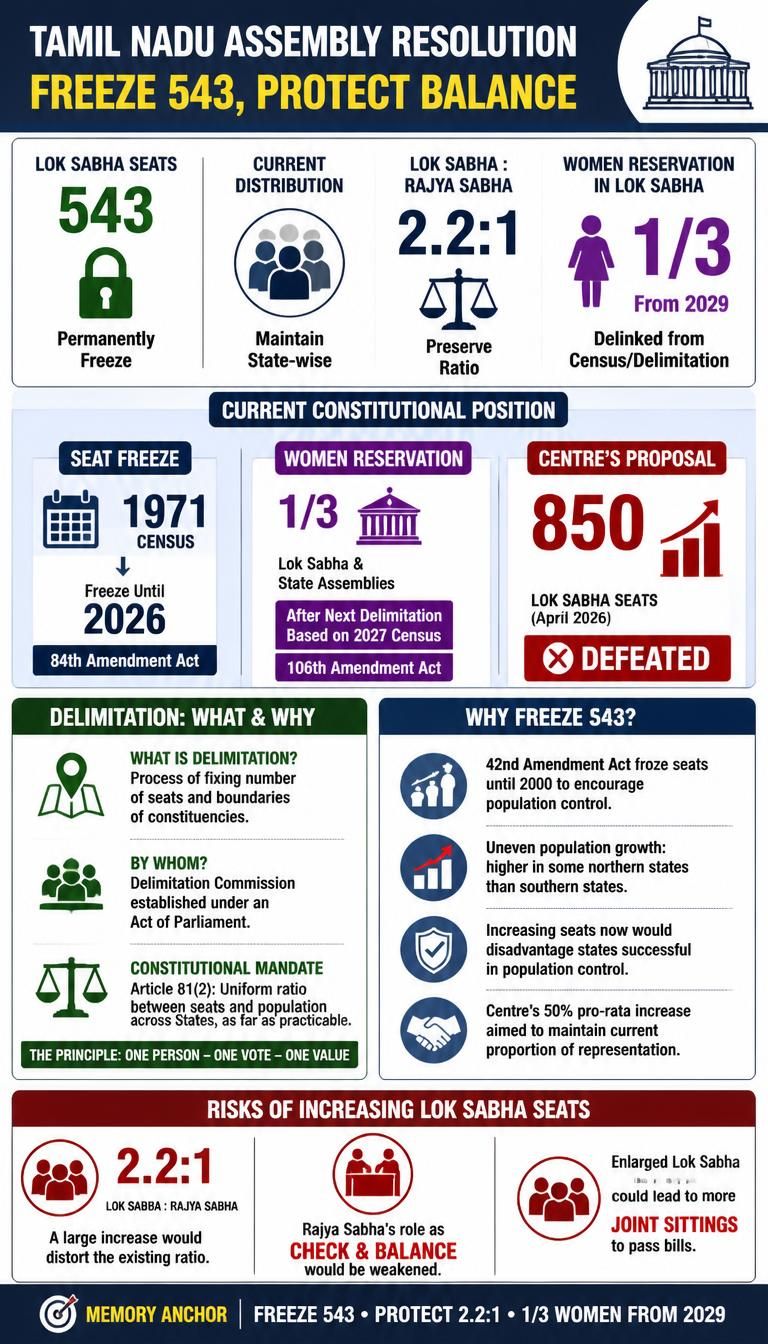
- The Tamil Nadu Legislative Assembly passed a resolution urging the Centre to permanently freeze the number of Lok Sabha seats at 543 and maintain the current state-wise distribution.
- The resolution also advocated for preserving the 2.2:1 ratio between Lok Sabha and Rajya Sabha seats.
- It sought the implementation of one-third reservation for women in the Lok Sabha from the 2029 election, delinked from any future census or delimitation.
- Lok Sabha seats are currently frozen at 543 based on the 1971 census until 2026, as extended by the 84th Amendment Act.
- The 106th Constitutional Amendment provides for one-third reservation of seats for women in the Lok Sabha and Legislative Assemblies, to be implemented after the next delimitation based on the 2027 census.
- The Union government's Constitution 131st Amendment Bill of April 2026, which proposed increasing Lok Sabha seats to 850, was defeated.
Delimitation.jpg
Detailed Insights:
- Delimitation is the process of fixing the number of seats and boundaries of territorial constituencies for the Lok Sabha and State Legislative Assemblies.
- This process is carried out by a Delimitation Commission established under an Act of Parliament.
- Article 81(2) of the Constitution mandates that the ratio between the number of seats and the population of a State should be uniform across all States, as far as practicable.
- The freeze on Lok Sabha seats, initially enacted by the 42nd Amendment Act until 2000, aimed to encourage population control measures.
- Uneven population growth across states, with some northern states experiencing higher increases than southern states, poses a challenge to the principle of "one person-one vote-one value."
- Increasing Lok Sabha seats based on current population projections would disadvantage states that have been more successful in controlling their population.
- The Centre's defeated proposal for a 50% pro-rata increase aimed to maintain the current proportion of representation for various States/Union Territories.
- A significant increase in Lok Sabha seats without altering Rajya Sabha strength would skew the existing 2.2:1 ratio, potentially diminishing the Rajya Sabha's role.
- An enlarged Lok Sabha could lead to more frequent Joint Sittings to pass bills, thereby undermining the Rajya Sabha's function as a check and balance.
- An increased number of MPs would reduce the time available for individual members to raise issues and significantly increase the financial burden on the exchequer, including MPLADS funds.
- A proposed reconciliation suggests freezing Lok Sabha seats at 543 to uphold federal principles, while increasing the number of MLAs in each state based on current population for democratic representation.
Key Concepts Involved:
- Delimitation: The process of redrawing electoral constituency boundaries and fixing the number of seats in legislative bodies.
- 42nd Amendment Act: Constitutional amendment that froze Lok Sabha seats based on the 1971 census until 2000.
- 84th Amendment Act: Constitutional amendment that extended the freeze on Lok Sabha seats based on the 1971 census until 2026.
- 106th Constitutional Amendment: Provides for one-third reservation of seats for women in the Lok Sabha and State Legislative Assemblies.
- Article 81(2): Constitutional provision ensuring a uniform ratio between Lok Sabha seats and population across states.
- Joint Sitting: A constitutional mechanism to resolve legislative deadlocks between the Lok Sabha and Rajya Sabha on a bill.
- MPLADS (Members of Parliament Local Area Development Scheme): A scheme allowing MPs to recommend development works in their constituencies.

SuperKalam is your personal mentor for UPSC preparation, guiding you at every step of the exam journey.
Download the App


STUDY RESOURCES
CONTACT US
ⓒ Snapstack Technologies Private Limited