GS 3: EconomyGS 3: Environment & EcologyGS 2: GovernancePrelimsGS2: Government policies and interventions for development in various sectors
Bring Back E10 For Older Vehicles. Work Out Food Versus Fuel Trade-Off, Pg14
News highlights E20 petrol issues for older vehicles, urging E10 reintroduction. It critically examines the food-versus-fuel trade-off, advocating a pause at E20 blending.
Practice MCQs
898 Students attempted
Key Highlights:
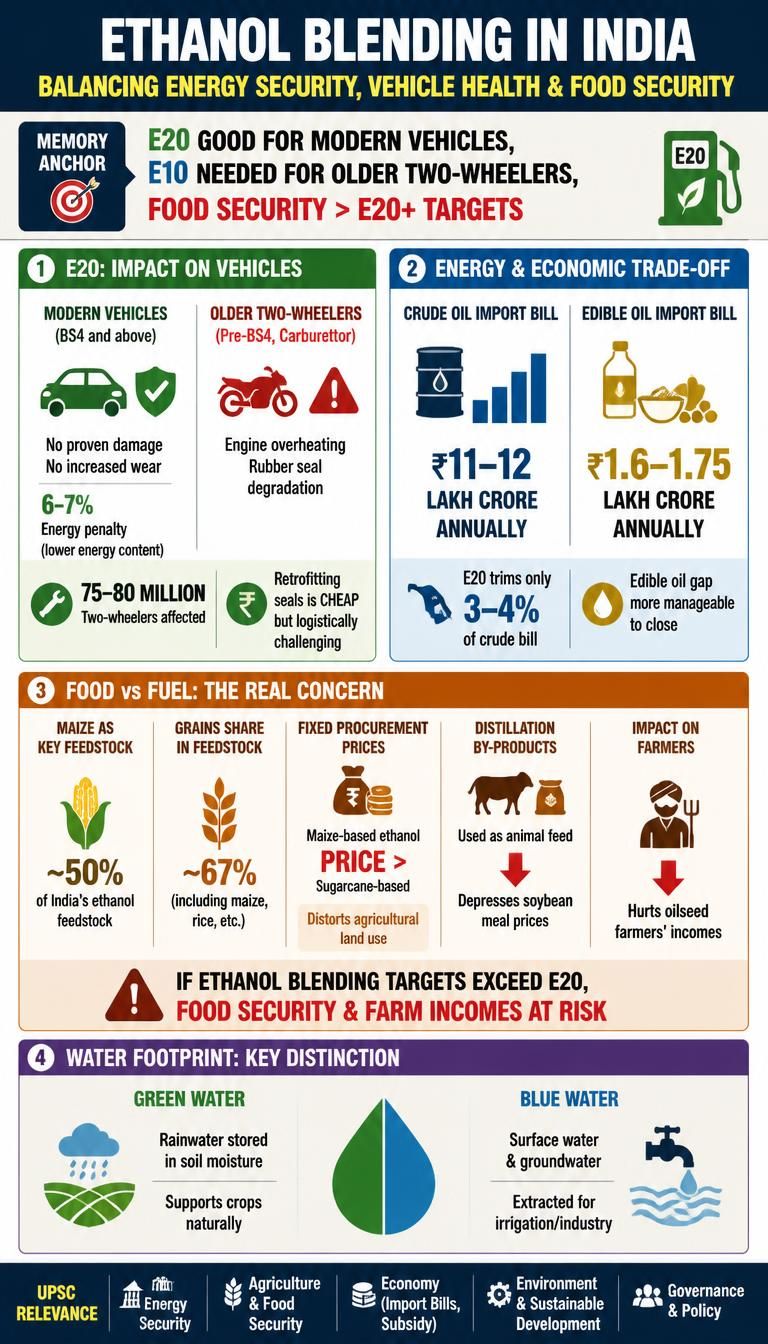
- Complaints regarding E20 petrol damaging engines and reducing mileage are largely unsubstantiated for modern vehicles.
- Older two-wheelers (pre-BS4 with carburettors) face genuine issues with E20, including engine overheating and degradation of rubber seals.
- The article advocates for the reintroduction of a lower blend, such as E10, for these older vehicles.
- A critical concern is the "food versus fuel" trade-off, particularly if ethanol blending targets exceed E20.
- India's crude oil import bill is around ₹11-12 lakh crore annually, while the edible oil bill is ₹1.6-1.75 lakh crore.
- Ethanol production increasingly relies on maize and other grains, impacting edible oil cultivation and farmer incomes.
E10.jpg
Detailed Insights:
- Ethanol contains approximately two-thirds the energy of petrol, resulting in a minor 6-7% energy penalty for E20.
- Studies by the Oakridge National Laboratory (US) and India's ARAI and Indian Oil found no increased wear in non-E20 rated cars.
- Carburettors in older vehicles cannot compensate for the extra oxygen in E20, leading to engines running hot.
- Retrofitting ethanol-compatible seals is inexpensive but logistically challenging for an estimated 75-80 million two-wheelers.
- While E20 trims only 3-4% of the crude bill, the edible oil gap is considered more manageable to close.
- Maize now accounts for about half of India’s ethanol feedstock, with grains contributing nearly 67%.
- Fixed procurement prices for maize-derived ethanol, higher than sugarcane, distort agricultural land use.
- Distillation by-products used as animal feed depress soybean meal prices, negatively affecting oilseed farmers.
- The distinction between green water (rainwater) and blue water (surface/groundwater) is crucial for assessing water footprint.
- The climate benefits of grain ethanol beyond E20 are not conclusively established by Indian life-cycle studies.
- The Ethanol Blending Programme has successfully cleared sugarcane dues, boosted rural incomes, and created an assured market.
- Policy decisions on blend levels are largely irreversible, unlike flexible instruments such as procurement prices or import duties.
Key Concepts Involved:
- E20 Petrol: A motor fuel blend containing 20% ethanol and 80% gasoline, aimed at reducing fossil fuel dependency.
- Ethanol Blending Programme: A government initiative in India to mix ethanol with petrol to reduce crude oil imports and promote biofuels.
- BS4 Emission Norms: Bharat Stage IV emission standards, which were implemented in India to regulate pollutant emissions from vehicles.

SuperKalam is your personal mentor for UPSC preparation, guiding you at every step of the exam journey.
Download the App


STUDY RESOURCES
CONTACT US
ⓒ Snapstack Technologies Private Limited