GS 2: PolityGS 2: Social JusticeGS 2: GovernancePrelimsGS2: Indian Constitutional Evolution, Features, Amendments, Basic Structure Doctrine
Why has the Centre opposed creamy layer for SC/STs?, Pg12
Centre opposes 'creamy layer' exclusion for SC/STs in Supreme Court, citing parliamentary power and lack of judicial precedent amidst ongoing petitions and student protests.
Practice MCQs
891 Students attempted
Key Highlights:
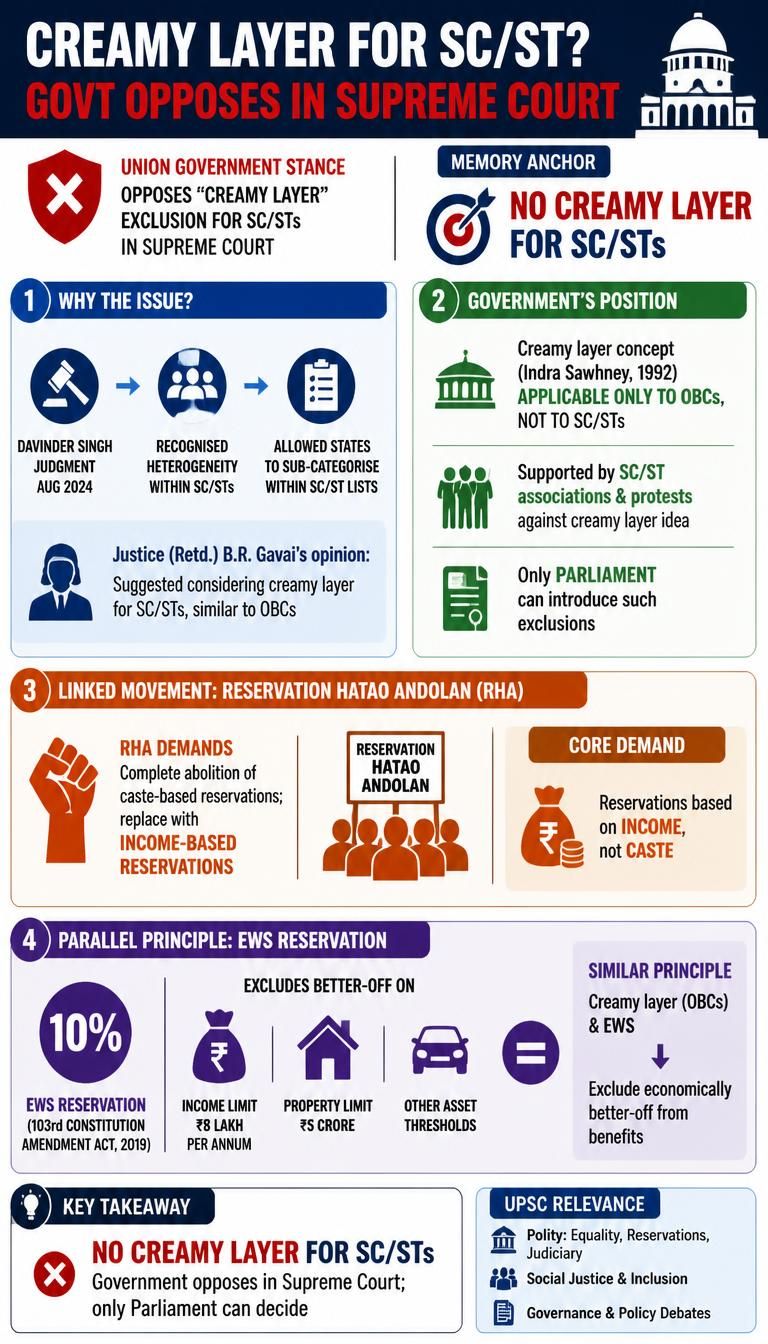
- The Union government has opposed the introduction of a "creamy layer" exclusion for Scheduled Castes (SCs) and Scheduled Tribes (STs) in the Supreme Court.
- This stance is in response to petitions following the Davinder Singh judgment of August 2024, which recognized the heterogeneity within SC/ST communities.
- The Davinder Singh judgment allowed State governments to sub-categorize within existing SC/ST lists to ensure reservation benefits reach the most backward.
- Justice (Retd.) B.R. Gavai's opinion in the Davinder Singh judgment suggested considering a creamy layer for SC/STs, similar to Other Backward Classes (OBCs).
- The government's opposition aligns with protests from SC/ST associations and its position that only Parliament can introduce such exclusions.
- The issue is intertwined with the Reservation Hatao Andolan (RHA), a student movement advocating for the abolition of caste-based reservations.
Creamy Layer.jpg
Detailed Insights:
- The Union government maintains that the creamy layer concept, established for OBCs by the Indra Sawhney judgment (1992), is not applicable to SC/ST classifications.
- The Davinder Singh judgment, delivered by a seven-judge bench headed by then Chief Justice of India D.Y. Chandrachud, highlighted the graded backwardness within SC/ST communities.
- The Reservation Hatao Andolan (RHA), gaining significant traction, demands the replacement of socio-economic caste reservations with income-based reservations.
- The Economically Weaker Sections (EWS) reservation embodies a similar principle to the creamy layer by excluding economically better-off individuals based on income and asset thresholds.
- Sub-categorization has been more widely implemented by State governments, with the Centre's arguable use seen in dividing the ST quota for Particularly Vulnerable Tribal Groups (PVTGs) in Eklavya Model Residential Schools.
- The Centre argues that modifying reservation policy, such as introducing a creamy layer, requires a holistic review and thorough empirical study, which is not within the judiciary's domain.
- The Justice (Retd.) G. Rohini Commission was formed in 2017 to sub-categorize OBCs nationally, but its report, submitted three years ago, has not been acted upon.
Key Concepts Involved:
- Creamy Layer: A concept to exclude economically advanced individuals from reservation benefits within a specific reserved category.
- Sub-categorization: The process of dividing an existing reservation quota for a category to ensure equitable access for diverse groups within it.
- Graded Inequality: The varying levels of social and economic backwardness observed among different communities within a larger reserved category.
- Reservation Hatao Andolan (RHA): A social movement advocating for the abolition of caste-based reservations and the implementation of income-based reservation policies.

SuperKalam is your personal mentor for UPSC preparation, guiding you at every step of the exam journey.
Download the App


STUDY RESOURCES
CONTACT US
ⓒ Snapstack Technologies Private Limited