GS 3: Science & TechnologyGS 2: GovernanceGS 2: International RelationsPrelimsGS2: Government policies and interventions for development in various sectors
‘Despite reputation, India’s per-unit space launch cost highest’, Pg11
New analysis reveals India's per-unit space launch cost is highest globally, challenging its cost-effective image and raising geopolitical concerns.
Practice MCQs
891 Students attempted
Key Highlights:
- A recent analysis published in Economics Letters indicates India has the highest per-unit space launch cost among major spacefaring nations.
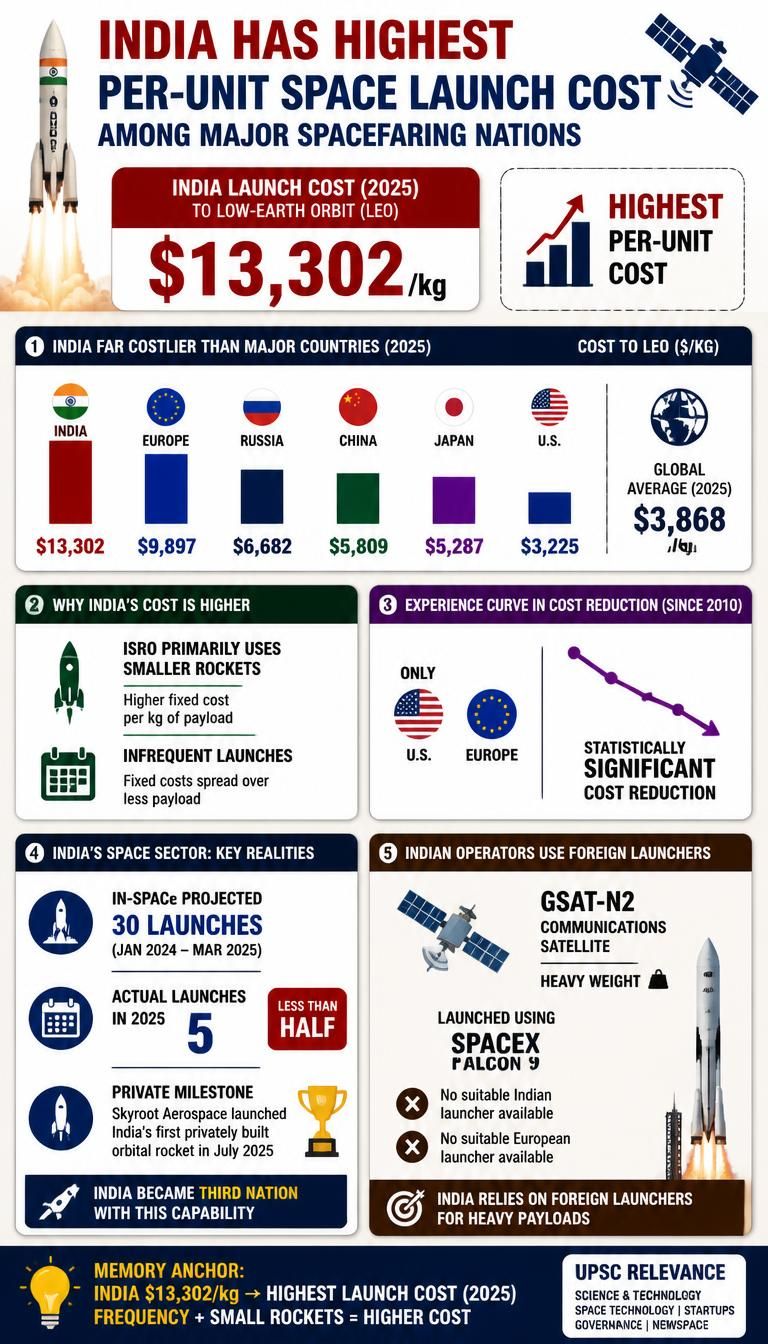
- The study, by Alessio Terzi and Francesco Nicoli, estimates India's cost at $13,302 per kilogram to Low-Earth Orbit (LEO) in 2025.
- This high cost is attributed to ISRO primarily using smaller rockets and infrequent launches, which spreads fixed costs over less payload.
- India is actively promoting private sector involvement in space, with IN-SPACe registering around 400 startups since 2020.
- Skyroot Aerospace launched India's first privately built orbital rocket in July, making India the third nation with this capability.
- Despite efforts, India recorded only five launches in 2025, leading Indian satellite operators like NewSpace India to use foreign launchers such as SpaceX's Falcon 9.
Indian Space costs.jpg
Detailed Insights:
- India's estimated cost of $13,302/kg to LEO significantly exceeds that of Europe ($9,897), Russia ($6,682), China ($5,809), Japan ($5,287), and the U.S. ($3,225).
- The global average for per-kilogram launch cost was $3,868 in 2025, highlighting India's comparative disadvantage.
- The study found that only the U.S. and Europe have demonstrated a statistically significant experience curve in cost reduction since 2010.
- IN-SPACe had projected 30 launches between January 2024 and March 2025, but actual launches were less than half this number.
- NewSpace India Limited (NSIL), the commercial arm of ISRO, used a Falcon 9 rocket for the GSAT-N2 communications satellite due to its heavy weight and unavailability of suitable Indian or European launchers.
- Bengaluru-based startups Pixxel and Digantara also utilized SpaceX for placing India's first private commercial satellites in orbit.
- The increasing reliance on a single dominant launch provider like SpaceX raises concerns about potential geopolitical leverage or "weaponisation" of this dependency.
Key Concepts Involved:
- Low-Earth Orbit (LEO): An orbit typically between 160 km and 2,000 km above Earth's surface, commonly used for satellites.
- Payload: The cargo, such as satellites or instruments, carried by a rocket into space.
- Experience Curve: A concept where the cost per unit of output decreases as cumulative production or experience increases.
- IN-SPACe: The Indian National Space Promotion and Authorization Centre, an autonomous agency under the Department of Space, facilitating private sector participation.
- NewSpace India Limited (NSIL): A Central Public Sector Enterprise under the Department of Space, responsible for commercializing ISRO technologies and services.

SuperKalam is your personal mentor for UPSC preparation, guiding you at every step of the exam journey.
Download the App


STUDY RESOURCES
CONTACT US
ⓒ Snapstack Technologies Private Limited