GS 2: GovernanceGS 2: PolityGS 3: Science & TechnologyPrelimsGS 2: E Governance
Digitisation and efficiency in criminal justice system, Pg8
India targets full digital rollout of its criminal justice system by July 2027, transforming investigations and trials under new citizen-centric laws for enhanced efficiency.
Practice MCQs
883 Students attempted
Key Highlights:
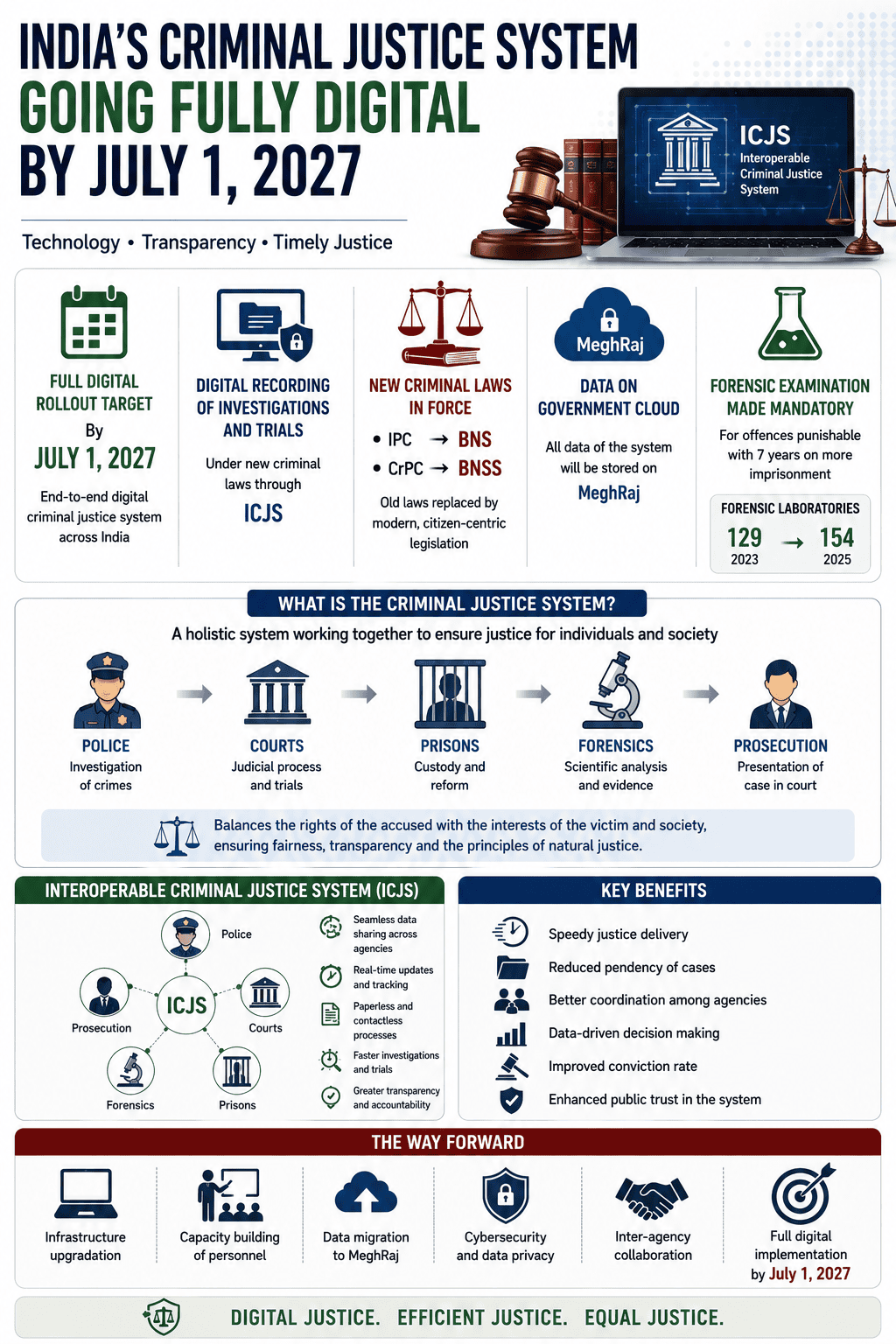
- India aims for a full digital rollout of its criminal justice system by July 1, 2027.
- This will facilitate digital recording of investigations and trials under new criminal laws through the Interoperable Criminal Justice System (ICJS).
- The Indian Penal Code (IPC) and Code of Criminal Procedure (CrPC) have been replaced by the Bhartiya Nyaya Sanhita (BNS) and Bhartiya Nagrik Suraksha Sanhita (BNSS).
- Data for the digital system will be stored on the government’s cloud platform, MeghRaj.
- Forensic examination is now mandatory for offenses punishable with seven years or more imprisonment, leading to an increase in forensic laboratories from 129 in 2023 to 154 in 2025.
Criminal Justice System.png
Detailed Insights:
- The criminal justice system comprises police, courts, prisons, forensics, and prosecution services, aiming to ensure justice for individuals.
- The system balances the rights of the accused with the interests of the victim and society, adhering to principles of natural justice.
- The new laws, BNS and BNSS, signify a shift from a punitive approach to one focused on justice delivery and retribution, emphasizing citizen rights.
- Unlike the adversarial system, the inquisitorial system, practiced in civil law countries, involves an active judicial role in investigating facts.
- Despite an increase in forensic labs, only 46% of First Information Reports (FIRs) are currently transmitted digitally to courts, indicating an incomplete digital chain.
- The uneven progress in digitisation across states highlights the necessity of a full digital rollout to enhance the system's overall efficiency.
- Judicial pronouncements, such as the Visakha v. State of Rajasthan (1997) guidelines, have historically played a crucial role in guiding reforms and filling legislative gaps.
Key Concepts Involved:
- Interoperable Criminal Justice System (ICJS): An initiative to integrate the IT systems of police, courts, prisons, prosecution, and forensic labs for seamless data exchange.
- Bhartiya Nyaya Sanhita (BNS): The new law replacing the Indian Penal Code (IPC), focusing on justice delivery and retribution.
- Bhartiya Nagrik Suraksha Sanhita (BNSS): The new law replacing the Code of Criminal Procedure (CrPC), emphasizing citizen rights and procedural fairness.
- MeghRaj: A government cloud platform providing secure and scalable infrastructure for digital services and data storage.
- Adversarial System: A legal system where two opposing parties present their cases before an impartial judge or jury.
- Natural Justice: Fundamental principles of fairness, including the right to a fair hearing and unbiased decision-making.

SuperKalam is your personal mentor for UPSC preparation, guiding you at every step of the exam journey.
Download the App


STUDY RESOURCES
CONTACT US
ⓒ Snapstack Technologies Private Limited