GS 2: PolityGS 3: Science & TechnologyGS 2: International RelationsGS 3: EconomyPrelims
Australian uranium fuels next phase in India's n-programme, Pg10
Australia greenlights uranium exports, ending NPT-based ban, to fuel India's ambitious 100 GW nuclear power expansion by 2047, bolstering strategic partnership.
Practice MCQs
883 Students attempted
Key Highlights:
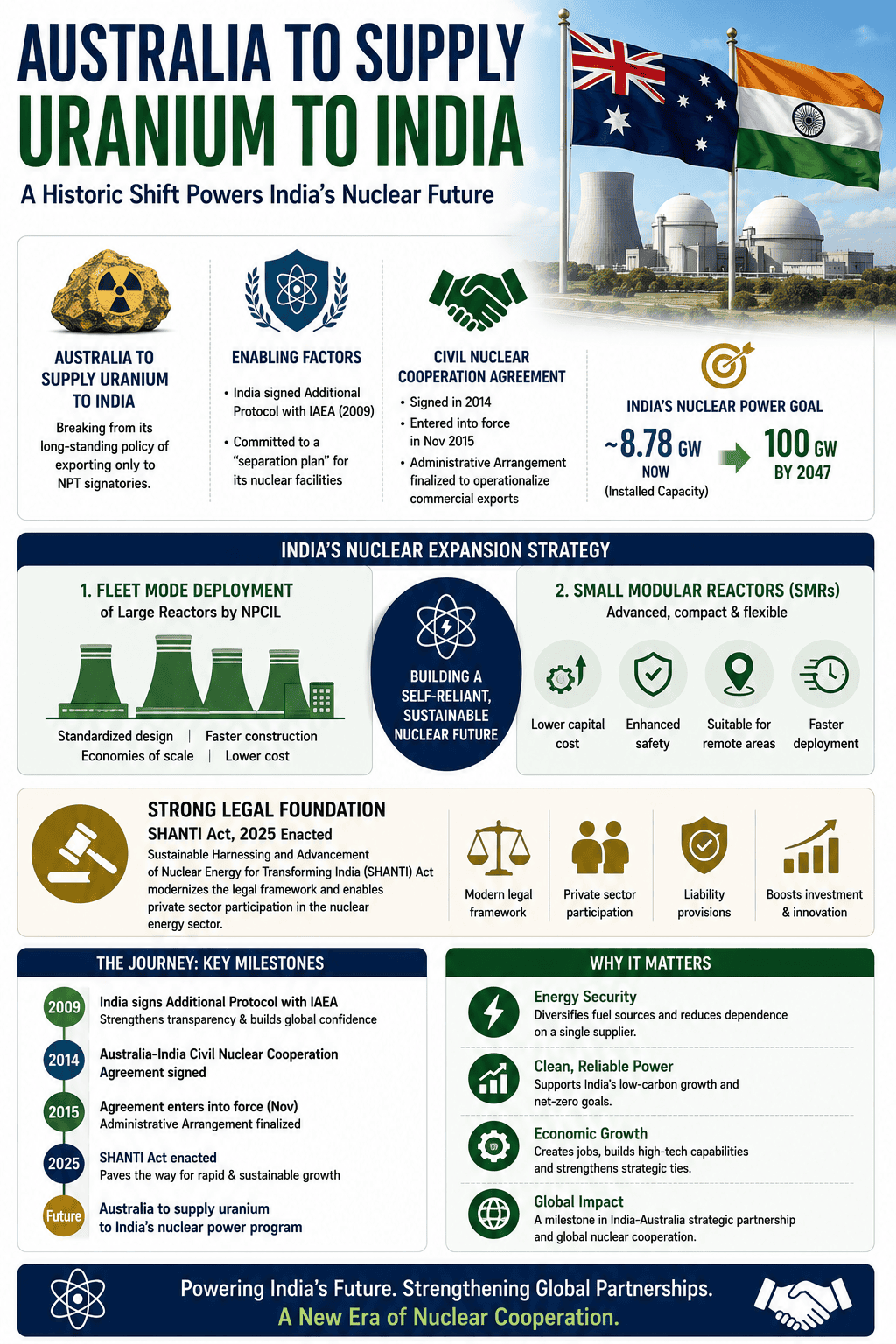
- Australia will supply uranium to India for its nuclear power program, marking a significant shift from Australia's historical policy of exporting only to Treaty on the Non-Proliferation of Nuclear Weapons (NPT) signatories.
- This change was facilitated by India signing an Additional Protocol with the International Atomic Energy Agency (IAEA) in 2009 and committing to a "separation plan" for its nuclear facilities.
- The Australia-India Civil Nuclear Cooperation Agreement was signed in 2014 and entered into force in November 2015, with the Administrative Arrangement finalized to operationalize commercial exports.
- India aims to significantly increase its installed nuclear power capacity from approximately 8.78 GW to 100 GW by 2047.
- India's nuclear expansion strategy includes a "fleet mode" deployment of large reactors by Nuclear Power Corporation of India Ltd (NPCIL) and the development of Small Modular Reactors (SMRs).
- The Sustainable Harnessing and Advancement of Nuclear Energy for Transforming India (SHANTI) Act, 2025, has been enacted to modernize the legal framework and enable private sector participation in the nuclear energy sector.
Ind-Aus.png
Detailed Insights:
- Australia holds the world's largest uranium reserves, accounting for approximately one-third or 28% of the global total, making its supply crucial for India's energy security.
- The quality of Australian uranium is superior to India's low-grade mineral, which incurs higher extraction costs and generates more waste.
- The Nuclear Suppliers Group (NSG) granted India an exemption in 2008, allowing it to engage in civil nuclear trade despite its non-NPT status.
- The Additional Protocol ensures that imported uranium is used exclusively for peaceful civilian purposes under IAEA safeguards.
- The Administrative Arrangement establishes practical procedures for tracking, accounting, and reporting the use of Australian Obligated Nuclear Material (AONM).
- India currently imports natural uranium from countries like Canada, France, Kazakhstan, and Uzbekistan, and enriched uranium from Russia.
- The SHANTI Act, 2025, repeals the Atomic Energy Act, 1962, and the Civil Liability for Nuclear Damage Act, 2010, replacing them with a single, comprehensive law.
- This new legislation allows for limited private participation in the nuclear sector, including building, owning, and operating nuclear power plants, and undertaking fuel fabrication.
- India is also pursuing a strategy to build a strategic uranium reserve to guard against supply-chain disruptions caused by geopolitical events or pandemics.
- The government maintains control over strategic and security-sensitive segments of the nuclear fuel cycle.
Key Concepts Involved:
- Treaty on the Non-Proliferation of Nuclear Weapons (NPT): An international treaty aimed at preventing the spread of nuclear weapons, promoting disarmament, and fostering cooperation in the peaceful uses of nuclear energy.
- Nuclear Suppliers Group (NSG): A group of nuclear-supplier countries that contributes to the non-proliferation of nuclear weapons by implementing guidelines for nuclear exports.
- International Atomic Energy Agency (IAEA): An international organization that promotes the peaceful use of nuclear energy and ensures its non-military application through safeguards.
- Additional Protocol (AP): A legal document that grants the IAEA expanded inspection authority to verify that a state's nuclear program is exclusively for peaceful purposes.
- Small Modular Reactors (SMRs): Advanced nuclear reactors that are smaller than conventional reactors, designed for modular construction and offering flexibility in deployment.
- Australian Obligated Nuclear Material (AONM): Uranium supplied by Australia that is subject to specific bilateral safeguards and tracking requirements to ensure its peaceful use.
- Sustainable Harnessing and Advancement of Nuclear Energy for Transforming India (SHANTI) Act, 2025: A landmark Indian legislation aimed at modernizing the nuclear legal framework, enabling private sector participation, and streamlining regulations for nuclear energy expansion.

SuperKalam is your personal mentor for UPSC preparation, guiding you at every step of the exam journey.
Download the App


STUDY RESOURCES
CONTACT US
ⓒ Snapstack Technologies Private Limited