GS 2: GovernanceGS 2: PolityPrelimsGS 2: Important Aspects of Governance, Transparency and AccountabilityGS 2: Indian Constitutional Evolution, Features, Amendments, Basic Structure Doctrine
How has the SC strengthened arrest safeguards?, Pg8
Supreme Court mandates written grounds for arrest and magistrate's permission for re-arrest after illegal detention, strengthening constitutional safeguards for personal liberty and accountability.
Practice MCQs
898 Students attempted
Key Highlights:
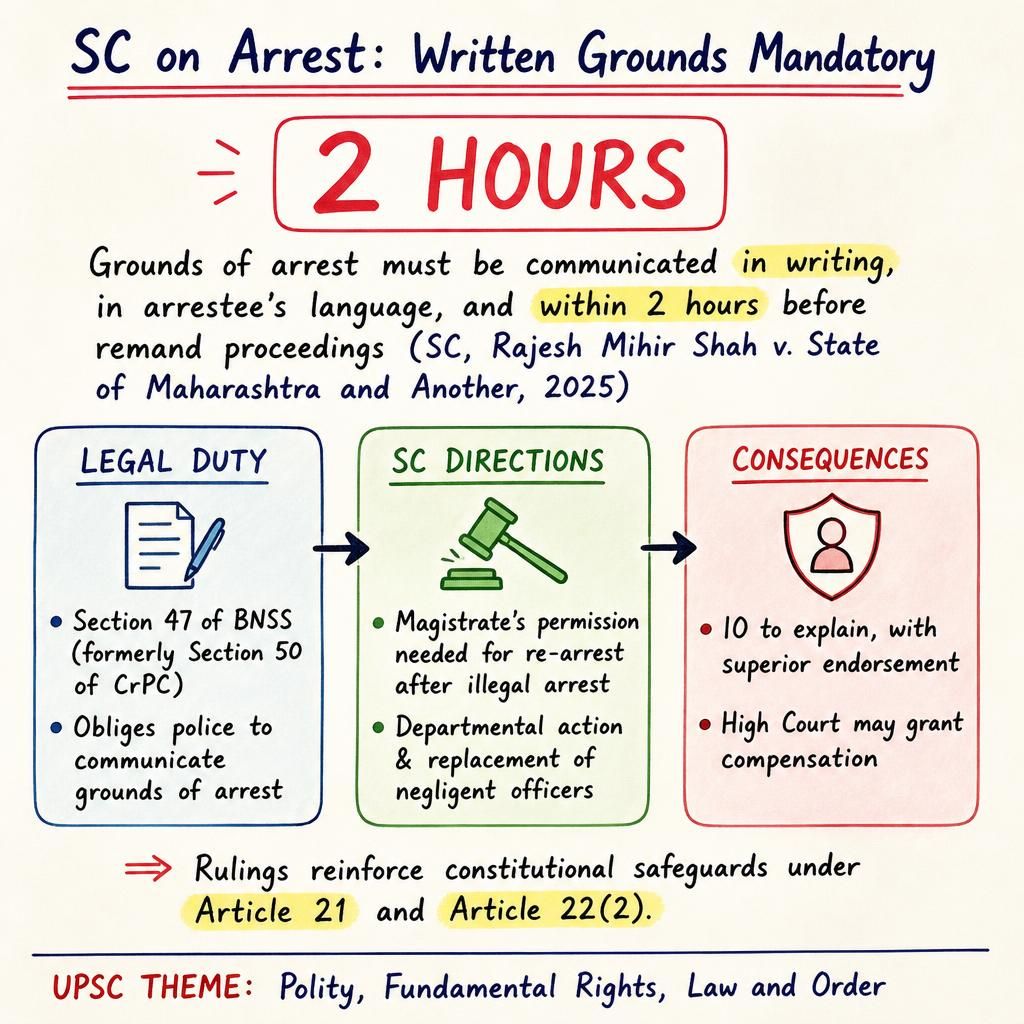
- The Supreme Court, in Jaskaran Jeet Singh Deol v. State of Punjab (September 2026), ruled that a magistrate's permission is required for re-arrest if the previous arrest was illegal due to non-supply of written grounds.
- The Court recommended departmental action against negligent investigating officers and their replacement in such cases.
- These rulings reinforce constitutional safeguards under Article 21 and Article 22(2), which protect personal liberty and mandate timely production before a magistrate.
- Section 47 of the Bharatiya Nagarik Suraksha Sanhita (BNSS), formerly Section 50 of CrPC, obligates police officers to communicate grounds of arrest to an accused.
SC on Arrest.jpg
Detailed Insights:
- In Pankaj Bansal v. Union of India & Ors. (2023), the Supreme Court mandated providing written grounds of arrest without exception, particularly in cases under the Prevention of Money Laundering Act, 2002 (PMLA).
- This principle was reiterated in Prabir Purkayastha v. State (NCT of Delhi) (2024) for cases under the Unlawful Activities (Prevention) Act, 1967 (UAPA), emphasizing its role as a vital safeguard for legal aid.
- The Court in Rajesh Mihir Shah v. State of Maharashtra and Another (2025) clarified that grounds must be communicated in writing, in the arrestee's language, and within two hours before remand proceedings.
- Non-compliance with these requirements renders the arrest and subsequent remand illegal, entitling the arrested person to be set at liberty.
- Consequences for non-compliance include the Investigating Officer explaining reasons for non-supply, endorsement by a superior authority, and potential compensation by the High Court.
- The rulings aim to strengthen the rights of the accused and ensure greater accountability of law enforcement agencies during the arrest process.
Key Concepts Involved:
- Article 21: Guarantees protection of life and personal liberty, ensuring no person is deprived except according to procedure established by law.
- Article 22(2): Mandates that an arrested person must be produced before the nearest magistrate within 24 hours, excluding travel time.
- Bharatiya Nagarik Suraksha Sanhita (BNSS): The new criminal procedure code that replaced the Code of Criminal Procedure (CrPC), governing arrest, investigation, and trial procedures.
- Grounds of Arrest: The specific reasons and facts for a person's detention, which must be communicated to the arrested individual.

SuperKalam is your personal mentor for UPSC preparation, guiding you at every step of the exam journey.
Download the App


STUDY RESOURCES
CONTACT US
ⓒ Snapstack Technologies Private Limited